
Key Takeaways
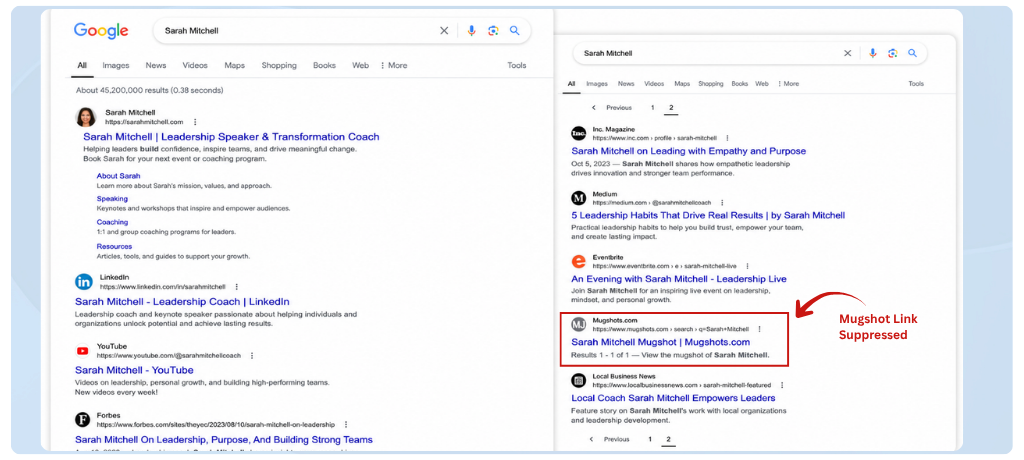
- Mugshot sites rank highly because they use strong SEO tactics and public-record authority.
- Removing negative content is difficult, so building stronger positive content is often more effective.
- A coordinated SEO strategy — not just random social posting — is essential for reputation management.
- Creating an “authority stack” of websites, profiles, press mentions, and published content helps outrank harmful results.
- Reputation repair takes time; meaningful search-result improvements can take several months to over a year.
The Real Problem Isn’t the Mugshot—It’s What Ranks First
You type your name into Google. The first result isn’t your LinkedIn profile or your business website. It’s a mugshot. An arrest record. A public booking entry that follows you into every job interview, client meeting, and first impression you’ll ever make online.
The anger is understandable. So is the helplessness. But here’s what most online reputation management guides miss entirely: the mugshot isn’t the root problem. What ranks first is the problem. And rankings are not random—they are the output of a structured system. A system you can learn, reverse-engineer, and compete against.
That’s exactly what reputation engineering means. Not erasing your history. Not manipulating search engines. Building stronger, more authoritative search signals around your real identity so that what the world sees first actually represents who you are today. Businesses and individuals facing damaging search results often use strategic mugshot suppression services to regain control of branded search visibility.
Why Mugshots Dominate Search Results
Before you can try to improve bad search results, you have to understand why they rank at all. Mugshot sites didn’t just accidentally make it to page one.
Public Records: Arrest records, booking information, and court filings are public information in most states in the U.S. Search engines index them freely and without limitation and deem them valid, authoritative sources.
SEO Structure: Mugshot websites are engineered for search. Your entire name is listed in the page title, URL slug, H1 heading, image alt text, and metadata. That sort of name search optimization offers a very clear indication of significance to Google.
Aggregation Networks: One booking record rarely stays in one place. It gets scraped, republished, and syndicated across dozens of aggregator sites—each one creating a new indexed page targeting your name. This aggregation is precisely why public record SEO creates such stubborn, persistent search visibility control challenges.
These three forces combined produce a result that is heavily optimized, widely distributed, and deeply trusted by search algorithms. That’s your actual competition.
Understanding the Page-One Battlefield
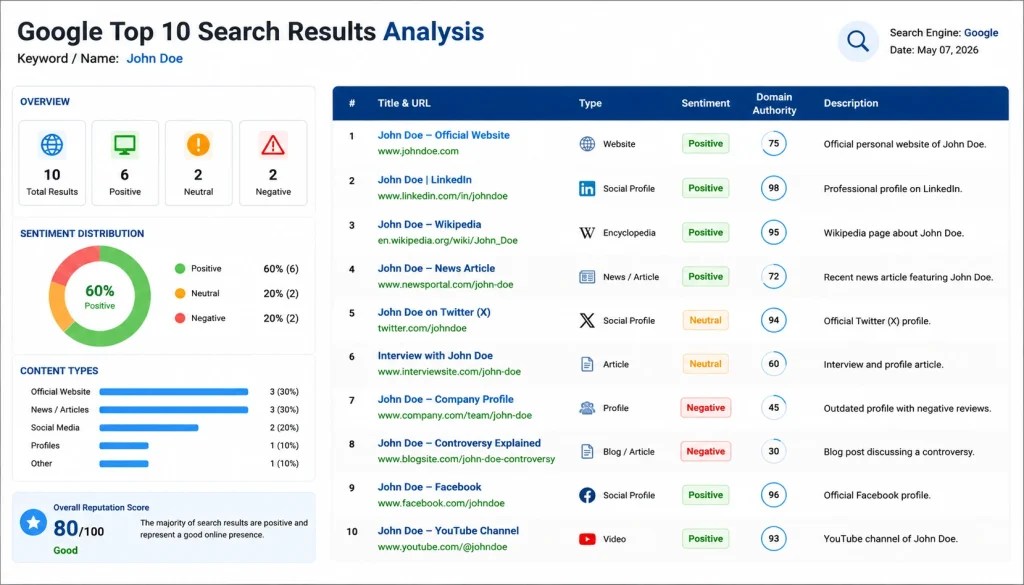
Effective search result suppression starts with a clear-eyed audit of what you’re actually competing against.
Analyze the Top 10 Results: Open an incognito browser and search your full name. Check all results on page one. Identify which are detrimental, which are neutral, and which assets you currently own.
Identify the replaceable positions: Not every page one result is a fortress. Look for thin content—basic directory entries, outdated forum posts, and low-engagement social profiles. These are your entry points. How to suppress negative search results is really a question of identifying weak positions and replacing them with stronger assets you own.
This analysis gives you a map. Without it, you’re building blindly.
Why Traditional Reputation Advice Falls Short
For most people looking to improve negative name search results, the same rehashed advice is given: post more on social media, develop a blog, and expand your LinkedIn. This instruction is not completely wrong—but dangerously incomplete.
Volume without strategy produces nothing. Twenty LinkedIn posts won’t displace a mugshot site sitting on years of domain authority and thousands of backlinks. What actually moves rankings is structured signal-building—the right assets, on the right platforms, with consistent entity signals.
Traditional ORM strategies also lean too heavily on removal. Though there are sometimes legal ways to remove mugshots from google, it is not always assured or permanent. Content is taken down from one site and reappears on another within weeks.
The more sustainable path is influence, not control. You influence what ranks by building what deserves to rank higher.
The Shift to Reputation Engineering
Reputation engineering is a fundamental reframe. Instead of reacting to content others created, you proactively build a search ecosystem strong enough to outperform it.
Google’s first page is real estate. Every position is occupied by something. Your goal is to occupy as many of those positions as possible with assets that reflect your real professional identity. This is digital footprint control at a strategic level—not just scattering your name across random platforms, but building a coordinated, authoritative network of rankable assets.
The shift is from deletion-focused thinking to signal-building thinking. From hoping content disappears to ensuring your content earns its rightful place.
How Search Engines Decide What Shows Up
To do reputation management SEO well, you need to grasp the three fundamental ranking factors:
Backlinks are links from reliable, established sites to your content, and they provide authority. The more reliable the referring domain is, the more authority gets passed on to your page.
Relevance is determined by entity consistency. Name, work title, city, state, and bio consistency across several sites help search engines identify you as a real person and feel more safe in what they expose.
Content longevity, engagement metrics, site speed, and structured data markup are trust signals. Good sources, like fast-loading pages, and then clicking on them builds trust over time naturally.
Personal branding SEO works through the intentional growth of all three signals simultaneously, spanning properties you own, control, and regularly update.
The Search Authority Framework
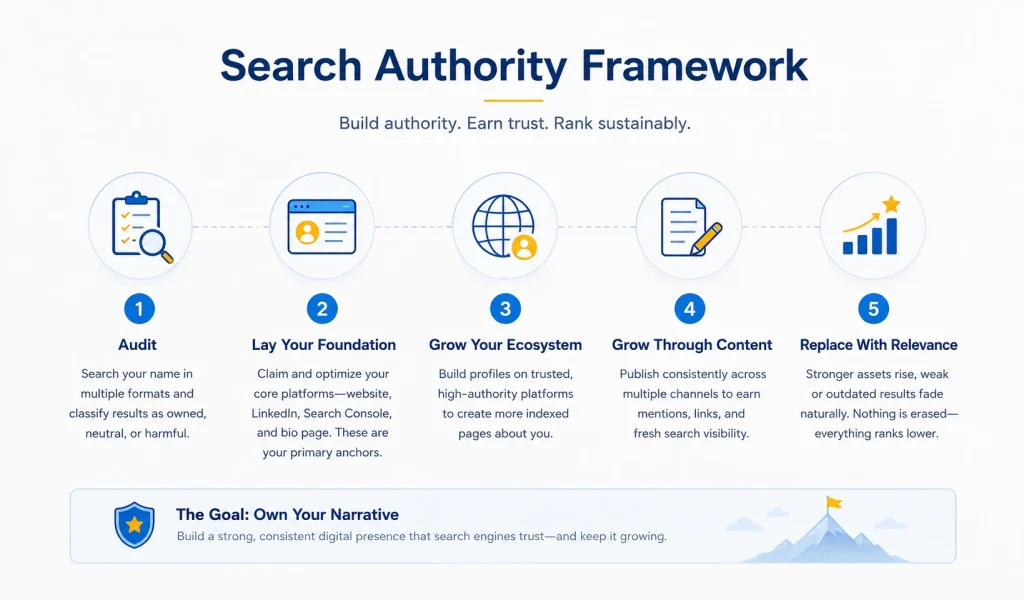
This is the five-step strategy that is the operational backbone of online reputation management without removal:
Step 1—Audit: Search your name in several formats—without a middle name and with a city or occupation next to it. All results must be documented on page two. Please classify each result as owned, neutral, or harmful.
Step 2 – Lay Your Foundation: Claim and enhance your primary platforms as much as possible: your own website, with your name in the domain; a complete LinkedIn profile; a Google Search Console-connected presence; and a bio page on a professional site. These are your major anchors for managing your online persona.
Entity Consistency is a Must: Use the exact same name format, professional title, and bio summary across all platforms. Inconsistency dilutes your entity signals and confuses search engines.
Step 3 – Grow Your Ecosystem: Build optimized profiles on secondary, high-authority platforms. Crunchbase, Medium, About.me, Quora, industry-specific directories, and local company listings. Each profile creates a new indexed page with your name as the main subject.
Step 4—Grow Through Content: Publish consistently and intentionally under your name. Guest articles, LinkedIn posts, podcast appearances, and press mentions all create fresh entries in the digital footprint indexed to your name.
Rankable Asset Criteria Focus on material on high-domain-authority sites, utilize your complete name organically in titles and early in the text in the body, and develop internal links between your owned assets when feasible.
Step 5—Replace With Relevance: Over time your assets age, collect links, and accumulate engagement, which helps them climb the ranks naturally. Thin directory entries, low-authority aggregators, get filtered out. This is the heart of the suppressed search results approach. Nothing is erased. Everything ranks lower.
What to Build First
When starting to build search authority personally, sequence matters. Begin with:
- A personal website at yourname.com (or closest available variation)
- A fully completed LinkedIn profile with a custom URL
- A Google Knowledge Panel claim via Google Search Console
- One high-quality author profile on a domain-authority publishing platform
These four assets establish your entity foundation. Everything built afterward amplifies from this base. Spreading effort too thin too early slows momentum significantly.
The Authority Stack Model
Brand reputation SEO is made up of layers, all of which support each other:
Tier 1 – Owned Assets: This includes your own website, branded social pages, and your professional portfolio. Highest control, highest long-term authority potential.
Tier 2 — Earned Assets: Press coverage, guest articles, podcast features, and interview mentions. These carry the highest trust signals because they originate from independent third parties.
Tier 3 — Claimed Assets: Platform bios, directory listings, and review site profiles. Lower individual authority but powerful in aggregate for name search optimization.
All three tiers must function together. Tier 1 without Tier 2 lacks external credibility. Tier 2 without Tier 1 has no authoritative destination to point toward. SEO for individuals requires building across all three simultaneously.
What This Looks Like in Practice
A professional facing how to outrank mugshots online might begin by purchasing their name domain, building a clean portfolio site, and fully optimizing their LinkedIn. In month two, they publish two guest articles on industry platforms and claim fifteen directory profiles using consistent entity details. By month four, their LinkedIn and personal site begin appearing on page one. By month eight, two guest articles have claimed additional positions, pushing a mugshot result to page two.
This is not a hypothetical. It is a repeatable pattern when the framework is applied consistently. Mugshot suppression follows predictable search mechanics—not miracles.
How Long It Takes
Honest, safe answer: results vary significantly based on competition, content quality, and consistency.
Most practitioners applying a structured repair reputation SEO strategy begin seeing ranking movement within three to six months. Significant displacement of high-authority negative results typically requires twelve to eighteen months of sustained effort.
Fixing negative search results legally is a reachable goal—but not an overnight one. Anyone who promises immediate results or assured removals is lying about how search engines work at their core. Set reasonable objectives, monitor movement on a quarterly basis, and judge success by position changes rather than overnight transformations.
What Not to Do
Avoid these mistakes in Google name results optimization:
- Never create fake reviews or fabricated testimonials. Platform violations and search penalties follow.
- Don’t do keyword stuffing and link schemes. Google’s algorithms are very severe in punishing manipulative practices.
- Never abandon the strategy prematurely. Consistency over time is the entire mechanism. Stopping at month two resets most of your progress.
- Never make promises to yourself about removal. Focus on influence, not guaranteed deletion.
Common Questions
Can mugshots actually be removed? Sometimes. Certain jurisdictions—particularly post-expungement or charge dismissal—provide legal removal pathways. GDPR offers options in Europe. Public records removal laws have been passed by states in the United States. Legal advice is definitely required before taking any formal removal action.
Does this approach work for all? The ability to develop authority to suppress negative search results is quite useful, but the time it takes and the results you get depend on the authority level of the competing material and how consistent you are with your efforts.
Is reputation engineering ethical? Entirely. Building your own content, claiming legitimate profiles, and publishing under your name involves no manipulation—only building what deserves to rank.
How to Protect Your Search Presence
Once you’ve improved your search visibility control, maintenance matters:
- Set up Google Alerts on your entire name to track new information as it is published
- Keep fresh signals going by publishing at least one new piece of material per month
- Check your page-one results each quarter and catch emerging dangers early.
- Keep all platform profiles updated with current professional information
Online identity management is not a one-time project. It is an ongoing practice.
DIY vs Professional Help
Personal branding SEO is something disciplined individuals can pursue independently using the framework outlined above. The strategy is transparent, legal, and learnable.
That said, professional ORM strategies accelerate timelines meaningfully—through established publisher relationships, technical SEO expertise, and experience identifying the highest-impact opportunities specific to your situation. If negative content is already affecting your career or business, professional guidance can compress a twelve-month timeline significantly. Structured, expert-guided approaches to reputation engineering are available at www.sagetitans.com for those ready to move with strategy and speed.
The End Goal: Improving What Represents You
Online reputation management was never supposed to be about erasing who you were. It’s about ensuring who you are today has a strong enough voice to be heard first.
Search engines rank what earns authority. Mugshot sites earned theirs through structured, deliberate systems. Reputation engineering is how you build a better system—one that reflects your real identity, your real work, and your real future.
Start where every strategy begins: search your own name. Understand exactly what’s ranking. Then build what deserves to rank instead.