
Key Takeaways
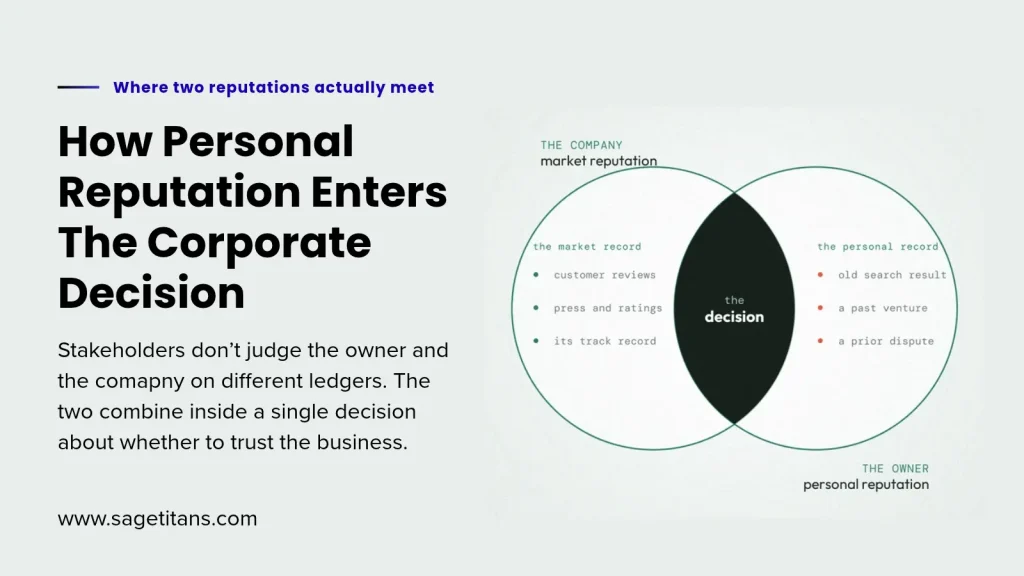
- Personal and company reputation aren’t two separate ledgers, stakeholders combine them inside a single decision about whether to trust the business.
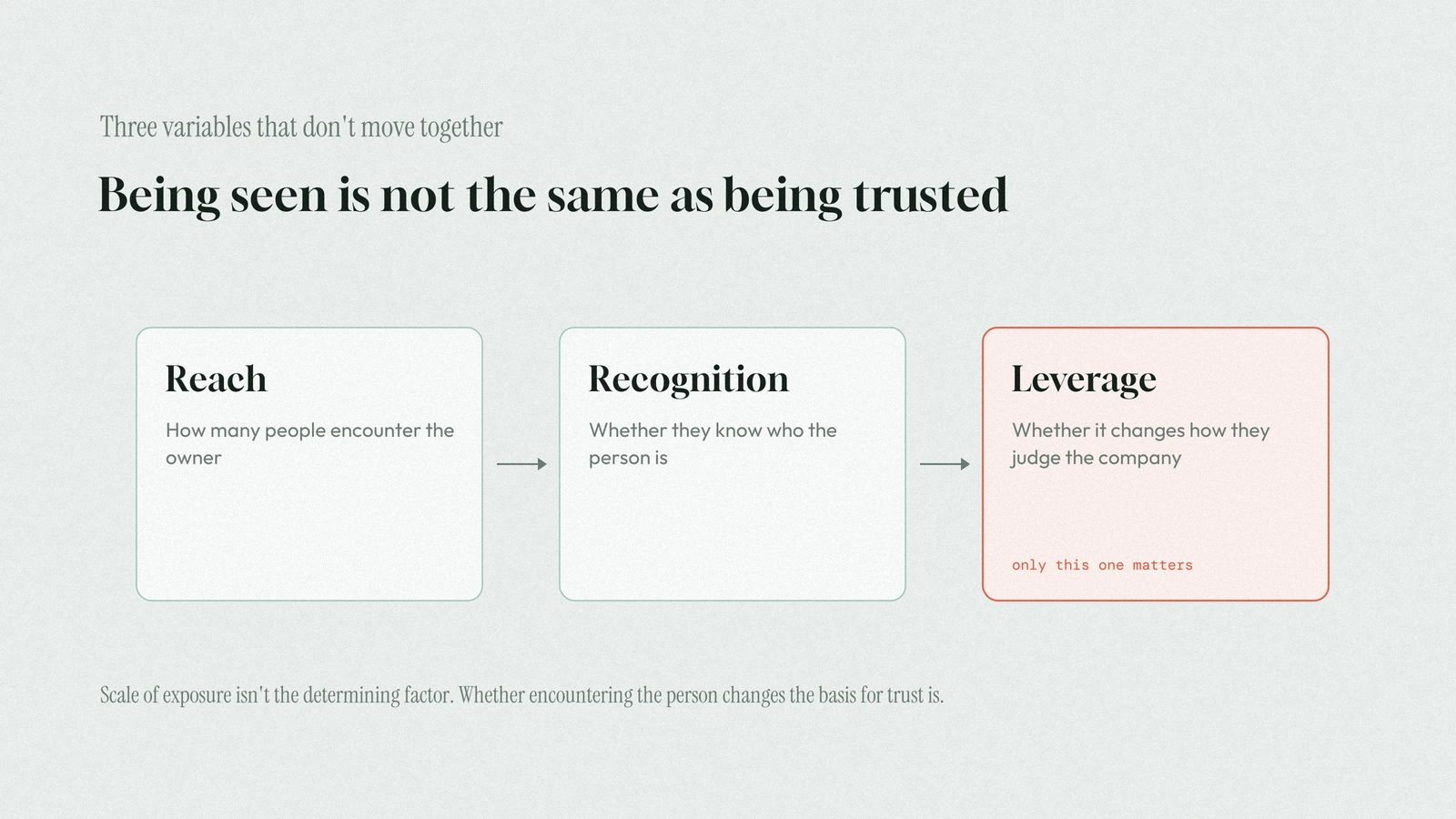
- Visibility isn’t the same as reputational leverage, what matters isn’t how widely an owner is seen, but whether encountering them changes how a stakeholder judges the company.
- Information can become relevant to a business without being about it, an old search result or past dispute enters a company evaluation the moment a stakeholder uses it while forming a judgment.
- Success hides reputational dependency, when an owner’s credibility keeps working, no one examines how much of the company’s trust is actually anchored to that one person.
- Don’t just measure reputation, stress-test what’s producing it, the real risk is discovering only after the owner departs how much of the business’s trust was tied to them.
The Blind Spot Isn’t Measuring Two Reputations Separately
Reputation management often separates into two parallel assessments: what the market thinks of the company and what surfaces when someone searches for the owner. The blind spot isn’t running them separately. It’s assuming that both results, added together, show how they combine inside a single stakeholder decision.
For a closely associated owner, the operative question isn’t what people think of the individual or the business in isolation. It’s when, and under what conditions, what stakeholders know or find about that person becomes part of how they judge the company. Once that connection exists, visibility alone stops being the variable that matters most.
Visibility Is Not the Same as Reputational Leverage
There is a difference between how many people encounter a business owner, whether those people recognize who they are, and whether that recognition changes how they evaluate the company. These are different variables, and they do not necessarily move together.
A founder who is broadly visible in consumer contexts may carry little weight with institutional investors assessing governance. An owner who is largely unknown outside a specific professional community may carry substantial weight within it. Scale of exposure isn’t the determining factor; what matters is whether encountering that person changes the basis on which a stakeholder is willing to trust the company.
Greater visibility creates more opportunities for the owner to enter a business evaluation. Whether that benefits the company depends heavily on what stakeholders find, how they interpret it, and what they do with it. Optimizing for visibility without examining what that visibility surfaces and for whom is a strategy built on an incomplete premise.
Once an owner’s reputation does influence how stakeholders evaluate the business, something else follows: information that has nothing to do with the company can start doing work inside a business decision.
Information Can Become Relevant to the Business Without Being About It
What a piece of information concerns and what it becomes relevant to are two different things. Its relevance can be shaped by the decision a stakeholder is making when they encounter it, not simply by what the information was originally about.
A stakeholder evaluating a company who then researches the owner as part of that process may bring information they find into the same decision. A professional dispute from a prior role, a failed venture in a different sector, or an arrest record from years ago need not reference the business, name the company, or concern any operational matter. What determines their commercial significance is whether the stakeholder uses them as evidence while forming a judgment about the company.
An old arrest-related search result is a clear example. It concerns only the individual. But if it surfaces when a prospective client, investor, or partner searches the owner’s name during a company evaluation, it enters that evaluation. The information hasn’t changed. Its relevance can depend heavily on the decision context in which it’s found.
This distinction shapes how removal and suppression decisions should be framed. Whether damaging information exists and whether it is likely to be encountered during a stakeholder’s research into the company are separate problems requiring separate thinking. Addressing one doesn’t automatically address the other.
If stakeholders occasionally bring personal information into a company evaluation, that is a question of what they may find. If they repeatedly rely on an individual’s credibility as a primary reason to trust the business, the nature of the problem changes.
Success Can Make Reputational Dependency Harder to See
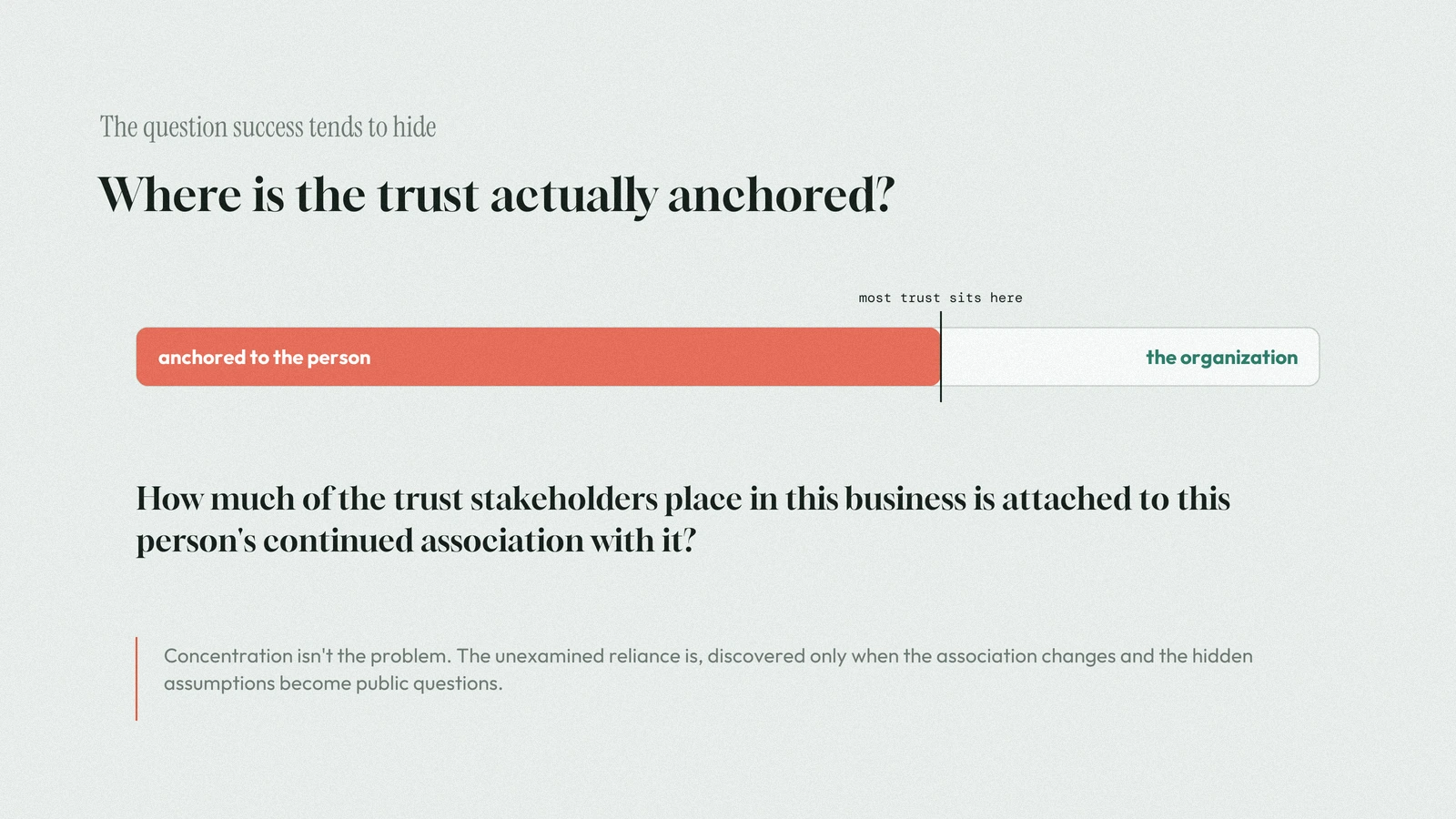
When an owner’s credibility, relationships, and standing consistently help stakeholders trust the company, everything can appear to be working well enough that the trust concentration goes unexamined. The same individual’s reputation can be both the asset the business is drawing on and the concentration it hasn’t yet looked at directly.
Trust being concentrated in an individual isn’t automatically a strategic problem. A business can draw significant and legitimate value from a founder’s expertise or a senior partner’s relationships without that being a failure of design. Concentration describes where trust is currently anchored. Dependency is a question about what the business is relying on continuing, and those are not the same thing.
A business may be making a rational trade-off, accepting concentration because the value it produces justifies it. The issue isn’t concentration itself. It’s when the reliance hasn’t been examined closely enough, when things are running smoothly enough that no one has asked what it would take to disrupt them, or what the business would look like if the trust producing those results shifted.
A useful stress test: how much of the trust stakeholders place in this business is attached to this person’s continued association with it?
A Strong Personal Reputation Can Raise the Reputational Cost of Separation
Under some conditions, the qualities that make a closely associated owner a stronger reputational asset can also increase the stakes when that relationship changes. These two things are produced by the same dynamic, not by different ones.
Highly regarded leaders can enhance their organizations’ reputations in ways that create a compounding effect: the stronger the association, the more the business’s trust position becomes tied to it. When that relationship changes abruptly or in circumstances that deviate from an expected and clearly communicated transition, the reputational reassessment can be significant. The reputational reassessment can be sharper when the individual was highly visible, strongly recognized within the industry, or closely associated with a period of strong performance.
When stakeholders trust a business partly because they trust the person leading it, removing that person changes the terms on which that trust was extended. A well-managed transition with a credible successor may reduce the extent of that reconsideration. Where trust has concentrated heavily in one individual, the same event lands with more force.
Building personal reputational value around a business carries a trade-off that deserves to be understood: the greater the concentration, the more the business is exposed to what happens when that association changes. Separation doesn’t determine the outcome on its own. What stakeholders make of the change depends on what they were already assuming, and that interpretation begins before any announcement is made.
A Departure Can Turn Hidden Assumptions Into Public Questions
While a closely associated owner remains with the business, stakeholders may have little reason to revisit the assumptions underlying their trust. When that stability breaks, the source of that trust becomes visible and available for scrutiny.
A departure prompts questions that weren’t being asked before. Was the business more dependent on this individual than it appeared from the outside? Does the organization retain what that person represented to clients, partners, or investors? Did something precipitate the change? Is this a transition or a signal of something deeper?
The same event an owner leaving a business they built can produce very different reputational outcomes depending on the answers stakeholders construct for those questions. A planned exit with continuity reads differently from an abrupt departure. One that follows a period of visible difficulty reads differently from one that doesn’t. The structural event is the same. The interpretation is shaped by what stakeholders already believed, what they were relying on that individual to represent, and how the period immediately following the change is handled.
This is what makes the departure moment disproportionately significant. It can bring into view assumptions that had previously remained in the background: assumptions that, while the association was intact, no one had needed to examine.
Don’t Just Measure Reputation. Stress Test What Is Producing It
A measure of current reputation can accurately describe what stakeholders think without revealing what is producing those views or what could cause them to change.
For a business where trust is closely tied to an individual, that gap is where the risk sits. Knowing that stakeholders view the company favorably, that the owner’s profile is clean, and that search results present well cannot necessarily reveal how much of the current trust position depends on something outside the business’s direct control.
Some questions surface what a standard assessment leaves unexamined:
-
What are stakeholders relying on when they extend trust to this > business?
-
How much of that is attached to the organization itself, and how > much remains tied to one person’s continued presence and > standing?
-
What information about the owner is likely to enter a company > evaluation, and through which research paths does it arrive?
-
What would have to shift before stakeholders reconsidered their > current position?
-
Has the business made a considered decision about the concentration > the association has produced?
These aren’t questions that require weakening a valuable association. They require understanding it well enough to manage it with open eyes.
The Goal Is Not Separation
A close association between an owner and a business can produce things that are difficult to replicate through other means: credibility extended to the organization, expertise that shapes how stakeholders read the company’s decisions, and relationships that open doors the business couldn’t open independently. None of that is an argument for distance.
The argument is for clarity. A business that understands what its association with an individual contributes, what information can enter stakeholder decisions through that connection, where trust has concentrated, and what stakeholders are likely to infer if that changes that business is managing the association rather than simply benefiting from it.
The risk is not necessarily being closely associated with a person. It’s discovering only after the relationship changes how much of the business’s trust was being produced by it.