

Key Takeaways
- Performance plateaus happen when campaigns hit market saturation
- Ad fatigue reduces click-through rates over time
- Competitor activity can drive up costs and reduce visibility
- Audience targeting may become too narrow or too broad
- Budget constraints limit scale opportunities
What’s happening when performance stops improving even though campaigns still look “healthy”?
Many marketers doing Google Ads Management feel that ad accounts reach a stage where optimization appears complete, and results stabilize. Waste gets stripped away. Targeting sharpens. Spend aligns with genuine buyer intent. Conversions climb. Costs settle. Growth feels steady, almost predictable.
Then comes the stall.
Budgets increase, but leads stop keeping pace. Cost per acquisition inches upward. Conversion volume holds flat. Nothing looks broken—campaigns remain live, tracking still fires, and creative rotates, yet results no longer respond as they once did.
This experience has become increasingly common across performance marketing. In 2024, A Wordstream report found that roughly 60% of industries saw year-over-year CPC increases averaging around 10%, driven primarily by rising competition rather than platform failures. A major cross-platform study likewise found that nearly three-quarters of performance marketers are now experiencing diminishing returns, attributing the slowdown to audience saturation and escalating costs rather than execution breakdowns.
What dashboards label as stagnation is often interpreted as a malfunction—when in reality the cause is different. In most cases, performance plateaus don’t reflect poor execution. They mark changing market conditions colliding with the limits of a maturing account. This article explores how Google Ads plateaus form, the distinct types they present, and how to determine whether the ceiling being reached lies inside the campaign structure or outside the platform altogether.
The Plateau Pattern Explained
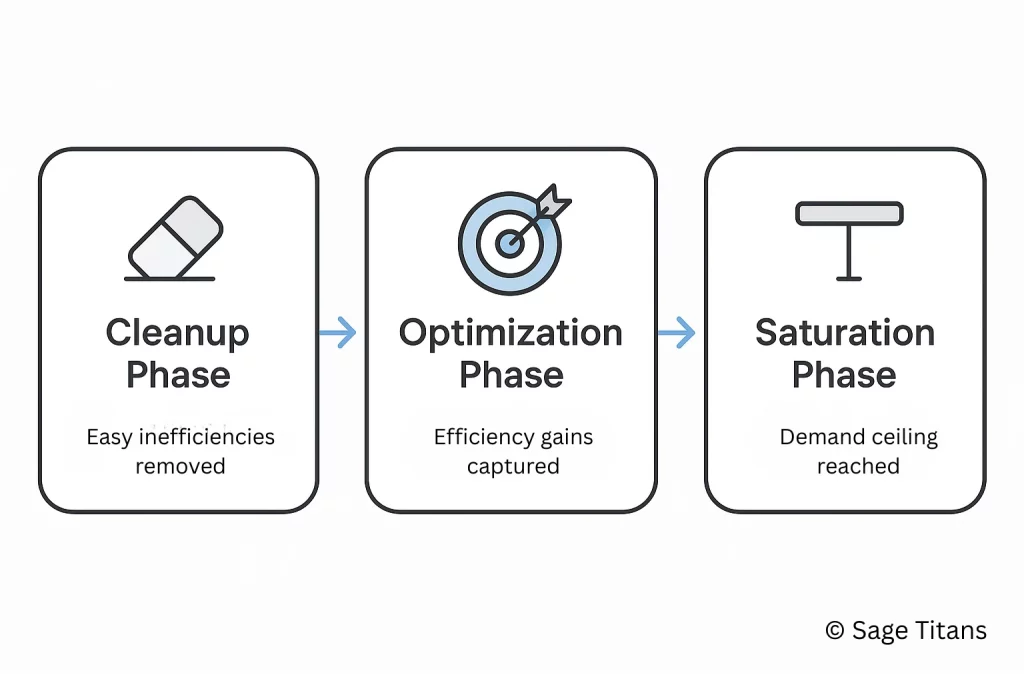
Early optimization works because inefficiencies are plentiful. Keyword waste, bidding fragmentation, weak landing alignment, and poor measurement all dampen performance. Removing these frictions unlocks results without requiring more demand—the same audience simply converts better.
Once that inefficiency is gone, progress slows. This change mirrors a basic economic reality: after easy gains are captured, every additional improvement becomes harder to earn. Marketing research describes the pattern clearly. Funnel.io notes that diminishing returns most often show up as rising cost metrics (such as CPC), flattening or declining ROAS, and stagnant conversion volume. Mailchimp describes how ad channels approaching saturation naturally deliver smaller incremental results, even under technically sound management.
Academic evidence underscores that this is not just a platform story. A 2024 study on dynamic advertising policy (Guo, ScienceDirect) demonstrated that incremental advertising exposure produces shrinking returns over time and can even weaken total brand goodwill when saturation occurs. Earlier work on advertising clutter (Ha, 1997) found that heavy message density reduced both audience response and advertising value. Many mature ad accounts follow the same performance pattern:
- Early progress
- Rising confidence
- Stalled momentum
- Uncertainty
- Reaction
Plateaus originate from environmental limits, not tactical failure.
Why Scaling Changes Auction Dynamics
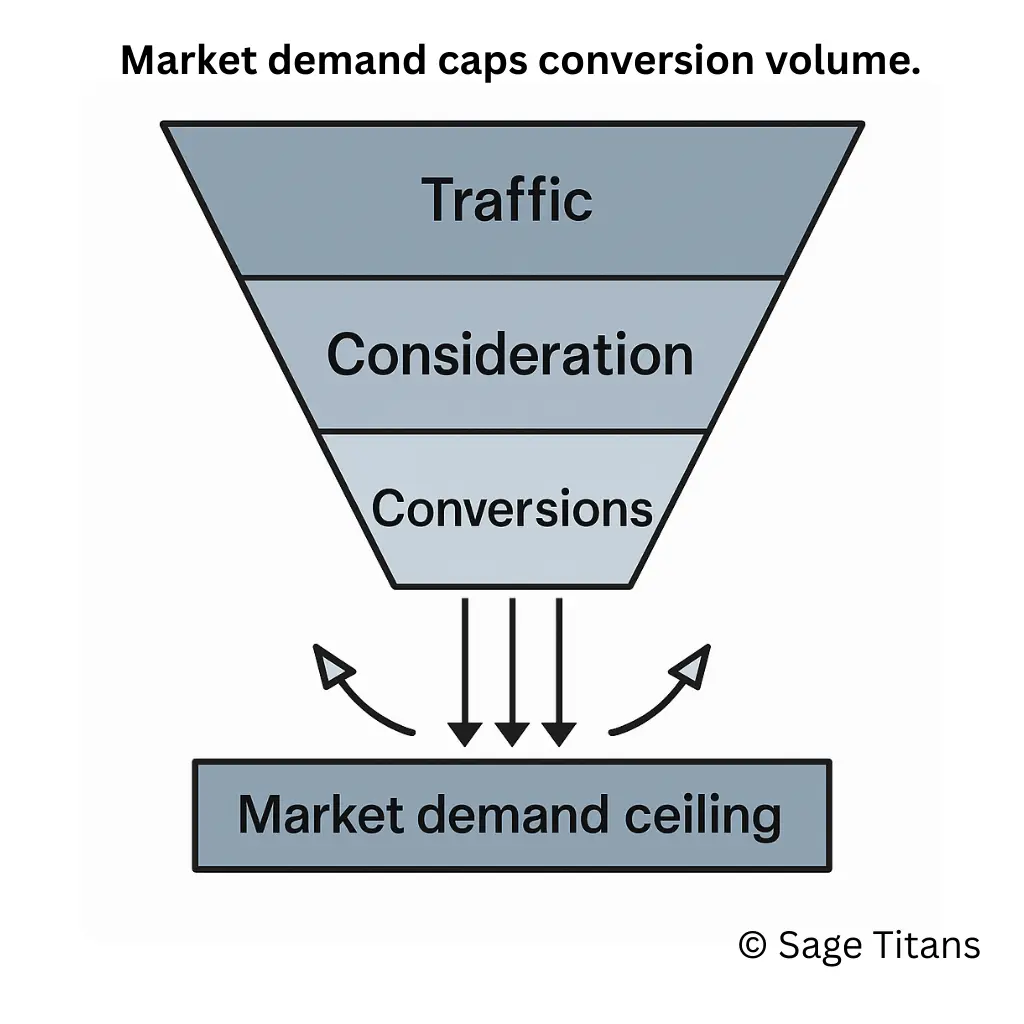
As campaigns mature, expansion runs into several structural forces. Put simply: costs rise faster than opportunity expands. Demand has limits. Search markets contain only a fixed number of high-intent queries. Because impression share is defined as impressions divided by total eligible impressions in Google’s documentation, there is a natural ceiling: once most eligible queries are captured, increasing bids or budgets has limited ability to unlock additional volume. After a point, higher budgets stop reaching new buyers and simply compete more aggressively for the same audience. Similar saturation effects show up in social and display environments when frequency climbs and audiences tire of seeing the same ads. The difference is that search demand saturates through query limits, while social and display saturate through repeated exposure—different mechanics with the same outcome: flattening response curves.
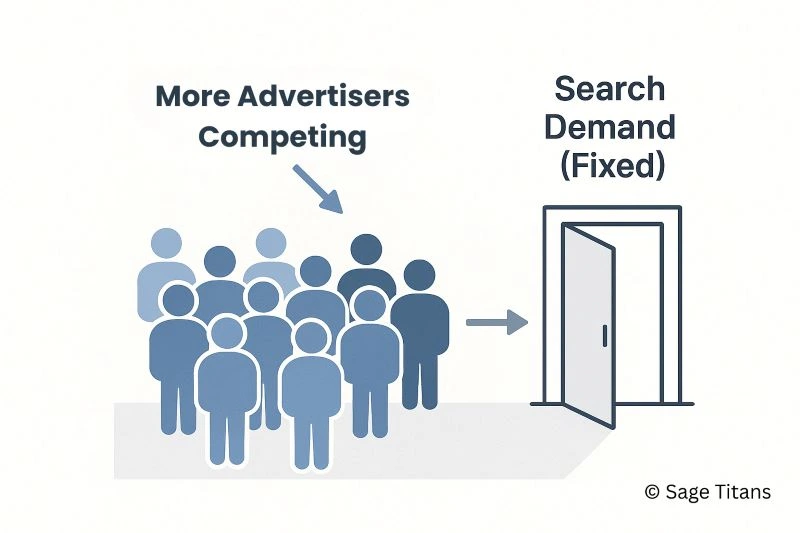
Competition steadily raises prices. Search Engine Land’s long-term reviews show 2–4% annual CPC growth, with some advertiser datasets posting double-digit yearly increases. RankFuse’s broader trend analysis illustrates the cumulative effect: average Google Search CPC rose more than 300% between 2015 and 2024, accelerating sharply after 2021 as digital competition intensified. Rising CPCs often create the appearance of stagnation: campaigns may convert at the same rate but require more spend just to hold the same market position.
Automation follows probability logic. Google’s Smart Bidding systems allocate spend toward traffic segments with the highest conversion likelihood first. As budgets scale, that pipeline necessarily broadens into lower-intent traffic. Performance averages soften not because automation fails, but because it reaches further into the opportunity curve. Creative wears out. Independent advertising research consistently shows declining engagement when exposure remains unchanged over long periods, even if targeting does not change, often appearing as flattening CTR and softening conversion rates despite stable impression volume. Growth often stalls because conversion demand grows more slowly than competitive pressure.
STEP 1—Identify Which Type of Plateau You’re Actually In
Not all plateaus look the same or arise for the same reason.
Efficiency Plateaus
An efficiency plateau occurs when performance remains stable at the current spend but worsens quickly as budgets increase. The most responsive segment of available traffic has already been captured, leaving expansion to chase lower-yield demand.
Volume Plateaus
CPA remains steady while conversion totals stall. This appears in narrow-demand sectors, single-offer product models, and brand-dominated competitive spaces.
Structural Plateaus
A structural plateau appears when spend increases without proportional conversion growth because campaign architecture restricts effective delivery. Internal account mechanics create these plateaus: overlapping campaign targeting, fragmented budgets, or misaligned conversion goals, rather than true limits of external demand.
False Plateaus
Performance appears flat due to distortions rather than real demand limits: tracking instability, attribution shifts (such as GA4 migrations or consent updates), or short-term seasonal and competitor surges.
After classification, the key question becomes whether the plateau is real or measurement-driven.
Plateau Type Comparison
| Plateau Type | What It Looks Like | Typical Cause |
| Efficiency Plateau | CPA rises when budgets increase | Auction saturation |
| Volume Plateau | CPA stable, but conversions stall | Limited demand |
| Structural Plateau | Spend increases without growth | Campaign fragmentation |
| False Plateau | Metrics temporarily freeze | Measurement or seasonality issues |
STEP 2—Check the Non-Negotiables Before You Touch Bids or Budgets
Plateau interpretation depends on a few baseline conditions. Most apparent plateaus trace back to only a few core variables. All three affect performance perception more than performance reality.
- Seasonality and competition: Demand cycles and competitor budgets shift throughout the year, changing both volume and cost without any changes to the account itself.
- Signal stability: Smart Bidding systems rely directly on conversion tracking. Small data disruptions, like duplicate events, partial tracking loss, and consent shifts, can dampen bidding precision without indicating strategy failure. These are the same failure points typically addressed during web analytics and GA4 implementations.
- Data fragmentation: Aggressive segmentation spreads conversions too thin across campaigns, clouding algorithmic pattern recognition. Fragmented campaigns spread conversion data so thin that bidding systems lose clarity.
- Creative fatigue: Message repetition steadily lowers response rates, even when targeting remains unchanged.
Many plateaus often recede once these stabilizers normalize. Once baseline conditions stabilize, interpretation naturally shifts toward identifying where limits truly reside.
STEP 3—Decide If You Have a Structure Problem or a Strategy Problem
Structure problems usually appear as internal competition or signal dilution within the account. This is where the nature of the ceiling becomes clearer. Structure problems live inside the platform. Overlapping Performance Max, Search, and Shopping campaigns can bid against one another for the same queries, such as brand terms, driving up CPC without increasing total conversions. Accounts often see total spend climb while branded impression share remains unchanged because multiple campaigns are competing internally rather than capturing new demand. Budgets that are split too thinly prevent any one campaign from gathering enough signal to learn effectively. Conversion goals or values that pull in different directions can confuse optimization. Case studies from ecommerce and B2B advertisers routinely show recovery following structural consolidation when real demand remains available. The same system-level thinking underpins modern Google Ads management models.
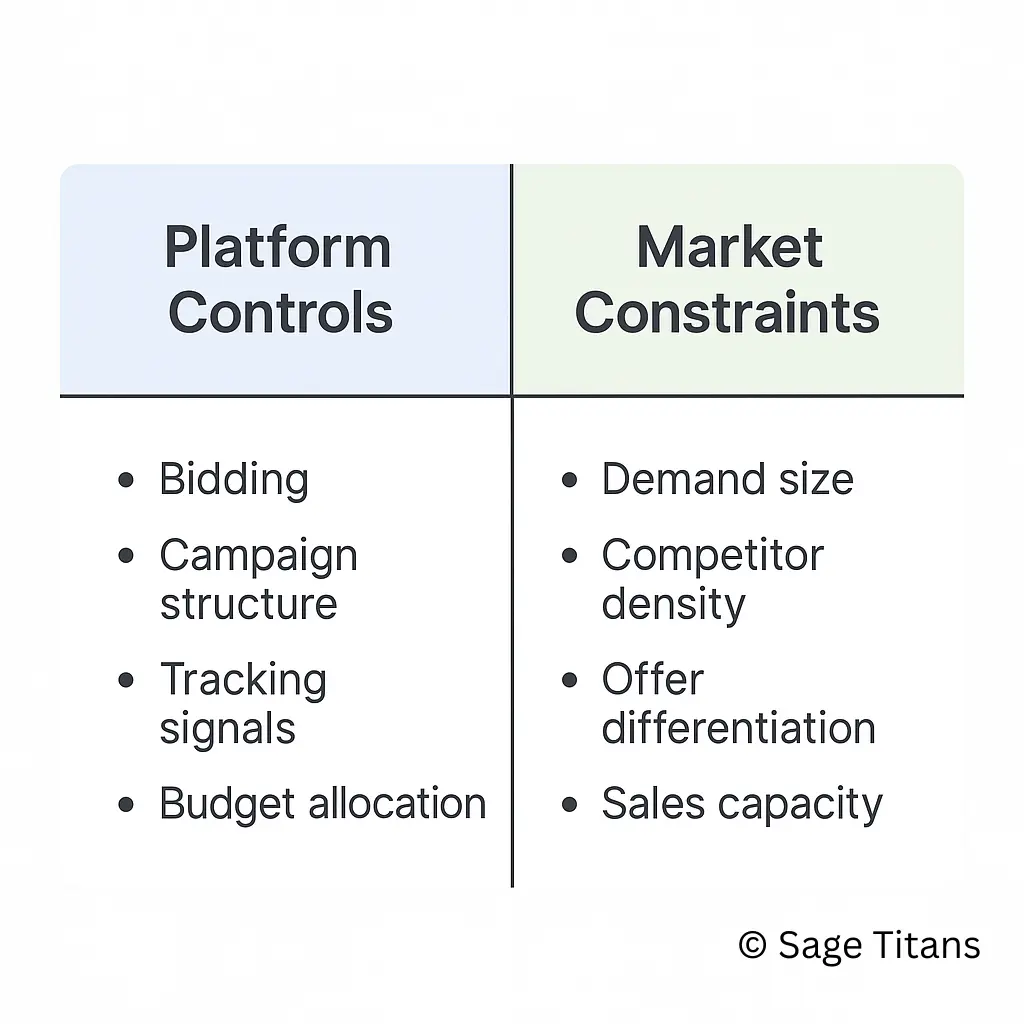
Strategy problems, however, live outside the interface. Markets may be saturated, offers undifferentiated, or sales conversion pipelines constrained. In B2B and high-consideration categories, plateaus often reflect downstream frictions where lead quality or sales qualification, not media efficiency, becomes the limiting factor. In strategy plateaus, the market becomes the bottleneck, not the advertising platform.
STEP 4—Simple, Safe Next Steps Based on Your Plateau Type
Efficiency plateaus align with consolidation and stability behaviors. Volume plateaus correlate with audience expansion and creative diversification. False plateaus generally dissolve once signal clarity returns and learning cycles restabilize. These patterns reflect common industry responses rather than fixed prescriptions. Short-term performance volatility often adds to plateau anxiety, particularly when systems are adjusting to new inputs. That distinction becomes critical when short-term volatility begins to feel indistinguishable from genuine stagnation.
False Plateaus & Learning Phase Misinterpretation
Changes to bid strategy or conversion tracking often trigger learning periods that typically last one to two weeks and can extend longer in more complex setups. During these windows, volatility increases and averages soften before stabilizing. True plateaus persist over months, not just across a single learning phase. Confusing learning phases with stagnation often leads to repeated changes that reset performance learning.
Why “Fixing” a Plateau Often Makes It Worse
Frequent reactive changes restart learning loops, widen bid volatility, and blur attribution baselines. Instead of restoring clarity, continual tinkering usually extends uncertainty. Seen at scale, these mechanics converge into a broader growth reality.
When Internal Optimization Reaches Its Limits
With maturity, incremental improvements from platform reconfiguration taper sharply. Gains increasingly depend on offer strength, creative development, audience cultivation, and funnel effectiveness. The platform gradually shifts from being the main growth driver to reflecting how strong the underlying business engine has become. In many mature accounts, plateaus reflect system maturity more than malfunction.
Conclusion—Treat Plateaus as Signals, Not Verdicts
Google Ads plateaus arise when mature spending systems encounter natural economic limits: constrained demand, rising competition, algorithmic expansion into weaker-intent traffic, and creative saturation. Account development commonly progresses as follows: classification, stabilization, structural clarity, and, finally, strategic expansion. Understood this way, stagnation becomes a navigational marker rather than a setback, signaling where growth transitions from tactical tuning to broader commercial evolution. Plateaus are not endpoints. They are transitions.
Additional analysis on such topics can be found within our carefully crafted collection of digital marketing insights.