
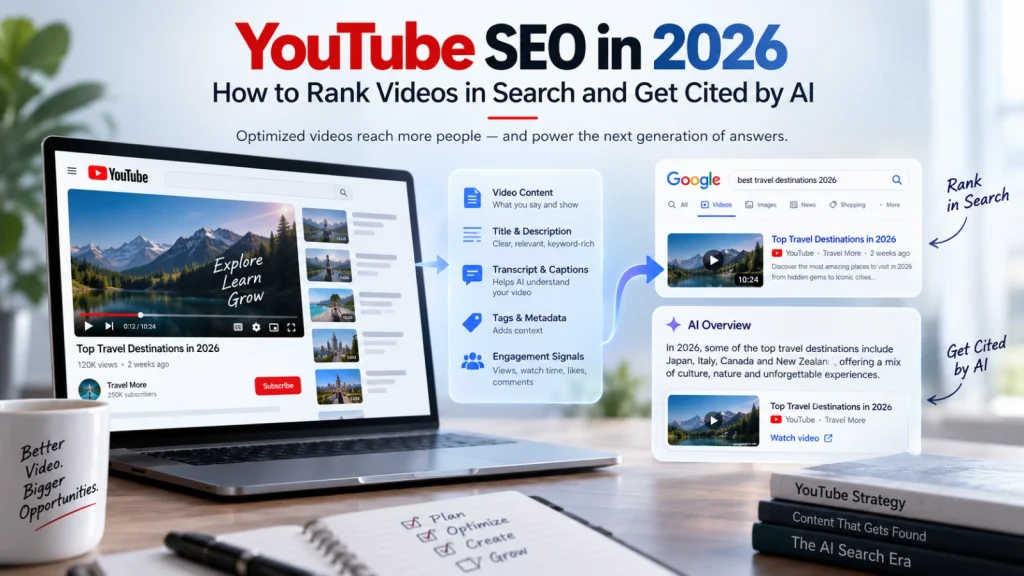
Key Takeaways
- Know your audience first: Create videos around what your target customers actually search for, watch, and care about.
- Optimize every video: Use clear, relevant titles and descriptions that match the searches you want to rank for.
- Stay consistent: Publish useful content regularly to keep your channel active and your audience engaged.
- Focus on engagement: Watch time, likes, comments, subscriptions, and continued viewing can strengthen content discovery.
- Extend your reach: Use Shorts, playlists, influencers, and related videos to attract more viewers and keep them engaged.
TL;DR: YouTube is the world’s second-largest search engine, and in 2026 ranking a video is no longer about keywords in a title. YouTube’s algorithm now rewards watch time, audience retention, and click-through rate, while Google increasingly pulls YouTube clips into AI Overviews. The videos that win are the ones built to be understood by machines and watched by people: clean transcripts, timestamped chapters, VideoObject schema, and answer-first structure. This guide covers how to rank on YouTube itself and how to earn the AI citations that now drive a growing share of discovery.
YouTube is not just a place to host videos. With around 2.7 billion monthly users and roughly 3 billion searches a day, it is the second-largest search engine after Google, and it is deeply wired into Google’s own results. A well-optimized video can now appear in a Google video carousel, a Key Moments snippet, and an AI Overview, all from the same upload. That makes YouTube a search channel first and a social channel second, which is exactly why it belongs inside an SEO strategy, not beside it.
This guide takes the search-and-AI view of YouTube: how the algorithm actually ranks videos in 2026, how those videos surface in Google and in AI answers, and what to change so your content gets found, watched, and cited.
What Changed: YouTube in 2026
If your last YouTube playbook was written a few years ago, several of its assumptions are now out of date. Five shifts matter most.
The living room is now the main screen. Connected TV passed mobile as YouTube’s largest US viewing surface in late 2025, and about 60% of US watch time now happens on television screens. Long-form content and clear on-screen structure matter more when people are watching from the couch, not scrolling on a phone.
Shorts is core, not a TikTok catch-up. Shorts now draw over 2 billion logged-in monthly users and can run up to three minutes. They are a primary discovery surface, especially for reaching new audiences, and they feed viewers into your long-form library.
The algorithm reads meaning, not just metadata. YouTube now uses Gemini-based AI to analyze what is actually said and shown in a video, its tone, topics, and pacing, well beyond the title and tags. What you say in the first fifteen seconds now influences ranking as much as the keyword in the title.
AI search arrived on YouTube itself. At Google I/O 2026, Google introduced conversational AI search inside YouTube, which can jump viewers straight to the relevant moment in a video. Structure and clarity inside the video now shape discovery, not just the description around it.
Google’s AI Overviews cite YouTube heavily. By some measurements, up to 29.5% of AI Overviews cite YouTube content. YouTube videos can appear in Google Search and AI-generated experiences, making video an increasingly relevant part of an AI-search strategy.
YouTube SEO vs Google Video SEO: Two Systems, One Goal
Most guides blur these together. They are related but rank on different signals, and knowing the difference tells you where to put your effort.
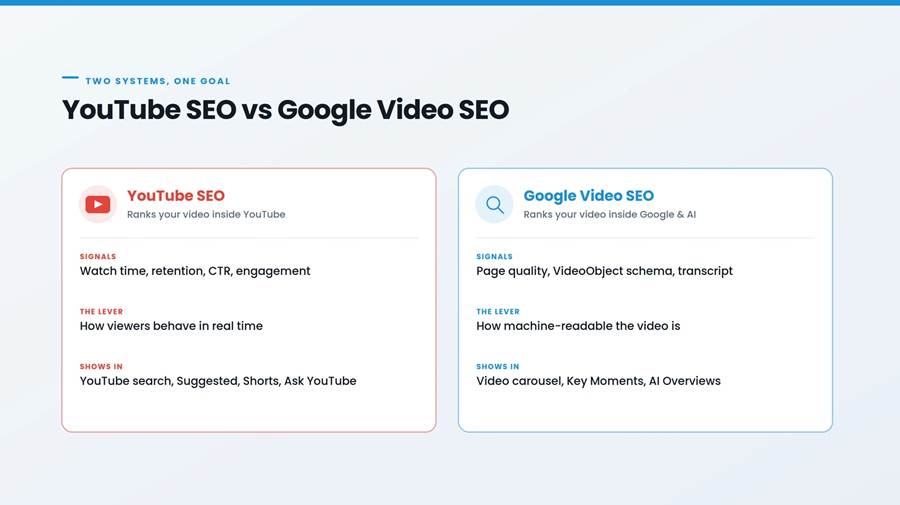
| YouTube SEO | Google Video SEO | |
| What it ranks | Your video inside YouTube search and recommendations | Your video (or its page) inside Google results and AI Overviews |
| Primary signals | Watch time, retention, CTR, engagement, satisfaction | Page quality, VideoObject schema, transcript, surrounding text |
| The lever | How viewers behave in real time | How machine-readable and well-supported the video is |
| Where it shows | YouTube search, Suggested, Shorts feed, Ask YouTube | Google video carousel, Key Moments, AI Overviews |
The practical takeaway: YouTube places greater emphasis on viewer response and relevance, while Google also relies on page quality, video understanding and structured information when surfacing video content. A serious strategy does both, because the same video can win inside YouTube and inside Google’s AI answers at once.
How to Rank a Video on YouTube in 2026
YouTube’s ranking is built around one question: will this viewer keep watching, and come back? Everything below feeds that.
1. Start with search intent, not just a keyword
Research what people actually search on YouTube, using the search bar’s autocomplete, YouTube Analytics, and a keyword tool. But go past the literal phrase. In 2026 the algorithm understands intent, so a video titled “Best Budget Camera 2026” can lose to one that clearly answers “which cheap camera should I buy and why.” Target the question behind the query, not only the words in it.
2. Earn the click with the title and thumbnail
Click-through rate is a core ranking signal, and it is decided by two things a viewer sees before watching: the title and the thumbnail. Keep the title clear, lead with the specific promise, and place the main keyword naturally near the front. A normal CTR sits in the 2 to 10% range; a thumbnail that reads instantly on a small phone tile does more for it than any clever wording. Test alternatives with YouTube’s built-in thumbnail A/B testing before assuming one works.
One habit worth building: judge every thumbnail at the size it will actually appear, not on your editing screen. Shrink it to the size of a fingernail on your phone. If the subject, the emotion, and at most three or four words are not legible at that size, it will lose the click no matter how polished it looks at full resolution. Most thumbnails are designed at the wrong scale, which is why they test worse than the creator expects.
3. Win the first fifteen seconds
Audience retention is one of the most important signals of viewer engagement and satisfaction, and most videos lose viewers in the opening seconds. State the value immediately, create a reason to stay, and skip the long intro. Depending on the video length and format, 50% to 70% average retention can be a useful benchmark, but your own retention curve is the more important reference. Check your Audience Retention graph in YouTube Analytics to find exactly where people leave, then improve that moment in your next video.
In practice, the retention cliff almost always sits in the same place: the gap between the thumbnail’s promise and the first thing the video actually delivers. When we audit underperforming channels, the fix is rarely better production. It is cutting the throat-clearing so the video starts paying off the click within the first ten seconds. A channel that does nothing else but tighten its openings usually sees retention move before any other change takes effect.
4. Structure the video into chapters
Timestamped chapters do double duty in 2026. For viewers, they make a long video navigable. For machines, they tell both YouTube and Google that the video covers discrete, extractable topics, which is what powers Key Moments in Google results and lets Ask YouTube jump to the right segment. Add clear chapter markers to every long-form video.
5. Give the algorithm clean text to read
YouTube reads your transcript to understand and rank the video. Auto-generated captions contain errors, so upload a corrected transcript or edit the automatic one. Accurate captions improve keyword matching, accessibility, and, increasingly, whether AI systems can lift your spoken answer into a summary. Add 5 to 10 relevant tags, set the correct category and language, and write a description that explains the video in plain, keyword-aware language rather than a wall of hashtags.
6. Keep viewers inside your ecosystem
Cards, end screens, and links to your related videos raise session duration, another signal YouTube rewards, because it shows your channel holds attention across multiple videos, not just one. Think of it as internal linking for video: point each video at the next logical one, the way a well-linked blog guides a reader deeper.
7. Publish consistently, and give new videos a strong first 48 hours
A consistent publishing schedule can help you build an active audience and generate more opportunities for discovery, and so is early velocity: how a video performs in its first 48 hours shapes how widely YouTube then recommends it. A predictable schedule trains both your audience and the algorithm. Promote each new upload where your audience already is, so the opening window shows real engagement.
How YouTube Videos Win in AI Search
This is where YouTube SEO and AI search visibility meet, and where most channels are leaving opportunity on the table. Google’s AI Overviews and conversational assistants pull YouTube clips into their answers at high rates, because video gives them something text pages often do not: clear structure, natural spoken language, timestamped answers, and real engagement signals of quality.
Most YouTube advice still treats this as a bonus. We would argue it is becoming the main event. A video that never cracks the top three of YouTube’s own search can still get pulled into a Google AI Overview and put in front of exactly the person asking that question, which is often a higher-intent moment than a casual YouTube browse. If you only measure YouTube-native views, you will undercount, and underinvest in, the discovery that increasingly happens off-platform.
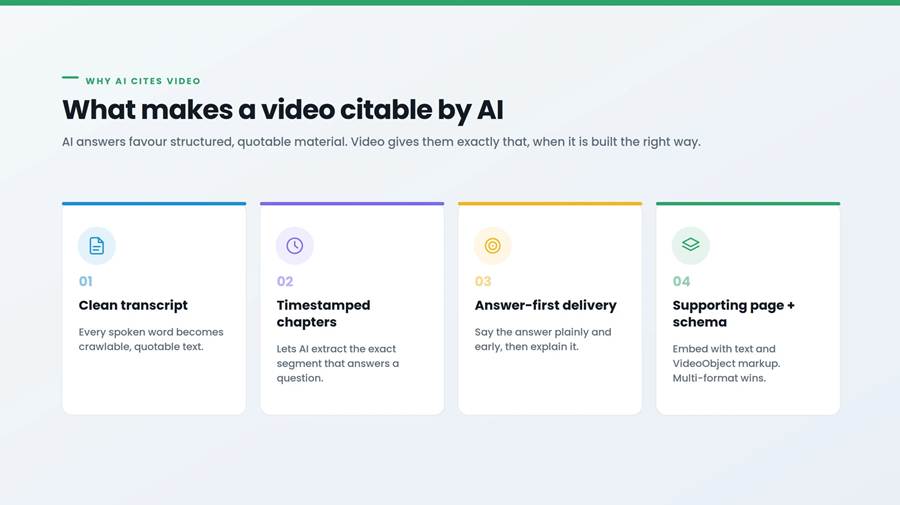
Four things can make video content easier for search and AI systems to understand.
Clean transcripts. Every spoken word becomes crawlable text. When you say a specific, self-contained answer out loud, that exact phrasing can be lifted into an AI summary. Vague or rambling narration cannot.
Timestamps and chapters. Explicit chapter markers let AI systems extract a specific segment as the answer to a specific question, rather than pointing at the whole video.
Answer-first delivery. Say the answer plainly, early, then explain it. This is the same answer-first logic that wins featured snippets and AI citations for written content, applied to what you say on camera.
A supporting page. Embed the video on a page with real supporting text and VideoObject schema. Multi-format content, video plus text plus images, is markedly more likely to be cited in AI Overviews than any single format alone. Google often surfaces the text for the answer and links the video for the demonstration.
If your brand already thinks in terms of generative engine optimization and answer engine optimization, YouTube is simply another surface those disciplines apply to. The video that answers a question clearly, with a transcript and chapters, is doing GEO and AEO work in a format that Google’s AI Overviews actively favor.
The Technical Layer: VideoObject Schema and Embeds
The difference between a video that Google can rank and one it treats as a black box is structured data. On any page where you embed a video, add VideoObject schema so Google can identify the title, thumbnail, duration, and upload date, and present the video as a rich result with a thumbnail and clickable Key Moments. If a video covers several topics, Clip markup highlights those sections. Pages that already rank well organically are more likely to have their embedded videos included in video rich results, so overall page SEO quality still matters.
A simple, durable pattern: for each important video, publish a companion article on your own site, embed the video in it, add the transcript as text, and mark it up with VideoObject schema. That single page can then rank as a web result, feed a video carousel, and supply an AI Overview citation, three surfaces from one asset.
Shorts, Long-Form, and Connected TV: Matching Format to Goal
These are not competing formats, they serve different stages.
Here is where we part ways with a lot of 2026 advice: Shorts are oversold as a growth engine for every brand. They are excellent for reaching new viewers, but the subscribers they bring are often low-intent, and Shorts views convert to long-form watch time far less reliably than the view counts suggest. For a consumer brand chasing awareness, lean into Shorts. For a B2B or considered-purchase brand, we would put the bulk of the effort into long-form that answers real buying questions, and use Shorts only as a trailhead that points to it. Volume on Shorts is easy. Volume that turns into a business outcome is not.
Shorts are for discovery. They reach new viewers quickly and, at up to three minutes, can now carry a real idea. Use them to answer one tight question or tease a longer video, then guide viewers to your long-form content.
Long-form is for depth, watch time, and monetization, and it is what connected-TV viewers increasingly watch on the biggest screen in the house. This is where retention and chapters earn their keep.
Connected TV changes production choices more than most creators realize. When 60% of US watch time is on a television, on-screen text needs to be readable from across a room, pacing can be a little more patient, and the living-room viewer is often in a considered, lean-back mindset rather than a quick-scroll one.
What to Measure
Views alone tell you almost nothing in 2026. Track the signals the algorithm actually rewards, and the ones that show AI visibility.
- Audience retention and average percentage viewed, the clearest quality signal
- Click-through rate on impressions, which tells you if title and thumbnail are working
- Watch time and session duration, including whether viewers continue to your other videos
- Traffic sources, so you know whether growth comes from YouTube search, Suggested, Shorts, or external
- Video appearances in Google, checked in Search Console and by searching your target queries
- AI citations, by periodically asking ChatGPT, Perplexity, and Google’s AI whether your video or brand is referenced for its core question
FAQ
Is YouTube part of SEO or social media? Both, but for a search strategy it is best treated as SEO. YouTube is the second-largest search engine, its results feed Google, and its videos appear in AI Overviews, so it belongs inside your search and AI-visibility work.
What is the most important YouTube ranking factor in 2026? YouTube uses multiple signals, including relevance, engagement, viewer satisfaction, and how viewers respond to a video. Retention is an important part of that picture. Title and thumbnail earn the click; viewers engagement and retention earns the ranking.
How do I get my YouTube videos into Google AI Overviews? Upload accurate transcripts, add timestamped chapters, answer specific questions clearly on camera, and embed the video on a page with supporting text and VideoObject schema. AI systems cite YouTube heavily because video gives them structured, quotable material.
Do Shorts help or hurt long-form performance? They help, when used for discovery. Shorts reach new viewers and can funnel them to your long-form library. Just avoid relying on Shorts alone if watch time and monetization are the goal.
Can AI-generated videos rank? Yes. Both YouTube and Google judge helpfulness and engagement, not production method, though YouTube requires proper AI-content disclosure and Google applies its usual quality standards. A useful video ranks whether a human or a tool made it.
How long until YouTube SEO works? It compounds. Individual videos can gain traction in their first days, but channel authority, and the consistent AI citations that come with it, builds over months of regular, well-optimized publishing.
The Bottom Line
YouTube in 2026 is a search and AI-discovery engine that happens to play video. Ranking is decided by how well people watch and how clearly machines can read what you made. The channels that win treat every video as a search asset: intent-driven, retention-first, chaptered, transcribed, and supported by a schema-marked page, so it can be found on YouTube, surfaced in Google, and cited by AI all at once.
Want your video content to rank in search and get picked up by AI, not just sit on a channel? Our SEO services build video into an integrated search and AI-visibility strategy.