
Key Takeaways
- Metrics are not conclusions. High engagement does not necessarily translate into purchase intent or revenue.
- Attribution can be misleading. The channel that gets credit for a conversion may not be the one that created customer demand.
- Awareness does not guarantee conversion. Customers need credible evidence and clear answers before committing to a purchase.
- Customer questions reveal friction. Recurring objections and unanswered questions can expose gaps in the buying journey.
- Better decisions require deeper insight. Combine quantitative data with customer behavior and qualitative feedback to understand what actually drives outcomes.
What the data establishes, what businesses conclude from it, and why the distance between the two shapes where investment goes next
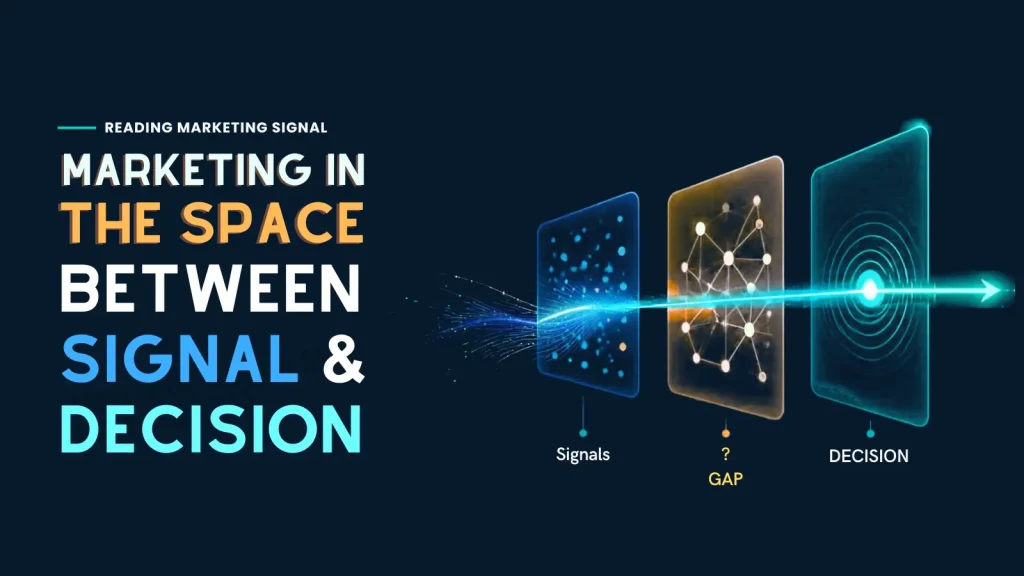
Marketing now produces an abundance of observable signals. Click-through rates, completion rates, engagement velocity, share behavior, search lift, and the dashboard is full. Signals invite conclusions, and the conclusions often travel further than the evidence justifies.
In Gen Z decision environments, where discovery, research, evaluation, and purchase can span multiple platforms and information sources, this becomes even more important. The core issue is not generational. It runs through how businesses interpret what they observe, regardless of audience or channel.
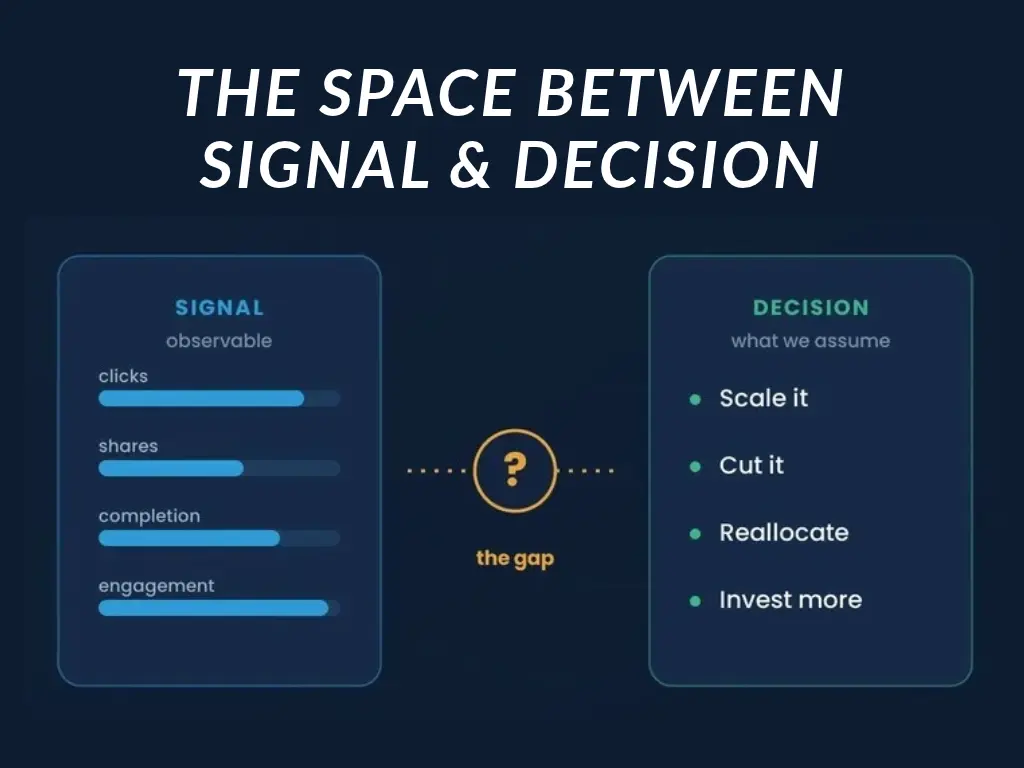
The question worth asking is not just what we are measuring; it is whether we are deciding because of what we think we measured.
A metric is not a conclusion
There is a distinction worth making precisely because it tends to get blurred: the difference between what a metric establishes and what the business decision built around it assumes.
A metric can establish that someone watched, clicked, shared, or completed an action. It cannot, by itself, establish why they did it, whether anything shifted in their thinking, or what they are likely to do next. Those conclusions require an additional assumption, one that is often made silently.
Consider a campaign that generates unusually strong engagement. The business concludes: the message resonated; we should scale it. The engagement is directly observable. The inference that the message resonated in the way that will produce the downstream outcome being anticipated is doing significant work. It is not wrong to make that inference. But it is worth knowing which part of the decision chain is evidence and which part is interpretation.
The subtler version of this goes beyond vanity metrics. It is inferential overreach on metrics that genuinely matter: where a real signal produces an overextended conclusion that then drives resource allocation, creative strategy, or channel investment.
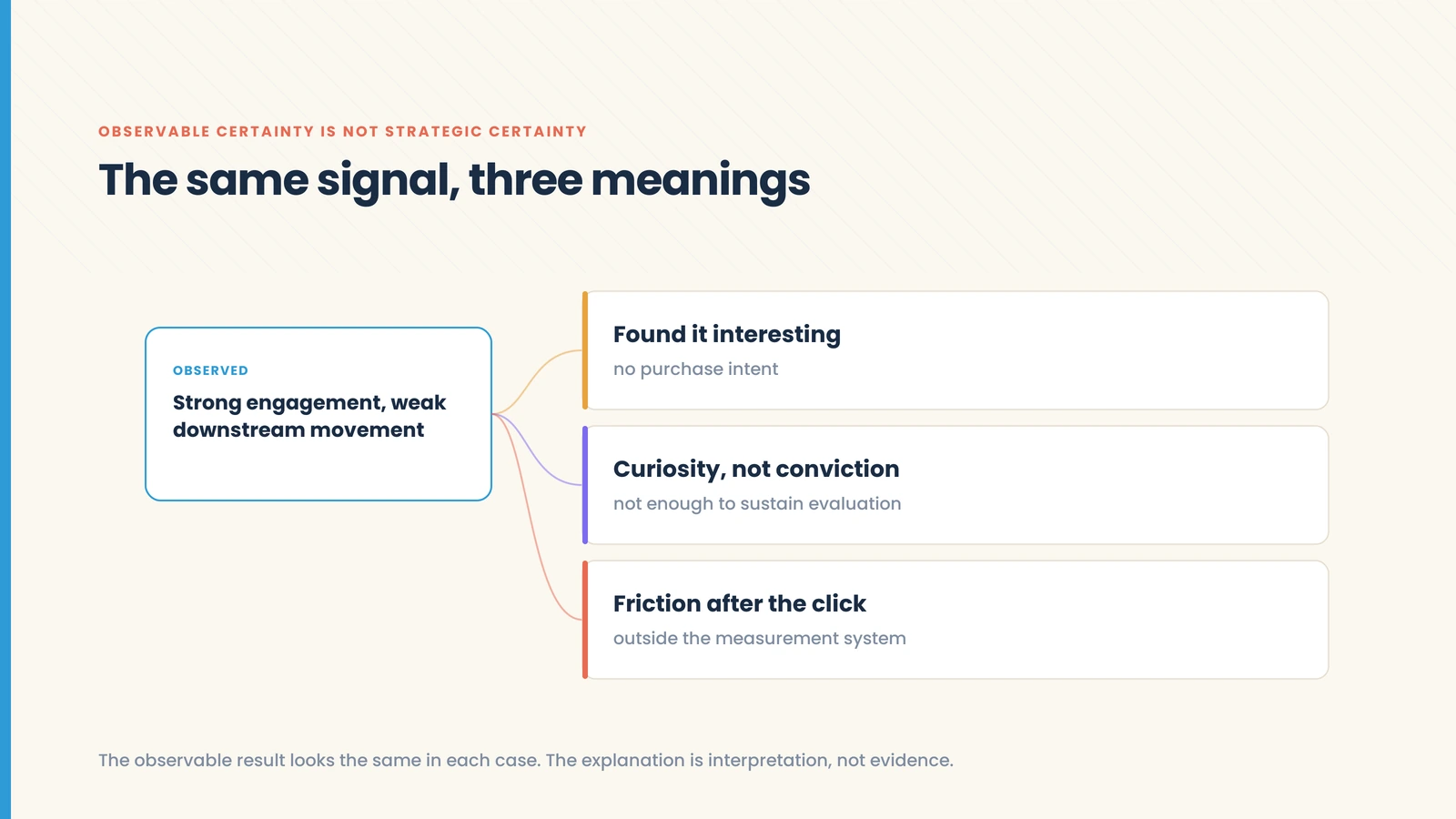
Observable certainty and strategic certainty are not the same thing. A business can know one thing with confidence while remaining uncertain about the more consequential question driving the next action.
The danger is not the metric. It is the decision made because of what the business assumed the metric proved.
A signal does not become more conclusive simply because one explanation for it is immediately useful. Strong engagement with weak downstream movement could mean the audience found the content interesting without purchase intent. It could mean the message created curiosity but not enough to sustain evaluation. It could mean friction exists after the interaction, outside the measurement system entirely. The observable result looks the same in each case. Before committing resources to one explanation, the more useful pressure to apply is this: what would look different in the data if that explanation were wrong? If the answer is not much, the explanation may be doing more work than the evidence supports.
A touchpoint can work without getting the credit
The familiar version of this argument is that customer journeys are non-linear. True, but not especially useful as a strategic observation.
The sharper version is this: presence before an outcome does not prove contribution, but the absence of a final conversion does not prove the absence of contribution either.
A touchpoint may introduce a consideration, resolve a specific objection, establish familiarity, or move someone toward a different environment where investigation continues. A different touchpoint may then perform a different role. The interaction that closes a transaction is not necessarily the one that made the decision possible.
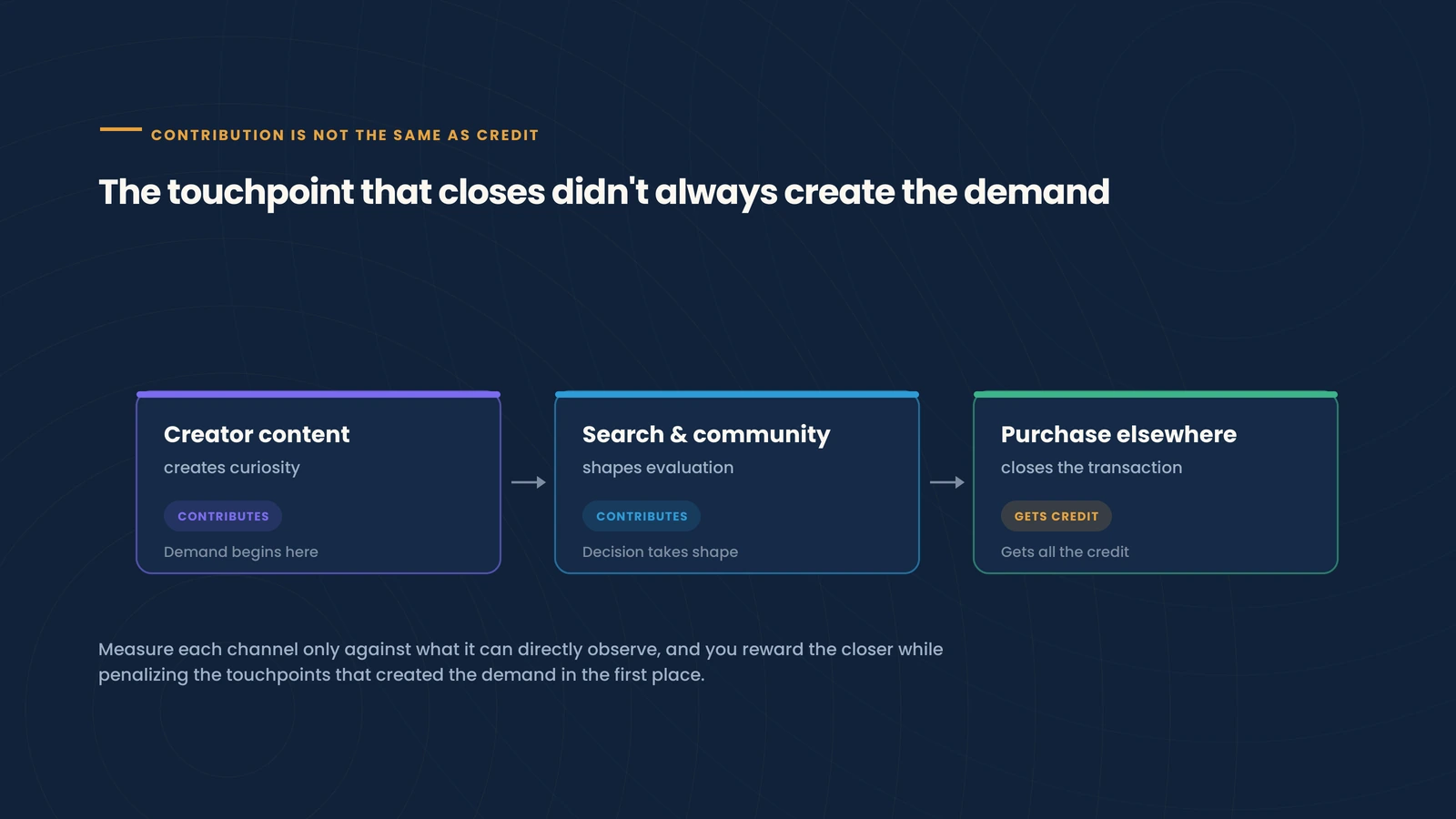
In one pattern particularly relevant to Gen Z decision environments, creator content may generate initial curiosity; search, community discussion, and comparison may shape evaluation; and purchase may happen somewhere else entirely. The question of which interaction caused the outcome is genuinely difficult not only because measurement has limitations, but also because the decision itself may be distributed across environments that can play different roles.
When individual channels are measured primarily against the outcomes they can directly observe, it becomes possible to penalize touchpoints whose contribution those outcomes don’t capture and to reward the touchpoint that closed a transaction without knowing what created the demand that preceded it.
Channel optimization and decision optimization are not always pointing in the same direction.
The diagnostic criterion “Did the conversion happen here?” is not sufficient to determine whether contribution happened here.
Do not keep a touchpoint simply because it appeared before the outcome. Do not abandon it simply because the outcome happened somewhere else.
A message is not the evidence
Marketing can move someone from “I was not thinking about this” to “Is this actually right for me?” What it often cannot do is answer the second question using the same interaction that created it. The claim that generates curiosity and the evidence a customer needs to evaluate that claim may live in different environments, in different formats, carrying different weight for the person looking.
The interaction that creates interest may also create questions it cannot answer.
When that happens, the interested customer may go looking through search results, comparisons, forum discussions, customer experiences, third-party assessments, or information they were not originally looking for. What they encounter there is not controlled by the original marketing interaction. It is the broader information environment that the claim now has to hold up in.
Interest creates new questions
A campaign moves someone from indifference to curiosity. That curiosity immediately generates a more specific, more practical question, one the campaign was never designed to answer. The customer may investigate elsewhere. Whether sufficiently relevant evidence is available when they go looking becomes the next issue, not as a replacement for whether the campaign worked, but as what follows when it does.
That unresolved question tends to leave traces. The same uncertainty about a specific claim, a practical detail, or a comparison that hasn’t been made clearly enough can surface in search behavior following awareness activity, in conversations with sales teams, in the comparisons customers reach for, and in the places where interest is visible but progression repeatedly stalls. The question is not which of those surfaces to monitor. It is whether the same uncertainty keeps appearing between initial interest and eventual decision. Recurrence is the signal. A question that shows up once may be idiosyncratic. A question that keeps appearing is telling you something the original marketing interaction did not resolve.
Message compression and decision complexity pull against each other. A campaign benefits from focus. A purchasing decision may carry uncertainties too specific to resolve within the interaction that created the interest.
More attention can expose an evidence gap
When curiosity repeatedly leads customers toward unanswered questions or contradictory evidence, stronger marketing can make an existing weakness harder to ignore.
The business may read this as an awareness issue. More awareness may help. But stronger marketing can sometimes reveal that the next constraint lies elsewhere, not in how many people are reached, but in what those people find when they go looking.
More awareness can mean more people investigating. When investigation repeatedly surfaces the same unanswered questions, greater reach sends more people toward the same friction point faster.
The goal is not omnipresence. It is having sufficiently relevant evidence available for the questions that emerge after interest is created, questions the brand may not have anticipated and cannot always answer through increasingly controlled messaging.
Sometimes the next constraint only becomes visible after marketing succeeds.
Seeing the signal is not seeing the decision
The argument running through this article is not primarily about measurement sophistication or attribution modeling. It is about a more fundamental tendency: treating partial visibility as a complete explanation.
A business observes signals. Those signals reveal something. The business assigns meaning to them, builds further conclusions on top of that interpretation, and makes investment decisions accordingly. Meanwhile, the customer may have continued beyond those observable interactions into search results, community discussions, comparison environments, review ecosystems, and encountered information that either reinforced or quietly changed how the original claim lands.
None of that continuation is necessarily visible in the dashboard.
The goal is not complete visibility into every part of the customer decision. That is neither achievable nor the right objective. The goal is to know the limits of what you can see before acting as though you saw more.
A metric offers partial evidence. A touchpoint may account for only part of what moved a decision forward. A message supplies only part of what a customer may use to decide. These are not deficiencies to be engineered away. They are the conditions inside which marketing decisions get made.
If your marketing succeeds in creating curiosity, what happens to that curiosity once it moves beyond the signals, touchpoints, and messages you directly control?
That is where the diagnostic work begins.
Our article on Observation Marketing picks up from there, exploring how to work more deliberately with the signals and patterns you can observe and turn those observations into stronger marketing insight.