
Key Takeaways
- The click didn't disappear, it moved in time: an AI Overview can create brand memory that converts later through branded search or a direct visit, invisible to last-click attribution.
- Zero-click hits content unevenly, so sort every page by where it sits between a simple answer Google can synthesize and a complex decision that still needs a visit.
- Decide each page's fate deliberately: defend the ones that still convert, surrender pure definitions to citation, and repurpose topics that matter in a stronger format.
- AI commoditizes explanation but rewards original observation, so research, first-hand experience, and proprietary data are what actually earn citations.
- Stop measuring success by sessions alone, and report impressions, branded search growth, and assisted conversions so leadership sees the visibility that traffic no longer captures.
Google entered the explanation business. Content that doesn’t bring something beyond what Google can already synthesize is now competing with the search bar.
That’s the shift underneath zero-click search, and it’s why the standard response of “optimize for AI Overviews” misses the actual problem. The issue isn’t which tactics to add. It’s that a great deal of informational content was built for a version of search where explaining things well was enough, and that version is no longer the one running.
This guide walks you through deciding which content is worth defending, which is better optimized for citation than for clicks, and how to measure and report what is happening, in a way that holds up in a leadership review or a planning conversation.
What Zero-Click Search Actually Is (and What It Isn’t)
Zero-click search happens when Google answers a query directly on the results page, through AI Overviews, featured snippets, knowledge panels, or People Also Ask boxes, and the user gets what they need without visiting any website.
This isn’t a penalty. The core principles behind Google’s indexing and ranking systems remain broadly consistent, even as Google continues to refine its ranking systems and AI-generated search experiences. What changed is what Google does with a top-ranking page once it decides the page is credible: for certain query types, it synthesizes the answer and presents it on the SERP instead of routing the user to the source.
The result can be a pattern in Search Console where impressions rise while clicks fall, because users often get enough information from the SERP before deciding whether to visit a website.
The click didn’t disappear. It moved in time.
When a user sees your brand cited in an AI Overview and doesn’t click, they don’t necessarily forget you. The exposure can create memory or recall. That recall may later appear as a branded search, a direct visit, or a purchase from someone who “just knew” your name when they were ready to buy. The demand is still there, it’s arriving through a different channel, at a different moment, and with a different attribution footprint than the original search generated. That mechanism explains why last-click attribution undercounts organic so severely right now. The organic impression happened. The conversion happened. The connection between them is invisible if you’re only measuring sessions.
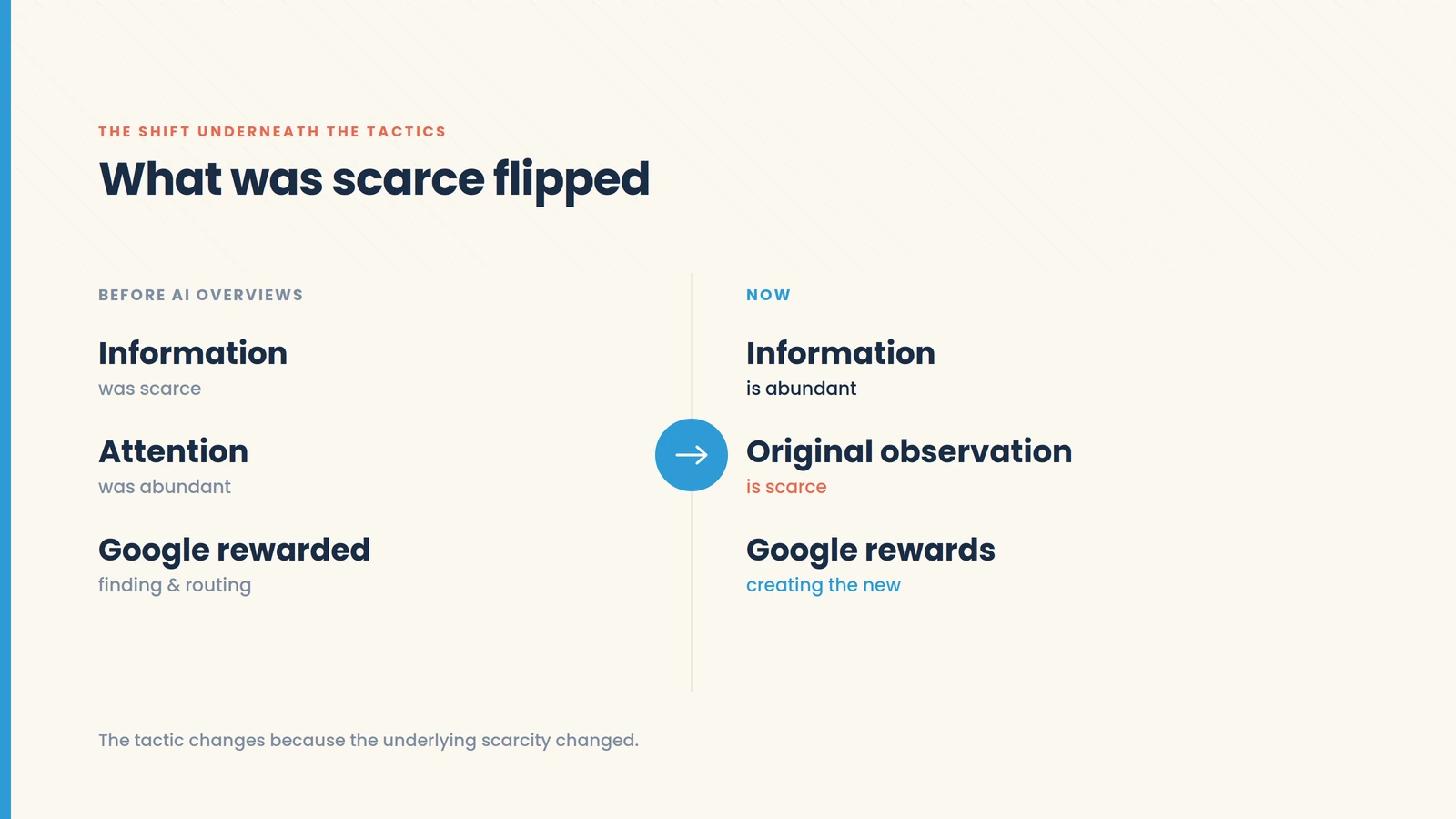
There’s a deeper economic shift underneath the tactical one. Before AI Overviews, information was scarce, and attention was abundant, Google rewarded finding information and routing users to it. Now information is abundant, and original observation is scarce. Google no longer primarily rewards finding information. It rewards creating information that didn’t exist before. That shift is what makes every content decision in this article necessary. Tactics change because the underlying scarcity changed.
AI compresses explanations and expands uncertainty simultaneously. Simple, stable questions get answered without a click, “What is canonicalization?” generates an AI Overview and the user moves on. Complex decisions generate more questions, not fewer.
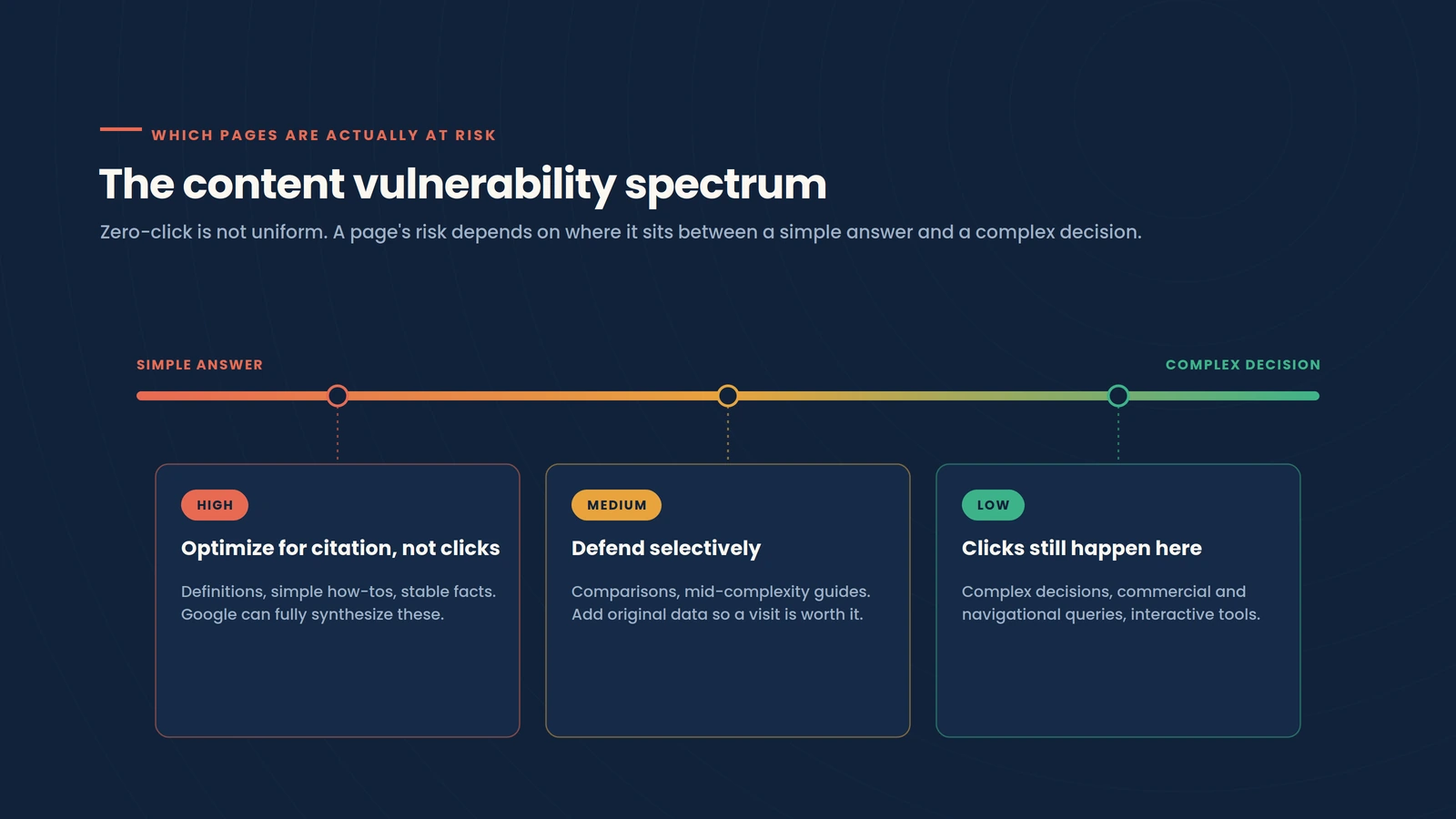
A user asking, “Should I migrate 200,000 URLs to a new domain structure?” gets five considerations from an AI answer and then needs expert help to act on any of them. AI reduces informational traffic. It may increase consultative traffic. Zero-click isn’t uniformly bad for all content types, it depends entirely on where your content sits on the spectrum from simple answer to complex decision.
Three things often get conflated when practitioners say “SEO is dead” or “zero-click is killing organic,” and treating them as one problem leads to the wrong solutions for all three:
Traffic decline on informational pages is real, structural, and largely permanent for queries where Google can synthesize a complete answer. A page explaining what a canonical tag is will get fewer clicks than it did three years ago. That’s not going to reverse unless search experiences change significantly.
Zero-click pressure is generally lower for commercial and navigational queries, although ranking difficulty continues to evolve with competition and Google’s ranking systems. A page targeting “best project management software for remote teams” or “SEO agency London” is not facing the same zero-click pressure as a definitions page. The competitive dynamics are broadly similar, although SERPs continue to evolve with new features and AI experiences.
Content ROI on informational pages is genuinely disrupted, but the disruption is uneven. Some informational content now generates significantly less traffic than it once did. Other informational content, original research, first-hand experience, and proprietary data, is more valuable than ever because it’s what AI systems are likely to cite.
Before you change anything, run a quick diagnostic in Search Console: Filter your top pages by impressions and sort by CTR.
Pages with high impressions, stable rankings, and unusually low or declining CTR on informational queries may indicate zero-click impact. Compare them against historical performance rather than using a fixed CTR threshold.
That split tells you where to focus, and in most cases, it’s a smaller portion of the site than the aggregate traffic decline suggests.
Five Things Worth Questioning Before the Frameworks
Before the decision tools, five observations that don’t require data , just a willingness to examine assumptions that are easy to carry unexamined.
Ranking first doesn’t guarantee AI citations, and ranking eighth doesn’t prevent them. Citation selection and ranking evaluate different things. A page ranking eighth with original data and clear structure regularly can get cited over a page ranking first with comprehensive but synthesizable coverage. The implication isn’t that rankings don’t matter. It’s that citation strategy and ranking strategy are not the same strategy, although they may overlap in certain places; conflating them produces effort that serves neither goal well.
The page getting the fewest clicks on your site might be creating the most demand. A definitions page that earns zero clicks but appears in AI Overviews for 40,000 monthly queries is generating brand exposure that sessions-based reporting cannot capture alone. Some of that business impact from that exposure may later show up as branded searches, direct visits, and conversions that attribution models assign to other channels. The measurement system says the page is failing. The business says otherwise.
Publishing more unfocused content can reduce your authority rather than build it. AI citation systems appear to weight topical consistency, a site that covers a topic comprehensively across focused, related pages, over sites with broad but scattered coverage. A team that publishes twenty pages across unrelated topics dilutes the topical signal that makes any individual page citable. Fewer pages on a narrower topic, each with genuine depth, produces stronger citation authority than publishing large volumes of shallow content across a wide surface area.
The more successfully an idea spreads, the less likely its originator is to be credited for it. When many credible sources support the same claim, AI systems may rely less on any single source, although they frequently continue to provide citations. Success turns original information into consensus, and consensus makes attribution optional. Publishing an original idea and stopping is a losing strategy. The citation window closes.
AI may increasingly reward teams that invest more in original observation than in publishing volume alone. The content that earns citations requires real observation, interviews, experiments, datasets, and first-hand experience, and none of that comes from publishing more simply for the sake of it. Publishing cheap information at scale accelerates the dynamic that makes cheap information harder to source, not because of the volume, but because of what the volume contains.
The Content Vulnerability Matrix: Which Pages Are Actually at Risk
The usual response to zero-click pressure is either changing everything or changing nothing. The more useful response is sorting your content by how much risk each page carries, because zero-click doesn’t affect all content equally.
The two primary variables that determine vulnerability are query intent and Google’s ability to synthesize a complete answer without the user needing more context.
One dynamic worth understanding before looking at the categories: AI Overviews often answer queries early in the user’s exploratory path, reducing the need for additional clicks. Before AI Overviews, a user who clicked your article might follow internal links, discover related topics, sign up for your newsletter, and eventually become a customer. Now the path often ends at the AI answer for informational queries. Content that survives zero-click pressure isn’t just content that earns clicks, it’s content that earns curiosity before it earns clicks. If the user has no reason to want more after reading the AI answer, they won’t look for you.
Here is how specific content types map across the vulnerability spectrum:
High Vulnerability: Optimize for Citation, Not Clicks
Definition and “what is X” pages. Google answers these directly in AI Overviews and knowledge panels. A page ranking first for “what is a meta description” is increasingly being cited alongside receiving fewer clicks than it once did. Structure these pages for citation quality, direct answers, clear headings, and well-supported facts, rather than relying solely on recovering historical click volumes.
Basic how-to guides covering stable, general processes. “How to write a title tag” or “how to set up Google Search Console” are synthesizable. If the how-to requires judgment, tools, or situational context that varies by user, it has more protection. A generic five-step process doesn’t.
Glossary and FAQ content built around common definitions. High vulnerability unless the definitions are proprietary, your own methodology, your own framework, your own terminology, in which case AI is more likely to cite you to use them.
Medium Vulnerability: Defend Selectively
Comparison pages (“X vs Y”). AI Overviews are appearing more frequently for comparison queries, but clicks still happen because buyers want more than a summary. A comparison page built on original testing, specific use-case guidance, or real user data often holds up. A comparison page that aggregates publicly available specs usually does not.
“Best X for Y” roundups. Vulnerability depends on specificity. “Best CRM for enterprise sales teams with Salesforce integration” still generates clicks because the answer requires context AI can’t fully provide. “Best project management tools” is increasingly synthesized.
Thought leadership and opinion content. An original perspective is harder to synthesize than factual content. A piece that takes a specific, defensible position on a contested topic has more protection than a balanced overview of the same topic. AI can summarize areas of consensus, but genuine expert disagreement often benefits from original sources and deeper analysis.
Low Vulnerability: Clicks Still Happen Here
Pricing, commercial intent, and product pages. Users searching with purchase intent click through. AI Overviews don’t replace the need to visit a pricing page, evaluate a product, or start a trial.
Original research and data pages. A study with your own data, a survey with your own respondents, an analysis of your own dataset, AI systems often pull from these because they can’t replicate the underlying source.
Community and experience-driven content. First-hand accounts, case studies with specific results, and content that documents what actually happened, these are generally more resistant because AI can’t generate them from aggregating other sources.
Local and navigational content. Users searching for a specific business, location, or destination need to click. This category is among the least unaffected as of today.
The finding that changes how you think about this
Some studies have found that more than 60% of AI Overview citations don’t come from page-one results. Google’s AI citation selection appears to rely on signals that are related to, but not identical with, traditional search rankings. A page ranking eighth with original data and clear structure can get cited over a page ranking first with comprehensive but synthesizable coverage. Vulnerability isn’t purely a domain authority problem, smaller sites have a real path to citation that doesn’t require outranking established competitors first.
Self-audit: ten questions to run against any page
Does this page answer a query Google can fully synthesize from existing sources?
Does the content contain original data, proprietary methodology, or first-hand experience?
Is the query intent informational, commercial, or navigational?
What does the page’s CTR look like in Search Console relative to its impressions?
Does the page require the user to make a decision that needs more context than a summary provides?
Is the page’s value in the answer itself, or in what the user does after getting the answer?
Does the content reflect something that happened or something that’s generally true?
Would a user who got a two-sentence AI summary of this page still need to visit it?
Is the page part of a topically consistent cluster or a standalone piece?
What would winning look like for this page, a click, a citation, or both?
Three of these questions are worth making permanent habits, not just audit items. “Would a user who got a two-sentence AI summary still need to visit?” applies before commissioning any new content. “Is the page’s value in the answer itself, or in what the user does after?” is a briefing question as much as an audit question. “What would winning look like?” should be answered before a page is built, not after it’s published.
If you want this done across your full content inventory, our SEO audit covers the same ground at scale.
Defend, Surrender, or Repurpose: How to Decide
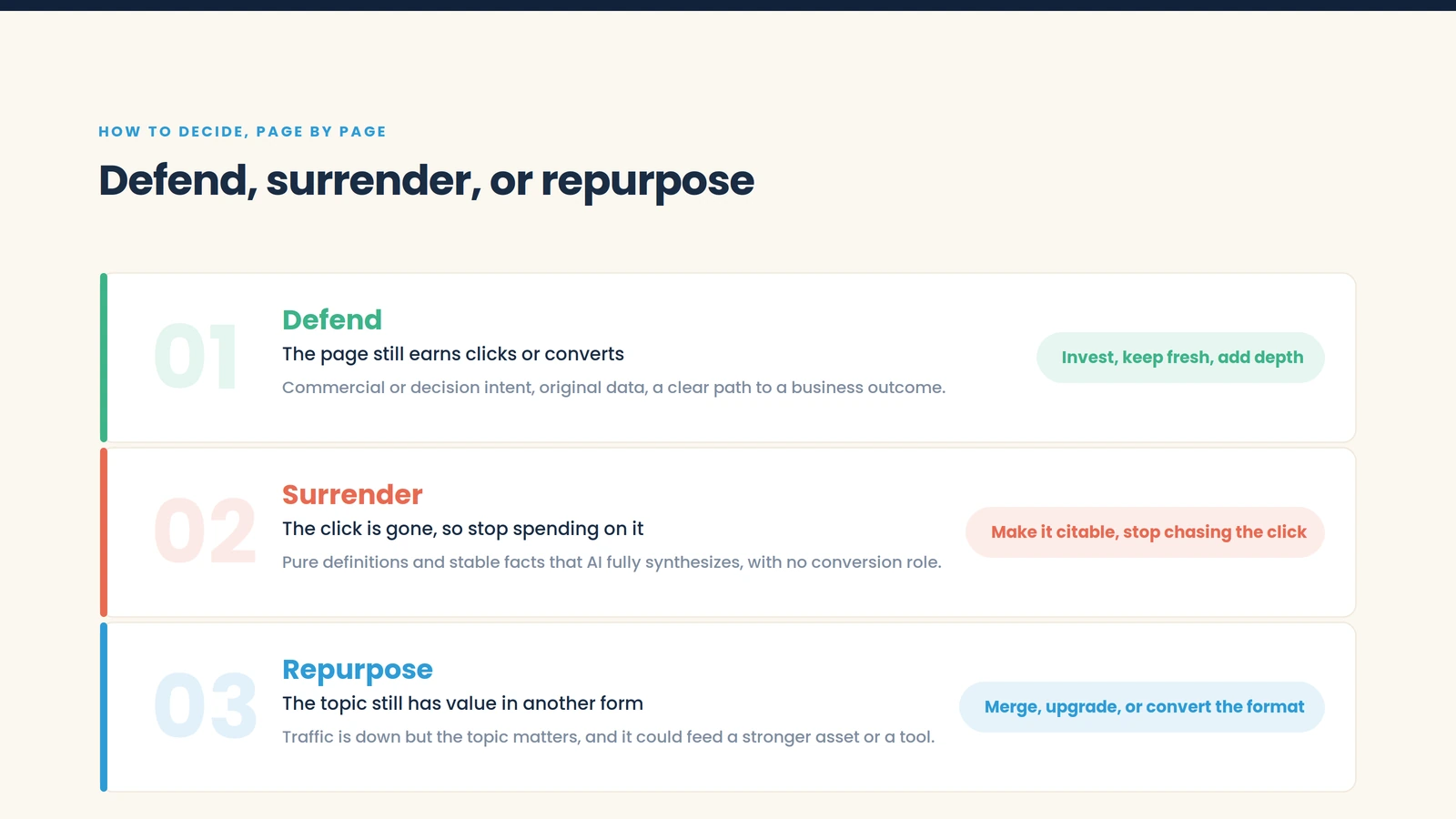
Once you’ve run your content through the vulnerability matrix, every page that lands in the exposed zone needs a decision. There are three options, and the right one depends on what the page contains, what it’s supposed to do for the business, and the sources you have to work with.
| Question | If Yes | If No |
|---|---|---|
| Can AI completely answer this query? | Optimize for citations | Defend or repurpose |
| Does the user need to make a decision after getting the answer? | Optimize for clicks | Evaluate whether citation or awareness is the better objective |
| Is there commercial intent? | Optimize for conversion | Optimize for awareness |
| None of the above apply? | Surrender, restructure for citation quality |
One thing to factor in before making that decision: original information has a half-life. A page that introduced an original idea moves through a predictable sequence, referenced, summarized, copied, expected, and invisible. At each stage, the idea becomes more widely known and less likely to be attributed to its source. The page might still rank first. Its citation value has declined because AI can now synthesize the idea from dozens of sources rather than needing to reference the original.
The more successfully an idea spreads, the harder it becomes for the originator to earn credit for it. Success turns original information into consensus, and consensus reduces the need for attribution. The citation window closes. Originality is a moving target rather than a permanent asset, every observation eventually becomes context for someone else’s observation.
Defending a page is, therefore, a time-sensitive decision, the window to add proprietary depth narrows as the original insight becomes common knowledge.
Defend
Principle: Add what AI cannot reconstruct.
Defend a page when you have something to add that AI cannot synthesize from existing sources, original data, first-hand experience, a proprietary methodology, or a specific use case analysis that requires judgment the AI doesn’t have access to. The mechanism: One likely reason original research performs well is that AI systems often benefit from citing information that is distinctive, attributable, or difficult to find elsewhere. A page that passes that test is more likely to get cited. A page that fails it gets synthesized without attribution.
What defending actually looks like: adding primary research to a page that previously summarized others’ research. Embedding original quotes from real practitioners. Restructuring around a specific scenario rather than a general answer. Publishing a dataset that came from your own work.
The test: if an AI system could write a version of this page tomorrow by combining your page with three competitor pages, you cannot successfully defend it. The content has to contain something that doesn’t exist elsewhere or something meaningfully differentiated, whether original evidence, unique experience, or expert analysis.
Defending is high effort. Citation behavior often changes gradually rather than immediately. During that period, monitor impressions, rankings, and AI citation visibility alongside clicks.
This approach fails when:
The query is transactional, and the user needs a price, booking, or purchase, original depth may not serve that intent
The topic has legal or regulatory dimensions where the user needs to verify with a primary source regardless of content quality
The content type is a tool or calculator, the user needs to compute something, not read an explanation of how the computation works
The idea the page is built around has already diffused into consensus, reducing the advantage of being its original publisher
Surrender
Surrender a page when the query is purely informational, the answer is stable and commoditized, and the business goal for the page was always awareness rather than conversion. The mechanism: a page optimized for citation quality, direct answer first, clear structure, quotable statistics, may be easier for AI systems to interpret and cite. The page may earn brand exposure without earning a click, which is still valuable if brand exposure is an important goal.
What surrendering actually looks like: restructuring for citation quality rather than click-through. Stop trying to recover clicks that aren’t coming back and start treating the page as brand visibility infrastructure.
Consider a page that earns zero clicks but appears in AI Overviews for 8,000 monthly queries is doing brand visibility work. Measure it as brand work, track impression volume, monitor whether branded searches increase in parallel, and report it in the context of awareness rather than traffic.
Restructuring for citation quality is often less resource-intensive than rebuilding a page from scratch, although timelines vary by site and workflow.
This approach fails when:
The page has commercial intent that hasn’t been fully developed, surrendering a page that could be repurposed wastes the authority signals it already has
The topic is so niche that AI Overviews don’t trigger for it, in which case traditional click optimization still applies
Brand awareness isn’t a meaningful goal for the business at this stage, early-stage companies often need clicks and conversions, not impressions
Repurpose
Principle: Shift from answering to deciding.
Repurpose a page when the informational angle is gone, but the commercial angle still has legs. The mechanism: AI can synthesize answers to general questions. It often cannot fully substitute for content that helps a specific user make a specific decision, because many decisions require context that varies by situation, and that context requires a click to explore.
What repurposing looks like: restructuring from “here’s how X works” to “here’s how to choose between X and Y given your specific situation.” The first version is synthesizable. The second more likely requires a click because the user’s decision depends on context the AI summary can’t fully account for.
Repurposing typically requires a moderate level of effort, with timelines varying based on the scope of restructuring and editorial workflow. Prioritize pages where the topic has genuine commercial relevance and where existing content already has authority signals worth preserving.
This approach fails when:
The commercial angle doesn’t genuinely exist, forcing a commercial frame onto purely informational content produces pages that serve neither goal
The page’s existing authority is closely tied to its informational focus, and major changes may alter the relevance signals it has accumulated.
Resource allocation for small teams
Surrender first, lowest effort, and it immediately stops the reporting problem of pages that look like they’re failing when they’re being cited. Repurpose second, starting with pages closest to commercial intent. Defend only when you have genuine proprietary depth to add and enough time to add it properly.
The “only big brands win” assumption doesn’t hold up against the citation data. If around 30% of AI Overview citations come from outside page one, citation selection is influenced by more than traditional ranking position or domain authority alone. A specific page with original data on a narrow topic gets cited over a large site’s generic overview of the same topic. Specificity is the equalizer.
Before deciding which path a page takes, two questions cut through most of the ambiguity: What would have to be true for a user to click this page after reading an AI summary of it? And is there anything on this page that couldn’t exist if you hadn’t produced it yourself?
What Actually Earns AI Citations
AI commoditizes explanation but increases the value of discovery. Explanations describe what is already known. Discoveries produce what wasn’t known before. AI can synthesize explanations indefinitely from existing sources. It cannot independently produce discoveries, it can cite them. That’s why originality matters, not just that it matters.
The cheap vs. expensive information distinction follows directly. AI can easily synthesize cheap information: definitions, summaries, lists, explanations of commonly documented processes. Expensive information is the result of an experiment, a dataset, an interview, a failure, or an observation. The defining characteristic isn’t effort, it’s irreproducibility. AI can spend infinite compute and still cannot recreate an interview that happened, a dataset that was collected, or a conclusion drawn from internal data that was never published elsewhere. That’s the content that becomes citable because there is no other way to access it.
| Content type | Citation potential | Effort | Durability |
|---|---|---|---|
| Original research / dataset | Highest | Highest | Long, until independently replicated |
| First-hand experience / case study | High | Medium | Long, irreproducible by definition |
| Original framework or methodology | Medium | Medium | Medium, decays as it spreads into consensus |
| Better explanation of existing ideas | Low | Low | Short, synthesizable immediately |
| Summary of consensus | Negligible | Lowest | None, AI already has this |
The competitive bottleneck in content strategy is shifting from production capacity to observation capacity, the ability to generate genuinely new data points from interviews, experiments, internal datasets, and first-hand experience. Organizations that produce observations faster than consensus forms will continuously create information AI cannot replace.
This is also where expertise itself is changing. Expertise used to mean knowing answers. Knowing answers is less scarce now, AI has most of them. Expertise increasingly means producing observations. The practitioners who accumulate citation authority over the next three years are not the ones who explain things most clearly. They’re the ones who have done things, observed things, and documented those observations specifically enough that AI systems have to reference them.
Citation eligibility vs. citation selection
There’s a distinction that explains one of the most common practitioner frustrations, “I added schema, and nothing changed.”
Citation eligibility is whether your page is technically accessible and parseable. Crawlability, indexing, and clear page structure help ensure your content can be discovered and interpreted. Schema markup can provide additional context where supported. Schema tells Google what type of content your page contains. It doesn’t tell Google your content is worth citing. Most pages with proper technical SEO are already eligible. Eligibility is the entry requirement, not the differentiator.
Citation selection is what Google evaluates once your page is in the candidate pool. Schema is necessary but not sufficient, treating eligibility and selection as the same decision is why adding schema produces no visible change in citation behavior. Four things correlate with selection based on available research and observable patterns:
Principle: Make extraction easier than interpretation. Pages compete for rankings. Claims compete for memory. AI cites pages by referencing the specific claims or passages it extracts from them. Passage-level clarity is increasingly important alongside page-level optimization. The mechanism: AI systems often retrieve concise, self-contained passages that can be incorporated into generated answers. A paragraph that builds toward a conclusion over five sentences requires interpretation. A sentence that states the conclusion first enables extraction. Every sentence in a section you want cited should be able to stand alone as a complete, accurate claim.
Answer at the heading level, not the paragraph level. If the answer to the question implied by your H2 doesn’t appear in the first one to two sentences under that heading, the section is harder to parse for citation. The mechanism: AI systems extract from a clear structure. They parse heading-to-content relationships. A section where the heading promises an answer, and the opening sentences deliver it, is structured for extraction. A section where the answer emerges after three paragraphs of context requires the model to interpret rather than extract.
First-hand experience signals. Content that demonstrates the author did something, ran a test, analyzed a dataset, worked through a specific problem, rather than researched what others say. This is valuable information, meaning AI cannot generate it by aggregating existing sources.
Topical consistency across the site. AI systems appear to weight sites that cover a topic area with depth and consistency over sites with one strong page surrounded by unrelated content. The mechanism: a site covering a topic comprehensively across multiple related pages may provide stronger signals of topical expertise. One page on SEO measurement surrounded by unrelated content is a weaker citation source than ten consistent pages on SEO measurement.
When many credible sources publish similar information, AI systems may rely on a broader set of sources rather than any single originator. When a hundred sources repeat it, AI may synthesize the consensus while citing one or more representative sources. The practical implication: publishing an original idea and stopping is a losing strategy. The citation window closes. Originality is a moving target rather than a permanent asset, every observation eventually becomes context for someone else’s observation. The value of original research isn’t in producing it once, it’s in continuously replacing yesterday’s observations before they become tomorrow’s consensus.
The query triggers an AI Overview that cites no external sources, Google occasionally generates answers entirely from its knowledge graph, and citation optimization doesn’t change that
The topic is so niche that AI systems have insufficient training data to generate a confident answer and defer entirely to search results, in which case traditional ranking matters more
The page’s most citable claim is also its most contested, AI systems may present multiple perspectives or rely on highly authoritative sources when claims are contested.
Before publishing any content intended to earn citations, ask:
Could AI produce this without me, and if so, what specifically couldn’t it replicate?
What observation does this piece require that isn’t already in the training data?
Is this claim extractable as a standalone sentence, or does it only make sense in context?
What to Track When Clicks Aren’t the Point
Principle: Measure what creates value, not just what is visible.
We optimized for visits because visits were visible. AI changed what is visible, not necessarily what creates value. A user sees your brand cited in an AI Overview, doesn’t click, searches for you directly three days later, and converts. Every step of that sequence worked. The attribution model captured none of it. These are the invisible winners , organic contributing to revenue while the session report says otherwise.
The replacement isn’t a single metric. It’s a tiered stack organized by accessibility.
Tier 1: Primarily using Google Search Console, with optional support from Google Trends or similar tools
Organic impressions. When a page appears in an AI Overview or a featured snippet, it generates an impression even without a click. Rising impressions against flat or declining clicks can be the signature of a page being cited and surfaced. Measure it as reach.
Branded search volume. The mechanism is the same delayed demand chain from the opening section. Zero-click exposure creates memory. That memory surfaces as a branded search when purchase intent arrives. Branded search growth is often one of the first measurable signals that citation awareness is converting to direct intent. For example, A 15% increase in branded queries in a quarter where organic sessions declined is a meaningful signal that visibility is working even when the click didn’t happen at the point of exposure.
CTR segmented by page type. Average CTR across a site is a blended number that obscures what’s happening. Segment by commercial versus informational pages. Commercial page CTR often holds relatively stable, those queries don’t trigger AI Overviews at the same rate because user intent requires a destination, not a synthesis. Informational page CTR declining while impressions increase is a common pattern for pages affected by zero-click SERP features. If commercial page CTR is also declining, that’s a different problem requiring a different diagnosis.
Tier 2: Analytics configuration required (using GA4 and related free Google tools)
Assisted conversions. A session that didn’t convert but appeared in the path of a session that did. Configure assisted conversion tracking in GA4 and build a baseline before drawing conclusions.
Direct traffic as a lagging indicator. When brand visibility increases through citations, direct traffic often increases in parallel as users who encountered the brand in AI answers return directly. A sustained increase in direct traffic against a backdrop of declining organic sessions is worth monitoring as a supporting indicator.
Revenue influenced rather than revenue attributed. Last-click attribution undercounts content that creates awareness without generating the converting session. A basic multi-touch model generally gives a more accurate picture of how organic content is contributing to revenue.
Tier 3: Paid tools, appropriate for agencies and larger teams
Share of voice across AI platforms. How frequently your brand appears in AI-generated answers for target queries, benchmarked against competitors.
AI citation tracking. Which pages are being cited in AI Overviews for which queries, where the defend, surrender, and repurpose decisions show up in the data over time.
The trade-off in measurement
| Metric | Accuracy | Accessibility | Executive legibility |
|---|---|---|---|
| Organic sessions | Low, undercounts zero-click contribution | Immediate | High, everyone understands it |
| Organic impressions | Medium, measures exposure, not impact | Immediate | Medium, needs context |
| Branded search growth | Medium, proxy for awareness | Immediate | Medium, requires explanation |
| Assisted conversions | Higher accuracy for multi-touch journeys | Requires configuration | Low, needs framing |
| Revenue influenced | Potentially the most complete business metric when measured well, but dependent on attribution methodology | Requires configuration | Low, hardest to defend |
| AI share of voice | High for AI visibility specifically | Requires paid tools | Low, unfamiliar to most executives |
The trade-off between measurement accuracy and accessibility is real. Sessions are easy to explain but increasingly incomplete for understanding AI-influenced customer journeys. Assisted conversions generally provide a more complete view of the customer journey, although they are harder to explain to non-specialists. The right approach isn’t to replace sessions entirely, it’s to add the Tier 1 metrics immediately, use them to build the new narrative, and introduce the Tier 2 metrics once the client or executive has accepted that sessions are an incomplete picture.
This approach fails when:
The business has a very short sales cycle where assisted conversion attribution doesn’t capture meaningful data, a same-session purchase journey makes multi-touch modeling largely limited
The client requires auditable last-click revenue attribution for budget justification, the visibility metrics are real, but they don’t satisfy that specific accountability requirement
The site is too small for branded search volume to be statistically meaningful, a site with 200 branded searches a month can’t use a 15% change as a reliable signal
Reading Search Console correctly
The impressions-up / clicks-down pattern has a healthy version and a problematic version, and they look identical in aggregate.
Healthy: impressions increasing on informational pages optimized for citation, CTR declining on those pages, CTR holding or improving on commercial pages, branded search growing in parallel.
Problematic: impressions increasing on commercial pages where clicks should be happening, CTR declining on those pages, and no corresponding growth in branded search or direct traffic.
In our work, we’ve seen this pattern create diagnostic problems. One tech client was sitting at over 450,000 monthly impressions with a CTR of 0.1%, and the initial read was that zero-click search was responsible. Zero-click was part of the picture. But a 0.1% CTR at that impression volume points to something beyond AI Overviews, pages surfacing for queries they weren’t built to serve, title tags misaligned with what the searcher actually wanted, or featured snippets capturing the click before the organic result even registered. Zero-click can lower CTR. It doesn’t lower it to 0.1% on its own. The risk of attributing everything to zero-click behavior is that it closes the diagnosis before the full picture emerges.
Segment before concluding anything from aggregate numbers.
Before reporting, ask:
What is the gap between what the dashboard is showing and what is happening in the business?
Am I reporting what’s visible or what’s valuable, and do I know the difference for each metric I’m presenting?
How to Report This to Leadership and Stakeholders
The measurement stack is only useful if you can explain it to someone who has been watching sessions decline for six months and wants to know whether the SEO investment is still working.
For in-house practitioners and business owners, the reporting problem is personal in a way that external consulting relationships aren’t. When leadership interprets declining organic sessions as declining SEO performance, the consequences aren’t a lost contract, they’re a reduced budget, a smaller team, or a credibility problem that follows you into the next planning cycle. Getting the framing right before the traffic drops is significantly easier than correcting it after.
The goal isn’t to spin the numbers. It’s to give decision-makers an accurate picture of what organic search is contributing, which requires different metrics than the ones most dashboards were built around.
The before/after report reframe
Old performance update: “Organic sessions declined 18% month-over-month. Rankings remain stable across tracked keywords.”
That slide invites one question from leadership: why are we still investing in this?
New performance update: “Organic impressions increased 24% month-over-month, meaning your content appeared in search results, including AI-generated answers, significantly more often than the previous period. Clicks on informational content declined as expected, consistent with AI Overview behavior for this content category. Click-through rates on commercial and product pages held at 4.2%, in line with the previous three months. Branded search volume increased 11%, suggesting that zero-click exposure is generating direct brand recall. Assisted conversions attributed to organic touch points increased 9%.”
That update tells the same story, organic sessions declined, but it shows what is happening, connects visibility to commercial outcomes, and makes the declining clicks a feature of the right strategy rather than evidence of failure.
Common Pushback and How to Navigate It
These three objections come up in nearly every internal review where organic traffic has declined. In our experience, they’re not unreasonable, they come from stakeholders using the metrics they’ve always used to evaluate a channel that has changed underneath them. The responses below aren’t scripts. They’re the reasoning that tends to move the conversation forward when the numbers alone don’t.
“Why is organic traffic down?”
This question usually comes from someone looking at a session’s graph and drawing the logical conclusion. The answer isn’t defensive, it’s mechanical. Search results now show answers directly on the page for informational queries. Users get what they need without clicking through. If rankings remain stable, the content may still be serving as a source even though fewer users click through. The more useful follow-up is to show what held: commercial page CTR, branded search growth, and assisted conversions tell a different story than sessions alone, and putting those numbers alongside the sessions’ decline reframes the conversation from failure to expected behavior.
“I don’t care about impressions; I care about pipeline.”
This is the right instinct from a business owner or CMO, and the response should meet it there rather than defend impressions as a metric. Impressions aren’t the endpoint, they’re a leading indicator of visibility that may contribute to future demand that shows up later in branded searches, direct visits, and assisted conversions. The move is to show the connection between the visibility data and the pipeline data in the same update, rather than presenting them separately. When a stakeholder can see that organic touch points appeared in 9% more assisted conversions this quarter while sessions declined, the impression metric stops being abstract.
“Can we get the traffic back?”
On commercial and transactional pages, yes, and that’s where the focus belongs, as commercial and transactional pages generally offer greater opportunity to recover or grow traffic. Informational traffic may remain lower while AI Overviews continue satisfying many informational queries directly. Framing this as a structural shift in today’s search environment rather than a solvable problem builds more credibility than promising a full return to historical traffic levels that may not be realistic. The more productive question to redirect toward is whether the content that’s earning citations is driving awareness that feeds into the commercial traffic that connects to pipeline and revenue.
When the conversation doesn’t land
Some stakeholders won’t accept this reframe regardless of how clearly it’s presented. If success metrics were locked into an OKR cycle before AI Overviews existed, or if leadership inherited a traffic-first definition of SEO performance from a previous team, the measurement conversation runs into a structural problem rather than a communication one.
In those situations, the most useful move is getting the new metrics added to the reporting template before the next planning cycle, not replacing the old ones, but sitting alongside them. A quarter of parallel reporting builds enough context that the reframe becomes self-evident rather than argumentative.
This approach fails when:
Success metrics are fixed in an OKR or board reporting template that can’t be updated mid-cycle, the reframing conversation has no leverage until the next planning period
Leadership has already decided to reallocate budget, accurate reporting doesn’t reverse a decision made for organizational rather than analytical reasons
The business doesn’t yet have enough alternative metric data to show meaningfully, presenting a new reporting approach without numbers to support it reads as deflection rather than strategy
The Channel Diversification Decision
The advice to not rely entirely on Google is correct. What’s missing is the specific trade-off analysis that makes it actionable.
| Channel | Audience ownership | Acquisition strength | Best fit |
|---|---|---|---|
| Email / newsletter | Highest | Retention, repeat purchase | Existing audience base |
| YouTube | Medium | Discovery, complex topics | Visual or demonstration content |
| Low, platform dependent | B2B thought leadership | Individual authority building | |
| Reddit / community | Low, community dependent | Niche trust | Technical or enthusiast niches |
| Partnerships / referrals | High | Highest conversion rate | Relationship-driven businesses |
Email and newsletters. Audience ownership is the highest of any channel, your list is yours regardless of algorithm changes. Slow to build: can take months to generate consistent qualified traffic. Strong for retention and repeat purchase. Weak for new customer acquisition at scale without a distribution partnership.
YouTube. High discovery potential with its own search algorithm. High-quality production cost is also high, a well-produced video often takes significantly more resources than a well-researched article. Growth often requires sustained long-term consistency. Strong for complex, visual, or demonstration-heavy topics.
LinkedIn. Fast feedback loop, publish today, often receive meaningful engagement signals within the first few days. Strong for B2B and thought leadership. The audience is on LinkedIn’s platform, not yours. Works best for individual authority building that drives people to an owned channel like email.
Reddit and community platforms. Trust is high when done correctly. Credibility takes sustained, genuine participation over time to earn, and perceived promotional intent in communities that value authenticity is damaging in ways that are hard to reverse. Strong for specific technical or enthusiast niches.
Partnerships and referrals. Often a very high conversion rate of any channel because trust transfer is already in place. Less scalable in the traditional sense, each relationship requires maintenance. Often underweighted because it doesn’t fit neatly into content calendars or channel reporting.
How to choose
The most common diversification mistake is spreading effort across multiple channels before fixing the measurement problem. A team that can’t report what their SEO is doing will also struggle to report what their YouTube channel is doing.
The right sequence: get the measurement right first, then identify which one alternative channel matches your audience, your content strengths, and your team’s actual capacity. One channel done well outperforms five channels done adequately.
Three questions to choose:
Where does your audience already spend time outside of Google?
What content format does your team produce well without significant additional resources?
What time horizon is acceptable before expecting meaningful results?
This approach fails when:
The team is already under-resourced for their primary channel, adding a second channel before the first is working makes the resource problem worse
The audience doesn’t exist on the alternative channel in meaningful numbers, effort without an audience produces effort without return
The time horizon for results doesn’t match what the business actually needs, a startup needing revenue in six months may find it difficult to build an email list or YouTube channel fast enough to replace declining organic traffic
Common Mistakes and the Mental Models Behind Them
Every mistake here is the logical output of a mental model that made sense in an earlier version of search, the model changed, but the habit didn’t follow. Understanding what caused each mistake is what makes it avoidable.
Optimizing every page for zero-click. The assumption: zero-click is a uniform threat, so the response should be uniform. Zero-click affects specific query types on specific pages. A commercial intent page optimized for citation rather than conversion is often less effective than one optimized for clicks, you’re structuring content for an outcome that doesn’t serve the page’s purpose. The vulnerability matrix exists to make this decision specific rather than blanket.
Measuring only traffic. The assumption: more sessions equals better SEO performance. This assumption held when successful rankings were much more likely to produce a visit. When citations generate impressions without clicks, sessions capture only the portion of search visibility that resulted in a visit. The deeper issue: we optimized for visits because visits were visible. The fix is adding Tier 1 metrics to every report before the traffic decline conversation happens.
Expecting schema alone to earn citations. The assumption: schema signals expertise to Google; therefore, schema improves citation chances. The confusion is between citation eligibility and citation selection. Schema affects eligibility, it helps Google understand what type of content your page contains. Selection is determined by content characteristics: original data, structural clarity, firsthand experience, and topical consistency. Schema is necessary but not sufficient, treating them as the same decision is why adding schema produces no visible change in citation behavior.
Publishing generic AI-generated content to fill informational gaps. The assumption: more content coverage equals more citation opportunities. The problem runs deeper. Every generic article published, cited, summarized, and aggregated across the web becomes part of the consensus pool that AI draws on to answer questions without citing anyone. The chain: generic article → AI summary → fewer clicks → fewer original observations → less new knowledge → even better AI summaries. Publishing cheap information accelerates exactly the dynamic that makes cheap information unsourceable. Zero-click may reduce the incentive to create the very information AI depends on.
Ignoring branded search as a leading indicator. The assumption: branded search is a direct traffic metric, not an SEO metric. In a zero-click environment, branded search growth can be an early signal that increased visibility is translating into brand awareness. One possible mechanism is the delayed demand chain, users who see your brand cited and don’t click sometimes search for you directly later. If branded search volume isn’t in your organic reporting, you’re missing the clearest leading indicator that the strategy is working before the conversion data catches up.
Conclusion
Zero-click search has changed what a successful organic presence looks like, but the challenge is more specific than most discussions make it. The teams struggling most aren’t losing because their content is bad or their strategy is wrong. They’re often struggling because traditional reporting emphasizes clicks and sessions, while modern search increasingly creates value without requiring every impression to become a visit.
What’s changed most is the relationship between visibility and visits, while high-quality content continues to support business outcomes in new ways. Original research still earns citations, commercial intent still drives clicks, and brand visibility still creates demand, it just takes longer to show up in the data than it used to, and it arrives through channels that last-click attribution wasn’t designed to capture. The teams that build measurement and content habits around that reality now will be better positioned regardless of how AI features evolve, the underlying skill is making deliberate decisions about what to produce and what to measure, and that skill transfers across whatever changes next.
The most useful first step isn’t rebuilding your content strategy. Take your top 20 pages by impressions, run them through the ten questions in the vulnerability matrix, and categorize each one as defend, surrender, or repurpose. That exercise takes two hours and produces a clear picture of where the exposure is, which, for most sites, turns out to be a smaller and more manageable problem than the aggregate traffic numbers suggest.
If the audit surfaces more pages to defend or optimize for citation than your team can handle alone, our generative engine optimization service is built around exactly that work.
For a deeper look at how generative engine optimization fits into a broader search strategy, this guide covers the discipline from the ground up.
Frequently Asked Questions
What percentage of searches are zero-click?
As of 2024, approximately 58.5% of U.S. searches and 59.7% of EU searches ended without a click, according to SparkToro research. Some studies have reported mobile zero-click rates exceeding 77%, although estimates vary by methodology and time period. These figures continue to shift as AI Overviews expand across more query types.
How do I measure zero-click search performance?
Start with Search Console: organic impressions, branded search volume, and CTR segmented by page type rather than averaged across the site. Add assisted conversions in GA4 and track direct traffic trends as supporting indicators. AI share-of-voice tracking is typically easiest with dedicated paid tools, although limited manual tracking is also possible; the Tier 1 metrics give you enough to report meaningfully without additional cost.
Does schema markup increase AI Overview citations?
Schema markup improves citation eligibility, it helps Google parse and categorize your content correctly. It doesn’t directly determine citation selection. Pages with a clean schema and generic content are unlikely to outperform pages offering genuinely original information. Get the technical foundation right, then focus on the content characteristics that drive selection: extractable specificity, structural clarity, first-hand experience signals, and topical consistency.
Can small websites compete in a zero-click search market?
Yes, and the citation data supports this specifically. Nearly 30% of AI Overview citations in a 2025 academic study came from pages outside the top organic results, meaning domain authority alone doesn’t determine citation. A small site with original primary research on a specific topic can be cited over a large site’s generic overview of the same topic. The path for smaller sites is depth and specificity on a narrow topic area, not broad coverage competing against established domains.
What content is most vulnerable to zero-click search?
Definitions, basic how-to guides covering stable general processes, and glossary content built around common industry terms. These are the query types Google can often synthesize from widely available information and sources. Content with original data, first-hand experience, commercial intent, or local specificity is significantly less vulnerable.
Is zero-click search permanent, or will clicks recover?
The shift appears structural rather than temporary, particularly for informational queries that AI can answer directly. Clicks on commercial, transactional, and navigational content have generally been less affected than informational searches and are unlikely to decline in the same way. Some recovery of informational clicks is possible for content that earns its citation by providing something AI can’t fully synthesize, but recovery in that context means citation appearances and brand visibility rather than necessarily returning to historical pre-AI traffic levels.
How do I explain declining organic traffic to clients?
Separate what declined from what didn’t. Informational page clicks declining while impressions increase is a common pattern for content affected by AI Overviews and other zero-click SERP features. Commercial page performance and branded search trends are more meaningful signals of whether the organic presence is contributing to business outcomes. Show both in every report, and frame the informational click decline as a content category characteristic rather than a performance failure.
Which content types are least vulnerable to zero-click search?
Original research and data pages, first-hand experience and case study content, commercial and transactional pages, comparison content built on original testing, and local or navigational content. These either benefit from a click to deliver their full value, contain information that is difficult to reproduce independently, or satisfy search intent that summaries alone often cannot.