
Key Takeaways
- GEO extends traditional SEO by optimizing content for AI-powered search engines and assistants, not just search rankings.
- SEO and GEO work together to maximize both search engine visibility and AI-generated citations.
- High-quality, well-structured content has a better chance of being understood and referenced by AI models.
- Authority and trust signals such as expertise, schema markup, and consistent branding improve AI visibility.
- Tracking AI citations is becoming an important metric alongside traditional SEO performance.
- Early adoption of GEO can help businesses gain a competitive advantage as AI-driven search continues to grow.
TL;DR
Generative Engine Optimization (GEO) is the practice of structuring your content and digital presence so that AI-powered search systems retrieve, cite, and recommend your brand in their synthesized answers. Where traditional SEO focuses on earning visibility and clicks from search results, GEO focuses on becoming one of the sources an AI is most likely to reference — through entity authority, factual richness, and content that machines can extract with confidence.
What Is Generative Engine Optimization, Exactly?
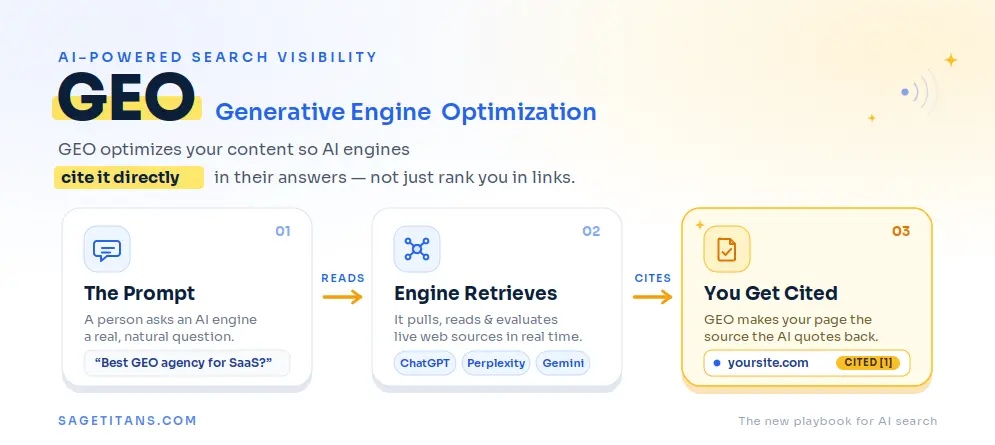
Generative Engine Optimization (GEO) is the practice of increasing visibility within AI-generated search responses. GEO focuses on retrieval, citation likelihood, passage-level extraction, and entity authority rather than webpage rankings alone.
Traditional search uses an index-and-retrieve model: a user queries the engine, receives a ranked list of results, and does the reading and comparison themselves. Generative engines retrieve and synthesize information from relevant sources, then return a consolidated answer, often with citations to supporting sources.
Ranking a URL is no longer the sole endpoint. GEO aims to make a source eligible for retrieval, citation, and inclusion within AI-generated answers.
Generative engines commonly perform three operations on a query:
- Retrieving — The engine searches indexes, vector databases, and other retrieval systems to assemble relevant documents or passages.
- Synthesizing — The LLM analyzes the retrieved information and combines the most relevant facts into a coherent answer.
- Attributing — The engine may provide citations or source links that indicate which sources contributed to the generated response.
A product comparison on Google AI Mode illustrates how this works. The engine may pull pricing from one source, technical specifications from another, and expert analysis from a third — then generate a single comparison citing multiple sources. No single source supplies the entire answer. Instead, different sources contribute information that supports different parts of the generated response.
Visibility increasingly depends on passage-level extraction. Models need clean, verifiable information they can isolate, interpret, and cite — not just pages optimized for human reading.
Where the Term “GEO” Came From
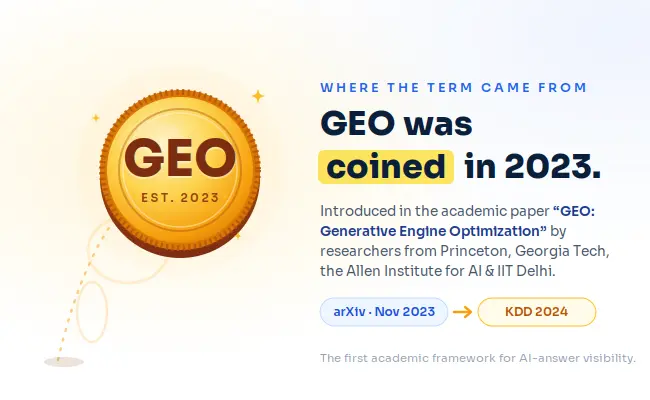
The term “Generative Engine Optimization” was coined in a November 2023 preprint by researchers from Princeton University, IIT Delhi, Georgia Tech, and the Allen Institute for AI, and later presented at KDD 2024. The study evaluated nine content-modification strategies across 10,000 queries and found that citations, statistics, and expert quotations improved source visibility more effectively than keyword-focused optimization.
GEO-Bench covered multiple query categories, including historical facts, product comparisons, and medical advice. The benchmark measured not just whether a source appeared in a generated answer but how prominently it appeared, using a visibility metric that accounted for the frequency and prominence of source references within the response.
The nine methods tested were:
- Statistics Addition — replacing vague assertions with precise numerical data
- Cite Sources — inserting references to reputable and verifiable sources
- Quotation Addition — integrating attributed quotations from recognized experts
- Authoritative Style — presenting information in a confident, expert, and authoritative tone
- Fluency Optimization — improving readability, flow, and grammatical correctness
- Easy-to-Understand — simplifying vocabulary and sentence structure
- Technical Terms — incorporating relevant domain-specific terminology
- Unique Words — introducing distinctive, low-frequency vocabulary
- Keyword Stuffing — increasing the density of query-related keywords
Three methods consistently ranked among the strongest performers: citations, statistics, and expert quotations. Generative engines appear to favor claims supported by evidence and attribution, not just claims that can be restated.
The findings challenged the assumption that keyword-heavy optimization drives visibility. In the benchmark, citations, statistics, and expert quotations consistently outperformed keyword stuffing — suggesting generative engines favor attributable, information-rich content over keyword density alone.
The study relied on a static, single-source evaluation environment and GPT-3.5-level metrics, which did not model how sources compete for limited citation slots in modern RAG systems. The reported gains should not be treated as direct forecasts for modern AI search visibility — but the directional finding holds: fact density and source credibility drive citation rates.
The Engines That Matter in 2026
A small number of generative search and AI assistant experiences across a handful of companies account for a large share of AI-driven discovery and research activity in 2026. For most brands, the key questions are scale, retrieval model, citation behavior, and visibility pathway. The profiles below focus on those differences rather than common AI capabilities.
These systems compete on different strengths. ChatGPT and AI Mode emphasize conversational search and research experiences; AI Overviews benefits from Google’s search distribution; Gemini and Copilot benefit from integration across their respective ecosystems, while Perplexity is known for prominent source citations and Claude for structured reasoning. Across platforms, visibility generally depends on content accessibility, retrieval eligibility, source authority, and relevance to the user’s query.
| Platform | Scale | Best For | Retrieval Model | Citation Behavior | Visibility Pathway |
| ChatGPT / ChatGPT Search | 900M+ weekly active users; 50M+ subscribers (OpenAI, 2026) | Largest standalone audience; conversational research | Web search via Bing infrastructure; Deep Research for multi-source investigations | Inline citations and source links; users can open cited pages directly | No publisher console; visibility depends on content being accessible and relevant to retrieval systems |
| Google AI Overviews | 2.5B+ monthly users (Google I/O 2026) | Largest reach; quick answers and topic exploration | Built on Google Search ranking and quality systems | Links to web sources included, designed to help users discover relevant websites | Crawlable, indexable content eligible for Search features; inclusion in Search does not guarantee appearance |
| Google AI Mode | 1B+ monthly users (Google, May 2026) | Complex conversational search; multi-step research | Query fan-out — one question triggers multiple searches across subtopics | Links and supporting web references included | Same indexing and crawling systems as Google Search; may decline to generate a response when confidence is low |
| Gemini | 900M+ monthly active users; enterprise adoption in millions of seats (Google I/O 2026) | Google ecosystem workflows; Workspace-integrated research | Search-grounded retrieval plus direct access to Gmail, Drive, Calendar, and Chat when permissions allow | Citation behavior varies across product surfaces; not all Gemini experiences expose the same attribution | Public websites appear through Search-grounded retrieval; Workspace visibility depends on connected content and permissions |
| Perplexity | 100M+ monthly active users (company executives, via press reporting) | Citation-first research; source verification | Web sources plus connected organizational data in enterprise environments | Citations visible throughout most answers — more prominently than most competing platforms | Depends on whether content exists within the sources that Perplexity retrieves from |
| Claude | ~18-30M users as of 2026 (third-party estimates; no official Anthropic disclosure) | Source transparency; document-grounded analysis | Web search, URL fetching, multi-source analysis, multi-step research workflows | Citations, source links, and document-grounded references; emphasis on traceability to original sources | Depends on Anthropic crawler access; site owners can manage permissions through documented controls |
| Microsoft Copilot | 150M+ monthly active users (first-party); 20M+ paid Microsoft 365 seats; ~900M monthly across Microsoft products (Microsoft, 2026) | Microsoft enterprise workflows; combining web and organizational knowledge | Bing-powered web retrieval combined with organizational content that users have permission to access | Citation behavior differs across Copilot surfaces; not consistent across every experience | Public websites need Bing discoverability; organizational visibility depends on connected Microsoft 365 knowledge sources |
How Generative Engines Choose Sources
From billions of pages to a cited few
Every prompt kicks off a brutal filter. Each layer drops more pages — only the survivors get quoted in the answer.
Counts are illustrative — the point is the shape. GEO is the work of clearing every layer so your page is one of the few that gets cited.
Generative search engines typically use retrieval-augmented generation (RAG): they retrieve candidate documents from web indexes or connected sources, evaluate relevance and source quality, and synthesize evidence into a response. Citations connect specific claims to supporting sources.
Most search-connected generative answers start with retrieval — the pool of sources assembled using a mix of keyword-based search, which finds exact matches, and semantic retrieval, which finds content based on meaning rather than wording alone.
That means a page can be relevant to a query even if it doesn’t use the same terms. Different platforms use different retrieval infrastructure. ChatGPT Search has historically relied in part on Microsoft’s Bing search infrastructure, while Google AI Overviews draw from Google’s own search index.
Once retrieved, sources are evaluated. Systems evaluate relevance, source credibility, freshness, and cross-source consistency. When multiple independent sources report the same information, that agreement may raise confidence. Low-quality, inconsistent, or unsafe sources may get filtered before synthesis begins. The exact criteria are largely proprietary — no major platform has disclosed how it scores and selects sources.
Synthesis is where the answer gets built. The model combines evidence from selected sources, attempts to reconcile conflicting information, and generates a response. Citations are then attached to ground specific claims in the final output.
Content that can’t be retrieved can’t be cited. Pages that clearly answer a question, support claims with evidence, and organize information for easy extraction are more likely to appear in generated answers.
SEO vs. GEO
| Optimization Dimension | Traditional SEO | Generative Engine Optimization (GEO) |
| Primary Objective | Optimize for rank position in search results pages to drive organic visibility and traffic | Maximize visibility, citation, and recommendation likelihood within AI-generated responses, while maintaining discoverability across traditional search |
| Discovery Mechanism | Hybrid retrieval combining lexical matching, semantic retrieval, neural ranking, and knowledge graph systems | Hybrid retrieval combining search indexes, semantic retrieval, embeddings, knowledge graphs, external knowledge sources, and retrieval-augmented generation (where applicable) |
| Target Units | Structured webpages, passages, URL hierarchies, entities, and metadata | Modular passages, semantic entities, discrete factual claims, and structured information that can be retrieved and cited |
| Content Structure | Optimize pages around topics and keywords | Optimize passages for answerability, factual clarity, and self-contained information — structured so AI systems can retrieve, cite, and synthesize it |
| Primary Authority Signals | Links, relevance, expertise, authority, trust signals, and content quality | Content quality, source reputation, entity recognition, trusted mentions, structured evidence, and traditional authority signals |
| User Journey | Click-through to publisher’s domain | Increasingly direct consumption within AI interfaces, with click-through behavior varying by platform and query type |
| Success Metrics | Impressions, Click-Through Rate (CTR), rank position, and organic traffic | Emerging metrics including citation frequency, AI share of voice, brand mention prevalence, citation prominence, and referral traffic from AI platforms |
Note: GEO is an emerging discipline. The GEO column reflects observed patterns, empirical research findings, and optimization principles across modern AI-powered search, retrieval, and answer-generation systems. Because the mechanisms governing retrieval, source selection, citation, and response generation are not fully disclosed by most providers, these practices should not be interpreted as universally documented or provider-confirmed ranking factors.
For a full breakdown of how GEO and SEO differ across objectives, metrics, and tactics, see our GEO vs. SEO guide.
The Core Levers of GEO
Entity presence, entity relationships, fact density, consensus and authority, and extractability are five recurring themes derived from the original Princeton GEO paper, subsequent academic research, and industry analyses. Together, these levers help explain why tactics such as citations, original research, digital PR, schema markup, comparison content, FAQ architecture, and knowledge graph optimization can influence AI retrieval, citation, and visibility. Academic research supports many of these factors directly, while newer studies and industry observations support the broader framework.
Lever 1: Entity Presence and Strength
Entity presence refers to how reliably a brand, product, person, or organization can be identified, distinguished, and retrieved within AI retrieval systems and knowledge representations. It is influenced by recognition strength, disambiguation clarity, topical salience, and cross-source consistency.
Before a model can recommend a company, it has to know the company exists — and have enough cross-source evidence to be confident about who that company is. That’s where many brands run into trouble. They publish content for years, yet references across sources point to inconsistent or ambiguous representations of the same entity.
Core dimensions:
- Entity recognition — whether the system can confidently identify the entity across different queries and contexts
- Entity disambiguation — how clearly the entity is separated from similar names, brands, or concepts
- Entity salience — how frequently and prominently the entity appears within a topic area
- Entity persistence — how consistently the entity appears across sources and platforms over time
In many cases, AI visibility challenges stem from entity ambiguity rather than absence. A brand can hold strong organic rankings while remaining poorly defined as an entity — search can surface relevant pages even with weak entity signals, but AI systems need clearer, more consistent entity definitions to retrieve with confidence.
Supporting tactics:
- Knowledge graph optimization
- Consistent entity naming
- Founder visibility
- Product documentation
- Structured entity references
Recognition alone isn’t enough. A model also needs to understand what an entity is associated with.
Lever 2: Entity Relationships and Associations
Entity relationships are the semantic connections between a brand and the categories, topics, use cases, industries, competitors, and concepts associated with it. These relationships help determine the contexts in which the entity becomes relevant for retrieval.
Once an entity is recognized, retrieval depends heavily on whether the model has learned when that entity is relevant.
Core dimensions:
- Category association — the strength of connection between an entity and its primary category: Salesforce → CRM, Stripe → Payments, Figma → Product Design
- Use-case association — how clearly the entity maps to specific problems or workflows: Notion → Knowledge Management, Zapier → Workflow Automation
- Semantic proximity — how consistently the entity appears alongside important concepts across independent sources
- Competitive positioning — where the entity sits relative to alternatives in AI-generated comparisons
- Relationship strength — how widely and repeatedly a connection is reinforced across independent sources
Companies often invest heavily in awareness campaigns while publishing very little content that reinforces the categories and use cases they want to own. The result is a brand that gets recognized but not retrieved.
Supporting tactics:
- Category pages
- Comparison content
- Use-case content
- Competitor analyses
- Ecosystem integrations
Strong associations require corroboration from credible, independent sources.
Lever 3: Fact Density and Information Gain
Fact density measures the quantity, quality, uniqueness, and usefulness of extractable information associated with an entity, while information gain measures how much new knowledge a source contributes beyond what is already widely available.
The original GEO research found that statistics, quotations, citations, and evidence-rich content substantially improve AI visibility. Generic claims are less likely to qualify. Specific, attributable, methodologically grounded facts do.
Core dimensions:
- Fact density — the concentration of definitions, statistics, data points, and processes within a given section
- Information gain — how much new knowledge the source adds beyond what competing sources already cover
- Originality — proprietary research, first-party data, and novel frameworks that cannot be found elsewhere
- Evidence quality — how verifiable and methodologically sound the claims are
- Knowledge compression — how efficiently a passage can be lifted and incorporated into a generated answer
Original research does not automatically earn citations. The differentiator is usually not publication but methodology, specificity, and whether the findings are genuinely difficult to find elsewhere. A benchmark with original data creates a citation opportunity that is difficult for other sources to replicate.
Supporting tactics:
- Original research
- Surveys
- Benchmarks
- Case studies
- Statistical analyses
Fact density creates the raw material for citation. Consensus determines whether that material gets trusted.
Lever 4: Consensus, Authority, and Corroboration
Consensus measures how consistently multiple credible, independent sources validate the same facts, associations, and claims about an entity — helping influence how confidently a model retrieves and cites information.
A company asserting its own expertise is generally a weaker signal than independent validation. The same claim supported by industry publications, academic references, expert contributors, and third-party reviews carries significantly more weight.
Core dimensions:
- Source authority — how credible and recognized the validating sources are
- Source diversity — validation spread across multiple independent sources rather than concentrated in one
- Corroboration strength — how consistently independent sources agree on the same claim or association
- Reputation transfer — authority inherited through references from trusted third-party sources
- Consensus formation — how widely a fact, entity, or association has been accepted across the web
Many brands underinvest in third-party corroboration and overinvest in owned content. In practice, external corroboration — even a single well-placed expert reference — often carries more weight in citation selection than multiple self-authored authority claims.
Supporting tactics:
- Digital PR
- Media coverage
- Expert contributions
- Academic references
- Third-party reviews
- Citations and references
Trusted content still needs to be findable and parseable. That’s where extractability becomes the final lever.
Lever 5: Extractability and Accessibility
Extractability measures how easily AI systems can discover, interpret, retrieve, and reuse information. It is determined by structural organization, technical accessibility, semantic clarity, and machine-readable signals.
Authoritative, fact-rich content can still underperform if it’s hard to reach or poorly structured. Structure isn’t cosmetic — it can influence what gets cited.
Core dimensions:
- Structural accessibility — how clearly information is organized through heading hierarchy, lists, tables, comparisons, definitions, and logical chunking
- Technical accessibility — whether systems can reliably reach and process content crawlability, clean HTML, and server-rendered pages
- Semantic accessibility — how clearly meaning is communicated through explicit definitions, unambiguous terminology, and coherent topic organization
- Machine readability — schema markup, structured data, and entity markup that help systems interpret content more reliably
- Citation absorbability — whether cited content meaningfully contributes to the generated response, not just appears as a source
Content structured for extraction does not just perform better in theory — studies and industry observations suggest it is more likely to be absorbed into generated answers. Most content is written to be read. Content written to be extracted is often easier for AI systems to reuse and cite.
Supporting tactics:
- FAQ architecture
- Comparison tables
- Structured content
- Schema markup
- Semantic organization
- Retrieval-friendly formatting
A note on distribution
Distribution is not treated here as a separate GEO lever because its primary role is to strengthen the other five levers rather than create visibility independently. Its role is to strengthen the other five levers by increasing mentions, associations, and corroboration across sources. Podcasts, conference talks, industry publications, and media appearances matter — not as a channel, but as a mechanism for building the entity presence, entity associations, and corroboration that can influence citation and visibility.
Who Needs GEO Right Now?

GEO matters most when buyers use AI assistants to research, compare, and evaluate options before making decisions. The key variable isn’t industry — it’s buying behavior. If prospects are asking ChatGPT, Google AI Overviews, Perplexity, Gemini, Claude, or Copilot questions related to products, services, or topics in your category, GEO is becoming relevant.
B2B Companies with Complex Buying Cycles
When purchases are expensive, involve multiple stakeholders, and require extensive evaluation, buyers are turning to AI assistants for vendor discovery, comparison, and shortlist formation — often before a single sales conversation begins. Enterprise software, cybersecurity, healthcare technology, financial services, and consulting are among the strongest GEO candidates for exactly this reason.
A security leader comparing MDR vendors may ask an AI assistant for recommendations before booking a single demo. Organizations that appear in that answer are already on the shortlist. Those who don’t may be less likely to enter the conversation.
What to do: Build category and comparison pages that answer evaluation queries directly. For most mid-market companies, respected industry publications and review platforms are more attainable than analyst coverage — and often more visible to buyers at the research stage.
Professional Service Firms
Professional service firms increasingly appear in AI-generated recommendations when buyers are actively evaluating providers — not just researching a topic. A buyer asking “Who’s the best M&A advisor for mid-market?” isn’t looking for information. They’re building a shortlist. AI pieces together that recommendation from reviews, publications, directories, and industry appearances in addition to the firm’s own website.
Firms that consistently appear across reviews, industry publications, directories, and expert roundups are more likely to be included in those recommendations because AI draws on repeated third-party signals when evaluating expertise.
What to do: Prioritize earned media, expert commentary, and speaking engagements. For law firms, local SEO and reviews remain dominant for most practices — GEO plays a larger role for national or specialized firms where buyers search beyond geography.
Consumer and Ecommerce Brands
GEO impact in ecommerce depends on buying behavior rather than product category. Products that require comparison, evaluation, or extensive research are more likely to appear in AI-assisted discovery, while commodity and impulse purchases remain dominated by marketplaces and direct navigation.
A buyer researching “best mirrorless camera under $3,000” is asking a synthesis question AI handles well. A buyer purchasing batteries is not; that decision often happens through convenience rather than extensive research.
What to do: Assess whether your category involves research-oriented buying behavior before investing in GEO. If buyers compare and evaluate before purchasing, build comparison content and buying guides. If not, prioritize traditional SEO and marketplace optimization.
Publishers and Content Creators
Publishers producing commodity informational content face the highest displacement risk from AI — when a generated answer adequately summarizes the information, the click may never happen. Publishers with original research, proprietary data, reporting, or analysis are harder for AI to replace because that content cannot be adequately reproduced in a summary.
For most publishers, GEO is therefore a content strategy question before it is a visibility question. The type of content strongly influences whether an AI citation translates into traffic or simply satisfies user intent without one.
What to do: Invest in content AI answers need to reference, rather than replace, original data, interviews, reporting, and analysis. Build brand authority strong enough that citations convert to direct traffic over time.
Founders and Subject-Matter Experts
AI-generated recommendations regularly surface people, not just organizations. Individuals consistently visible across podcasts, publications, and research are more likely to appear when users ask who the leading experts in a field are. The mechanism is expert attribution — AI identifies experts primarily through earned authority signals rather than content volume alone.
A founder cited across multiple high-authority industry publications is more likely to be surfaced than one with a large social following alone. Self-published content alone rarely creates the cross-source corroboration needed for expert attribution.
What to do: Pursue interviews, expert commentary, and research citations that build corroboration across independent sources. Associate your name consistently with the specific topics and categories you want to own.
Frequently Asked Questions
Is GEO the same as AEO/LLMO/AIO?
The terminology is still messy. GEO, AEO, LLMO, and AIO all describe efforts to improve how brands are discovered and cited in AI-generated answers, but different vendors and platforms use the terms differently — sometimes interchangeably, sometimes not. You’ll end up doing many of the same things across all four: publishing useful content, building authority, and making information easy for language models to extract and cite.
Is GEO replacing SEO?
GEO isn’t replacing SEO. Most generative search experiences still depend on the same web content that SEO helps surface — quality content, authority, and crawlability still matter. SEO asks whether people can find you. GEO asks whether AI assistants mention you after they find you. For most organizations, both are best managed together rather than traded off against each other.
How do you measure GEO?
Different teams measure GEO differently. A publisher may care most about AI referral traffic, while a software company may focus on how often it gets cited in buying-related prompts. One common starting point is citation rate — if your brand appears in 30 out of 100 relevant prompts, your citation rate is 30%. Teams also track AI share of voice against competitors and prompt coverage across query types. Referral traffic alone can lag behind visibility gains, which is why citation rate and share of voice are often tracked alongside it.
How long does GEO take to show results?
The platforms don’t publish citation-selection timelines, which makes specific promises hard to trust. Google states that its generative search features build on the same Search systems as traditional SEO and that changes typically take weeks to months. Weeks to months is the safest current working assumption for GEO.
You Still Need Strong SEO Foundations
GEO does not replace SEO — it extends it. AI search features depend on crawlable, indexed content and often favor sources with strong authority, credibility, and third-party validation. Studies have found meaningful overlap between AI Overview citations and content already performing well in organic search, though reported rates vary by methodology.
Organizations struggling with crawlability, indexing, content quality, or review signals will usually see larger gains from fixing those fundamentals than from pursuing GEO-specific tactics. In practice, companies that earn visibility in AI search are usually the same companies that already have strong content, strong reputation signals, and solid SEO foundations.
If you want to see where your brand stands in AI-generated answers, our GEO audit maps your current visibility across the engines that matter.