
Key Takeaways
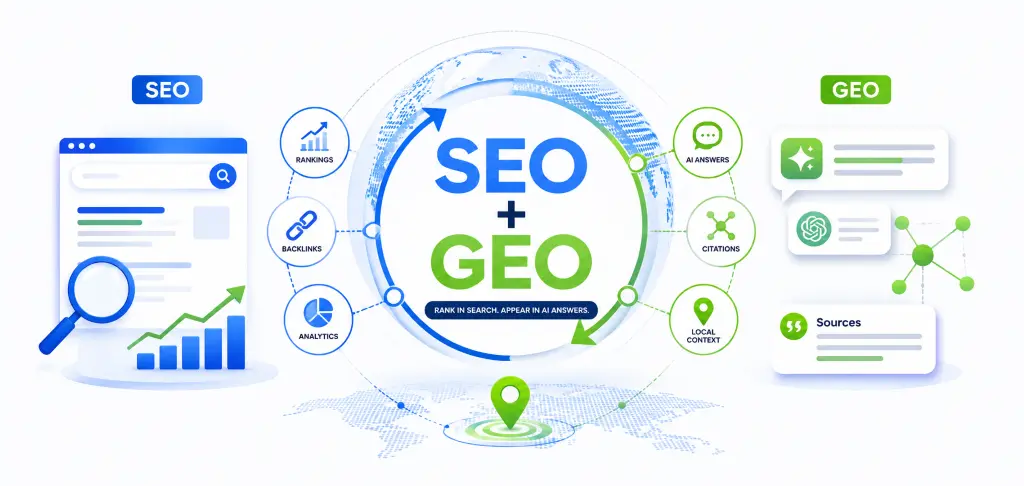
- SEO helps you rank in search results, while GEO helps your content appear in AI-generated answers.
- GEO is not replacing SEO—brands that excel at both will gain the greatest visibility.
- High-quality, authoritative content remains the foundation of success in both SEO and GEO.
- AI search prioritizes context, credibility, and relevance over traditional keyword optimization alone.
- Earning citations and mentions is becoming just as important as earning rankings and backlinks.
- Marketers who adapt early to AI-driven search will be better positioned as user behavior continues to evolve.
Type into a search bar, press enter, and a page of results appears, ranked and structured. That was the door. It is no longer the only one.
Somewhere between the rise of AI-powered search and the quiet shift in how people decide what to trust, a new discipline has entered the conversation. One that marketers at every level are trying to get their heads around — and one that is worth understanding properly rather than quickly.
This article explains SEO and GEO: their differences, overlaps, and how a brand can use both. It also includes hype that is worth ignoring and shifts that are worth acting on.
What SEO Truly Is and Why It Still Drives Organic Growth
People have always gone searching, searching for answers, for solutions, for the thing they cannot quite name yet but will know when they find it. What changed over time was not the looking — it was where it happened. And for a significant stretch of the internet’s life, it happened in one place: a search bar, a query, and a list of results appearing almost instantly. Somewhere in that list, if the work had been done right, was your brand waiting.
Search Engine Optimization is the discipline built around earning that position — a layered set of signals the algorithm reads to decide who belongs where. Those signals cover keyword relevance, the authority of domains linking back to yours, the technical soundness of your pages, and how thoroughly your content covers what someone actually came looking for — not just the surface of it. Threading through all of it is E-E-A-T — expertise, authoritativeness, and trustworthiness — the standard that separates a source worth trusting from one worth skipping.
Get enough of those signals right, and the algorithm rewards that work with something genuinely valuable — visibility with people who are already looking for what you offer.
It has been refined over decades. The tooling around it is deep, the institutional knowledge substantial, and for most businesses, organic traffic still runs significantly through it.
That is the baseline. Not a starting point to move past quickly — the ground everything that follows is actually standing on.
GEO Explained: How Brands Get Cited in AI-Generated Answers
Something shifted, and somewhere in the evolution of how people look for information, a new kind of answer started appearing. Not a list. An answer. Already assembled, already synthesized, delivered by an LLM that had done the reading before the user even thought to scroll.
That changes something fundamental about how a brand gets found. A 2025 McKinsey survey found that half of consumers now actively seek AI-powered search engines — and among those users, 44% named it their primary source of insight, ahead of traditional search. This is not early adoption behavior. It is a shift already underway at scale.
Generative Engine Optimization(GEO) is the discipline built around that new surface. Where SEO asks how to earn a position in a list of results, GEO asks something different: how do you get inside the answer itself? How does your content become the thing an AI tool or LLM reaches for when someone asks a question you are uniquely positioned to answer?
The platforms where this plays out are ones increasingly showing up before traditional search results do: ChatGPT used as a research tool, Perplexity with its inline citations, and Google’s AI Overviews sitting above the results page before the list even begins. When a user puts a question to any of these systems, the system synthesizes a response from content it has processed and deemed credible. GEO is the practice of making your content the kind that gets pulled into that synthesis.
The goal shifts in a way that is worth sitting with. Take a query like “best CRM software.” A page ranking first on Google might drive thousands of clicks. Ask the same question to an AI system, and what comes back is often a synthesized answer that names tools like HubSpot or Salesforce directly— sometimes without a click ever occurring. The difference is not visibility versus invisibility. It is traffic versus presence inside the answer itself. You are not chasing a click anymore. You are chasing a citation — becoming the source an AI quotes from, draws on, or builds part of its answer around. Sometimes that surfaces your brand visibly. Sometimes the user absorbs your thinking entirely and moves on without ever arriving at your page. What that is worth depends on what you are trying to achieve. But it is a different proposition from SEO in ways that matter.
GEO sits within a broader family of emerging disciplines—AEO, LLMO, and AI search optimization — each with its own focus, all pointing at the same fundamental shift in how answers reach people.
How GEO and SEO Differ — And Where They Share Common Ground
Some questions don’t resolve cleanly. This question is one of them.
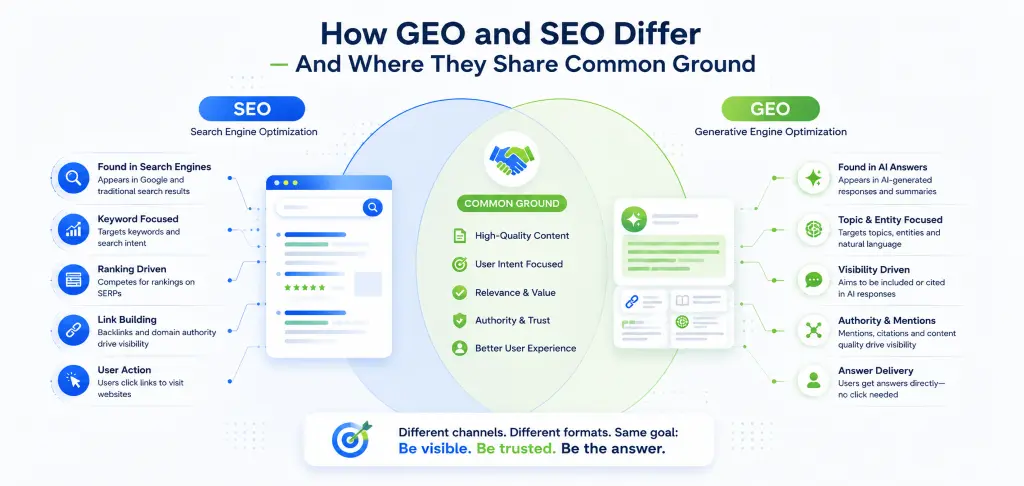
Ask practitioners whether GEO and SEO are genuinely different disciplines or the same game with a new scoreboard, and the answers are split: reasonable on both sides, incomplete on both sides because the ground is still shifting under everyone’s feet — including the people closest to it.
The case for sameness has logic behind it. Content that earns Google’s trust tends to share qualities with content that AI systems reach for — clear structure, sourced claims, demonstrated expertise, and logical organization. A solid SEO foundation may already be closer to GEO-readiness than the noise around it suggests. For this camp, GEO is less a new game and more a new layer on a familiar one. There is real merit to that view.
The case for difference has logic behind it, too. And this is where it gets specific.
SEO earns rankings, and rankings drive traffic. The visit is the event — someone lands on your page, and everything flows from there. GEO builds presence inside the answer itself, at the exact moment someone is asking a question. Sometimes that surfaces your brand visibly. Sometimes the user takes what they need and never arrives at your page. These are not the same objects wearing different clothes.
Authority works differently, too. SEO has leaned historically on backlinks — external domains pointing to yours, telling Google you are worth trusting. GEO draws authority from what lives inside the content itself. Named authors. Clear attribution. Specific, verifiable claims. Formatting that makes individual passages easy to lift without losing meaning. And there is something else worth naming here: a 2025 University of Toronto study found that AI search shows a systematic bias toward earned media — third-party, authoritative sources — over brand-owned content. A stark contrast to how Google weighs its source mix. Which means a strong backlink profile and a well-optimized brand site may still leave a brand underrepresented in AI-generated answers if the third-party conversation around it is thin or absent.
Depth carries particular weight here, too. AI systems appear to favor sources with concentrated, specific knowledge over sources covering many topics at the surface level. Breadth has its place in SEO. In GEO, depth does more of the heavy lifting.
The way content is written matters differently, too. SEO was largely shaped around keywords — specific terms people type into a search bar, matched against content containing those terms. GEO operates in a different linguistic register entirely. AI search tends to involve fuller, more conversational questions. Writing that anticipates a complete question and answers it directly, in plain language, appears better suited to this environment than writing built around short keyword phrases. The subject matter can be identical. The writing target is meaningfully different.
There is also the question of what content is actually being built for. SEO content earns a position. GEO content earns a citation — which means it has to be the kind of writing a system can extract a coherent, meaningful passage from without losing context. A paragraph that defines something clearly — what a process involves, what a term actually means, what distinguishes one approach from another — can move directly into an AI-generated answer intact. A long, narrative explanation that builds to its point across several paragraphs often cannot. Content that only makes sense as a whole, that resists being lifted in pieces, is harder to cite. The shift is subtle but consequential: from writing for a page to writing for a passage.
There is also the question of what GEO actually produces in terms of traffic. SEO, at its best, drives volume — visitors arriving through rankings in numbers that can be tracked and forecasted with reasonable confidence. GEO may drive less traffic in the conventional sense. When an AI system answers a question inline, fewer people navigate to the source. What some early observers have noted is that visitors arriving through AI referral sometimes appear further along in their consideration, though this is still a pattern being understood rather than an established finding. How much that quantity-quality tradeoff actually matters depends on what a given business needs from its content.
And then there is stability. SEO rankings maintain reasonable consistency from week to week. GEO citations are more variable — a point confirmed empirically by researchers at the University of St. Gallen, who found that the same query can produce different sources across runs, prompts, and time, making one-off observations unreliable. Visibility in AI search is better understood as a distribution than a fixed position. There is no rank-one result to defend in the same way. That changes what monitoring looks like, what success looks like, and what can realistically be held over time.
Then there is measurement, where GEO is still in its early stage, and decision-makers should factor that into their planning. SEO measurement, in contrast, is mature. Rankings, click-through rates, organic traffic, impressions — the tooling is reliable, and the picture it produces is reasonably clear. GEO measurement is still in early stages. As AI-generated search experiences expand, tracking brand visibility is becoming increasingly possible — though the discipline is still in its early stages and evolving.
That evolution is worth sitting with rather than working around. Rather than waiting for measurement infrastructure that does not yet exist, the more useful shift may be to start tracking brand influence alongside traffic — monitoring where and how the brand surfaces in AI responses, what perception those mentions are building, and whether branded search interest moves in relation to GEO activity. It is a different picture than an analytics dashboard—reflecting the more fluid nature of AI-generated systems today.
Neither side of the original debate is wrong. Neither is complete. What sits between them is probably closest to the truth — two disciplines with a shared foundation that diverge meaningfully enough in execution to deserve separate thinking.
The overlap is real. So are the gaps.
Powerful Content Moves That Serve Both SEO and GEO
The content investment most businesses have already made can do more than it currently does. Across both SEO and GEO, the same body of work — written and structured with more intention — reaches further.
What serves both channels well is not a separate content strategy. It is the existing one, made more deliberate in specific ways that matter.
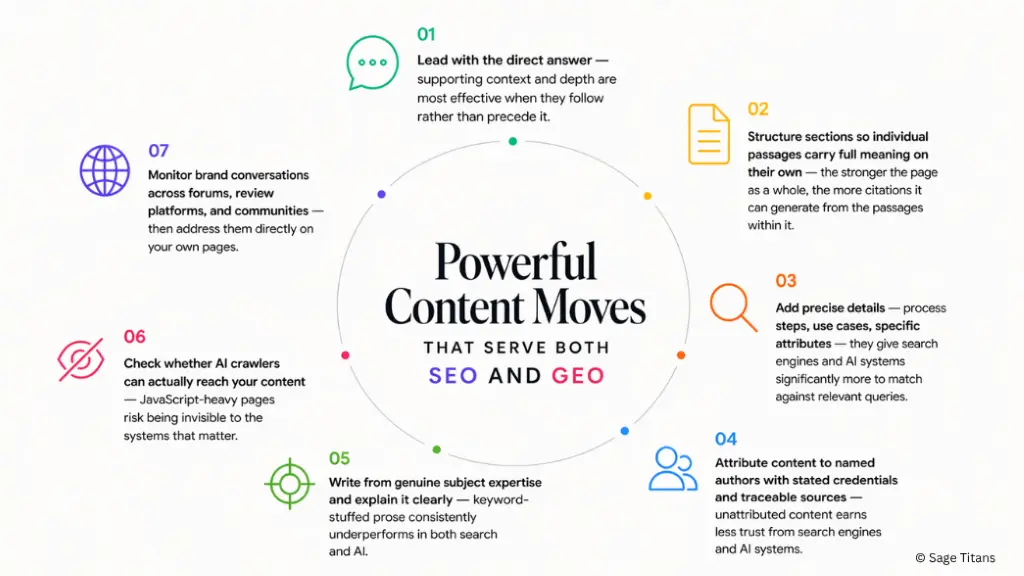
1. Answer first, context second
There is a pattern that both ranking algorithms and AI systems appear to share — they reward content that gets to the point. The answer near the top, the nuance and depth following behind it. Content that takes time to arrive at its point may not serve either channel as well — both search algorithms and AI systems appear to favor content where the core response is accessible early.
2. The passage matters as much as the page
A well-ranking page and a well-cited page are not always the same thing. AI systems and LLMs need to be able to lift a coherent, meaningful passage from your content without losing what makes it useful. A paragraph that defines something clearly — what a process involves, what a term actually means, what distinguishes one approach from another — can move directly into an AI-generated answer intact. A long, narrative explanation that builds to its point across several paragraphs often cannot. That requires headers that orient, sections that stand on their own, and structures that don’t collapse when taken out of context. Content that only makes sense as a whole but not in isolation of its sections is harder to cite — and increasingly, harder to trust.
3. Specific Content Outperforms Vague Pages
Vague pages serve no one well anymore. For product and service content, especially, the details — process, use cases, and precise attributes — are exactly what an AI needs to return your content for specific queries. FAQs built around questions people actually ask give both search engines and AI systems significantly more surface to work with. The more specific the content, the more places it can show up.
4. The people behind the content are part of the signal
Content that reads as though it emerged from genuine expertise — with a named person behind it, a stated perspective, and a traceable source — carries more weight than content that could have come from anywhere.
5. Clarity over optimization
Prose written around keywords rather than around genuine insight and meaning tends to underperform in both channels. Writing the way a knowledgeable person actually explains something — direct, clear, without performance — is better suited to both ranking algorithms and AI model preferences. That is not a coincidence. It is what good writing has always done — it just now has more surfaces to do it on.
6. Invisible content does not exist
Some AI platforms crawl content independently, and some sites have inadvertently blocked them. Content that loads only through JavaScript may be invisible to certain crawlers entirely. Before assuming content is in the pool AI systems draw from, it is worth confirming it is actually reachable. Presence assumed is not the same as presence confirmed.
7. Off-Site Mentions Are Part of the GEO Footprint
AI systems draw from a wider web than most content strategies account for — forums, third-party publications, review platforms, and community discussions. What is being said about a brand in those spaces feeds into what AI systems understand about it. Recurring questions or concerns surfacing on Reddit or in video commentary, left unaddressed on owned pages, leave a gap. Closing that gap does two things: it builds trust with users, and it gives AI systems more accurate information to draw from. The off-site conversation and the on-site content are not separate problems.
None of these tasks requires starting over. It requires paying closer attention to what the content is actually doing — and for whom.
Why GEO Belongs in the Broader Marketing Conversation
Most of the GEO conversation lives at the content level. That makes sense, as content is where the work shows up most visibly, where changes can be made most immediately, and where progress is easiest to point to. But there is a dimension to this shift that no amount of content work alone resolves.
AI search does not live inside a single function. It runs across organic search, paid media, social, product, and customer experience — channels that in most organizations have their own goals, their own definitions of success, and very little visibility into what the others are doing. A content team optimizing for organic traffic, a paid team optimizing for conversions, and a product team shaping messaging independently can produce three different narratives about the same brand. AI systems pulling from across those surfaces may reflect that inconsistency back to users — assembling an answer from signals that were never meant to sit alongside each other. When those functions stay in separate lanes, strategy fragments in ways that are slow to notice and slower to fix. Decisions get made with incomplete pictures. Gaps open up quietly.
The organizations finding their footing here are not always the ones with the largest teams. They are the ones whose functions share context with some regularity — not just when something goes wrong, not just at the end of a quarter. The conversation does not need to be elaborate. It needs to exist.
Then there is the pace of the space itself. AI systems are moving quickly enough that keeping up can feel like a genuine operational challenge. That feeling tends to push organizations toward one of two places — chasing every development or ignoring most of them. Neither produces much that is useful. What works better is having someone — or a small group — whose attention is deliberately here. Watching what is changing. Deciding what actually warrants a response. Making sure the rest of the organization is not caught off guard by something that was visible to anyone paying close enough attention.
AI search is not any one team’s problem to solve. The assumption that it is tends to be where the gaps begin.
A Word on the Hype
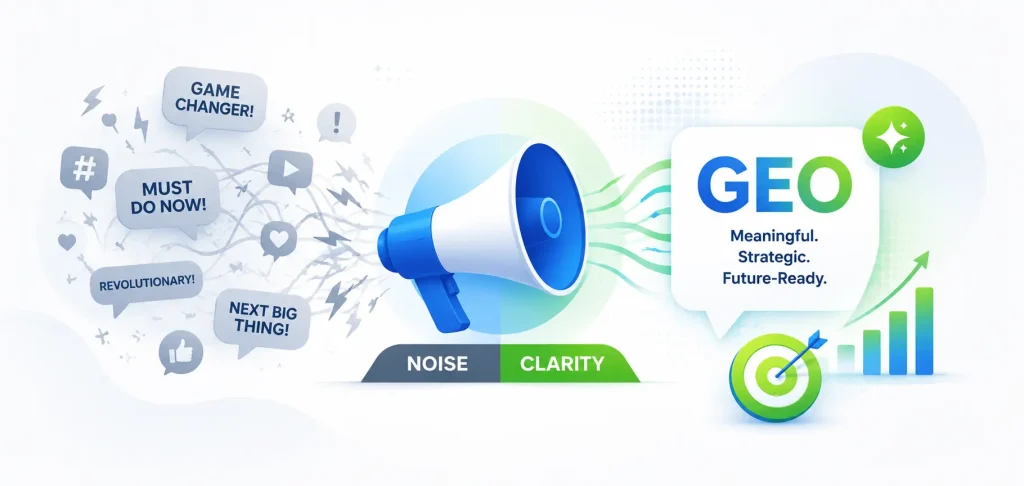
Any new discipline that matters attracts attention quickly. GEO is no exception — and with that attention, has come considerable noise.
A significant ecosystem of vendors, consultants, and tools has emerged around this space — much of it reflecting genuine interest in a discipline that is still being defined and understood. Some of it is older thinking wearing a new name. And some of it — particularly the instinct to produce large volumes of content targeting every possible variation of a query — may be quietly working against the goal it claims to serve. Content that covers a significant surface area but lacks depth or original insight does not build credibility with AI systems. It signals the opposite. Credibility, as both Google and AI systems appear to read it, is not something volume builds. It is something volume can erode.
Skepticism toward vendor claims is reasonable here. Not cynicism but skepticism. The playbook is being written in real time, by people who are figuring it out alongside everyone else. What appears to work today in GEO may not work the same way in the future. Treating any current framework as settled is probably premature.
At the same time, dismissing the space entirely carries its own risk. The shift is visible to anyone paying attention — AI systems are becoming an early stop, sometimes the first one, in how people go looking for information. That is not a projection. It is something anyone paying attention can see happening. The question worth sitting with is not whether to engage with GEO but how to do so with appropriate proportionality — letting the evidence and business needs drive the pace of investment rather than the surrounding noise.
The vendor claims and frameworks will evolve as understanding deepens. The underlying shift in how people find information will not.
The Future of Search Visibility: Why SEO and GEO Belong Together
Two disciplines. One foundation. The conversation around GEO can make it feel like a departure from everything search marketing has been, but the more you look at what GEO actually runs on, the more familiar that foundation becomes. Credibility. Depth. Content that earns trust rather than just attention. These are not new requirements. They are SEO’s oldest ones.
What SEO built — content that earns trust, pages that demonstrate genuine expertise, and technical foundations that tell algorithms and audiences alike that a source is worth returning to — did not become less valuable when AI search arrived. It became the raw material GEO runs on. Citation does not happen without credibility. Credibility does not appear without the kind of sustained, deliberate work that good SEO has always required.
The two are not in competition. They are in sequence. One laid the groundwork. The other is extending it toward surfaces that did not exist until recently. Brands that understand that relationship are in a meaningfully different position from those treating this as a choice between one or the other.
The most grounded approach right now is not choosing between them; it is understanding how they work together and where each one fits within the larger marketing effort.
Search is not being replaced. It is getting wider. The people looking for answers are still out there, still asking the same kinds of questions. Where those questions get answered is changing.
The questions people are asking have not changed. Where those questions get answered is shifting. And the work of being worth finding — credible, deep, genuinely useful — that remains exactly what it has always been.
If that work is something you want to look at seriously — across both traditional search and AI-generated answers — our Generative Engine Optimization service is a good place to start.