
Key Takeaways
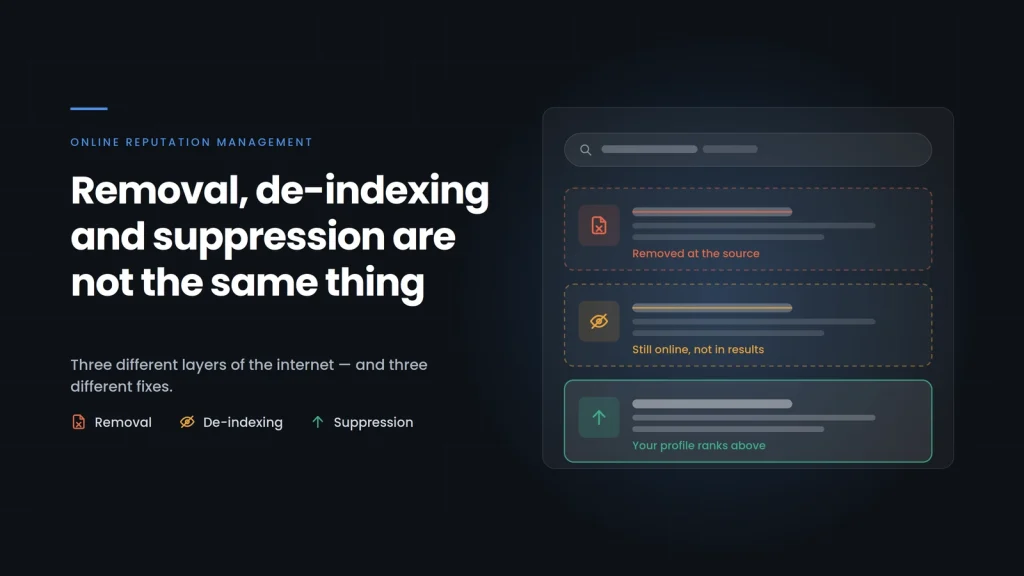
- Removal is the most effective solution because it permanently deletes the mugshot from the original website.
- De-indexing hides content from search results but does not remove it from the website itself.
- Suppression improves your online reputation by pushing negative results lower in search rankings with positive content.
- Not every mugshot can be removed, especially if it's part of a legally maintained public record.
- The best strategy depends on your situation, including legal eligibility, publisher policies, and search engine rules.
- A combination of removal, de-indexing, and suppression often delivers the best long-term reputation management results.
If your mugshot removal quest is bringing you to confusing, conflicting information, you are not alone. Most consumers looking for how to remove a mugshot come across three terms (removal, de-indexing, and suppression) used virtually interchangeably by companies that should know better. That uncertainty costs people time and money and peace of mind.
In short: mugshot removal is about removing the image from the original website; de-indexing is about requesting search engines like Google to not show an existing page in search results; and suppression is about building up other information to make the mugshot harder to discover. They handle distinct problems. The first step toward real reputation rehabilitation is to recognize which one you actually need.
This guide decodes each strategy in plain language, describes how mugshots really circulate online, and provides you with practical tools for assessing your personal case.
Why These Three Terms Are Often Confused
De-indexing, mugshot suppression, and removal all try to hide an undesired photo. The publisher’s website, the search engine’s index, and search visibility are different internet levels.
Dealing with them as interchangeable leads to bad decisions like paying for removal when the real issue is Google Mugshots results or expecting suppression to delete something online.
Conclusion: These are different tactics, not names.
How Mugshots Spread Across the Internet
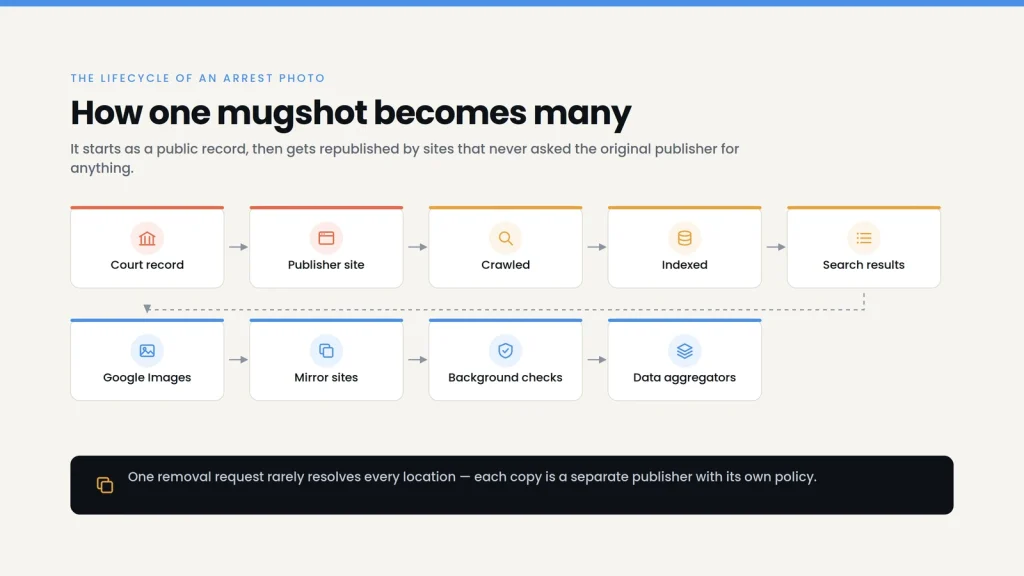
To better understand your digital footprint, it helps to understand the lifetime of a mugshot:
Court/Public Record → Publisher Website → Search Engine Crawl → Search Index → Search Results → Google Images → Mirror Sites → Background Check Sites → Data Aggregators
Arrest photos typically start as public records, are picked up by publishers, and are republished by mirror sites, background check companies, and data aggregators. This is why a single action, like one removal request, rarely resolves every place the image appears.
What is Mugshot Removal?
Mugshot removal is the process of removing content straight from the website of the original publisher. The source page vanishes when it is successful, but this does not immediately remove copies or cached versions on other websites. There is no uniform guarantee; removal is largely dependent on the publisher’s own policy and cooperation.
What Is De-indexing?
Mugshot de-indexing is not about the webpage itself but about search indexing. It is the request to a search engine not to show an already existing page in its search results, where acceptable under the relevant policies. The underlying page may still be there on the web; it’s just tougher to surface through search. You cannot de-index every page, and the result depends on the platform and jurisdiction.
What Is Suppression?
Mugshot suppression raises professional profiles, favorable publicity, and personal websites above undesired results in reputation management. Although suppression doesn’t destroy or hide things, it modifies search visibility over time.
Side-by-Side Comparison
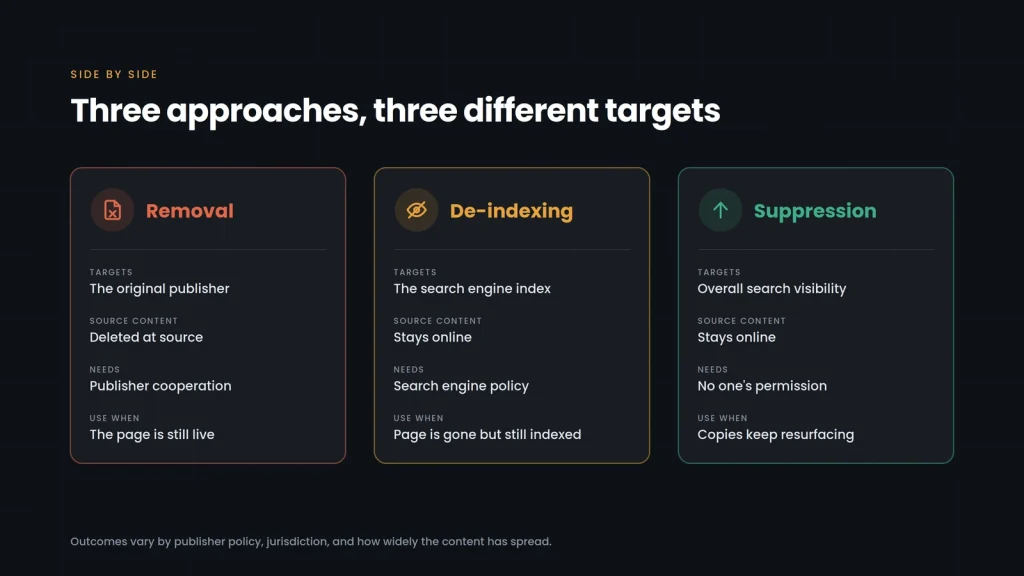
| Approach | Targets | Source Content | Requires Cooperation | Typical Use Case |
| Mugshot removal | Original publisher | Removed from source | Publisher | The Page is still live |
| Mugshot de-indexing | Search engine index | Stays online | Search engine policy | Page removed but still indexed |
| Mugshot suppression | Overall online reputation | Stays online | None | Multiple copies, ongoing visibility issue |
Which Approach Fits Your Situation?
A practical decision framework:
- De-indexing could be useful if the publisher removes the content but it still shows up in searches.
- Suppression or de-indexing can be more practical if the publisher declines removal.
- If multiple copies exist across mirror sites, a layered approach is often needed.
- Search results management takes precedence if search visibility is the primary concern.
These are just beginning points, not promises, as results differ from instance to case.
Can These Strategies Work Together?
Yes, often. Some situations resolve with a single approach; others require mugshot removal combined with de-indexing and ongoing suppression. There’s no fixed sequence that applies to everyone.
Common Myths vs Reality

- Myth: Google owns mugshot content.
Reality: Google indexes it; publishers own and control it. - Myth: De-indexing deletes the webpage.
Reality: It only affects search visibility. - Myth: Suppression hides information.
Reality: It improves the ranking of other content; it doesn’t erase anything. - Myth: Expungement automatically clears online content.
Reality: Court records Sealing doesn’t remove third-party republications. - Myth: Every mugshot can be removed.
Reality: Eligibility depends on the publisher, jurisdiction, and platform policies.
Common Mistakes to Avoid
- Contacting the wrong party for the wrong outcome.
- Assuming search engines control publisher content.
- Ignoring copied or syndicated versions.
- Expecting instant results.
- Buying a service without understanding what problem it actually solves.
Why Similar Cases Have Different Outcomes
Results differ based on publisher policy, jurisdiction, legal context, syndication, search engine rules, and timing. Two seemingly identical cases can produce very different results because of these underlying variables.
Setting Realistic Expectations
Timelines vary. There are no guaranteed outcomes. Publisher cooperation, search engine updates, and future redistribution all play a role, which is why ongoing monitoring matters as much as the initial action.
What Can and Cannot Be Controlled?
Often within reach (depending on the situation):
- Requesting removal from the original publisher
- Requesting search result removal where eligible
- Refreshing outdated results after source changes
- Improving search visibility through reputation management
Often outside your direct control:
- Third-party republication
- Archived copies
- Publishers that decline requests
- Future redistribution of lawfully available public information
How to Evaluate Your Situation
A quick self-assessment checklist:
- Who owns the webpage?
- Is the page still live?
- Has it been indexed by Google?
- Has it been copied elsewhere?
- Is Google Images involved?
- Are legal documents available?
- What outcome are you hoping for?
- Is removal realistic, or is suppression more appropriate?
- Would a layered strategy make sense?
Frequently Asked Questions
Can Google remove mugshots? Google can de-index certain pages under applicable policies, but it doesn’t control publisher content.
Does de-indexing delete content? No. The webpage can remain online even after de-indexing.
Can suppression remove a mugshot? No, suppression improves the visibility of other content rather than removing anything.
Why is my mugshot still showing after expungement? Record sealing affects official records, not necessarily third-party websites.
Can copied mugshots be removed? Sometimes, but each copy may require a separate request.
Can strategies be combined? Yes, layered approaches are common.
Conclusion
Removal, de-indexing, and suppression each solve a different piece of the same problem, and understanding that difference is what leads to realistic, informed decisions rather than wasted effort. Every case is different, shaped by publisher policy, jurisdiction, and how widely the content has spread. If you’re trying to figure out which combination of strategies fits your specific situation, a professional case assessment, like the kind offered at www.sagetitans.com, can help clarify a realistic path forward based on the specifics of your case.