
Key Takeaways
- AI search isn't killing SEO, it's exposing the pages that only ever existed to catch a click and offered nothing after it.
- The real divide is traffic-capture SEO (worthless once the click fades) versus durable-value SEO (still useful in sales, support, and citations).
- The fastest test for any page: if a handful of existing sources could rebuild it with little lost, AI can flatten it into a summary and send no one to you.
- What still compounds is what's hard to reconstruct, original data, first-hand experience, and real implementation depth, not keyword-shaped coverage.
- Stop judging pages by whether they rank, and start asking whether they'd still deserve a place if the clicks dropped tomorrow.
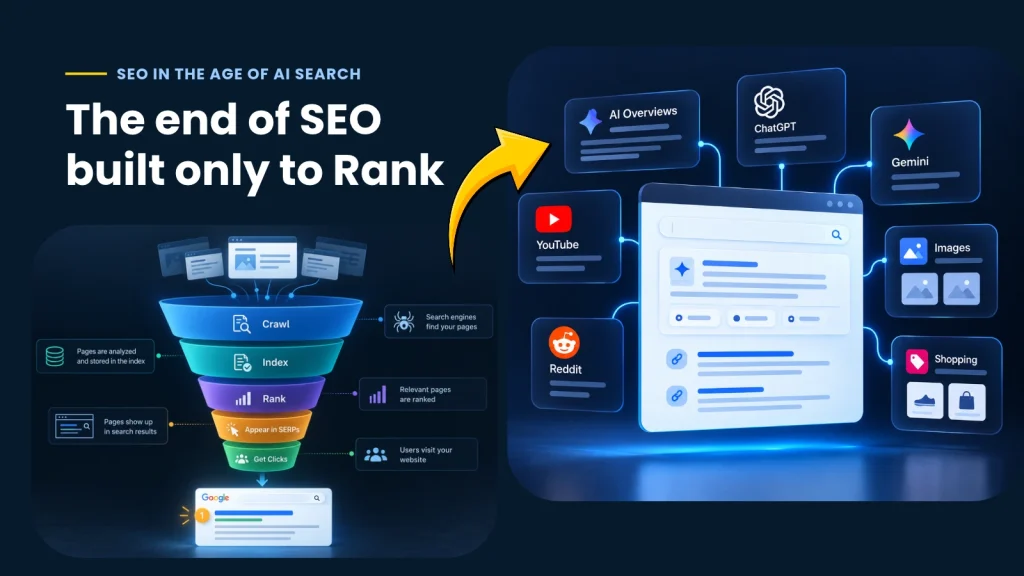
As AI search weakens the link between being seen and being clicked, the SEO under the most pressure is the kind built mainly to win rankings rather than to be genuinely useful.
Some SEO programs still look healthy on the dashboard. Traffic is holding, rankings are stable, and the content library keeps growing. But ask what a lot of those pages are actually for, and the answer gets vague. Plenty of them exist for one reason: they ranked, visits followed, and that was taken as proof enough.
That’s what AI search is exposing. Not a traffic collapse, at least not yet and not everywhere, but the fact that rankings and sessions don’t prove as much as they used to. For years, traffic let SEO teams put off a harder question: what is this page for, beyond getting visits? That cover is wearing thin.
So the real question isn’t just how to optimize for AI search. It’s which parts of your program still matter once the click stops doing so much of the work.
AI search is exposing a divide inside SEO
Not every page in an SEO program was doing the same job, even when they all showed up in the same traffic report. Some pages were useful mainly because they caught the click. Others earned their place by helping someone understand something difficult, make a decision, or get through a tricky setup.
As AI answers take over more of the easy informational work, that difference starts to show. Traffic is becoming a weaker stand-in for value, and the pages under the most pressure are usually the ones that depended most on the visit itself.
The old bargain let sessions stand in for strategy
Ranking led to clicks, and clicks led to sessions. That chain worked well enough for long enough that nobody questioned it much. Once a page ranked and visits came in, nobody had to ask what it contributed after the click.
A post on “What is a content audit?” or “Best practices for internal linking” could sail through a business review as long as it pulled in enough monthly sessions. Whether those visits helped anyone understand the product, supported the pipeline, or helped a customer decide anything was left vague, because the traffic was already doing the justifying.
That’s how a lot of SEO libraries grew. Broad informational coverage, topics added because they sat next to other topics, and pages built around easy, moderate-volume queries kept piling up because a dashboard screenshot could defend them.
The click means less for some kinds of searches
The click isn’t weakening evenly. Early research on AI Overviews suggests the drop is steeper for generic informational searches than for content where depth or technical detail makes the visit hard to skip.
So the pages most at risk aren’t simply “top-of-funnel” or “informational” pages. They’re the ones where a summary meets the searcher’s need well enough that visiting the source no longer seems necessary. A definition, a short explanation, a quick comparison, or a light overview of a familiar idea can often be answered right on the results page. If your page adds little beyond a decent summary of what everyone already knows, losing the click doesn’t cost the searcher much.
That’s usually less true for pages with real implementation detail or decision-shaping information. A page that walks through migration tradeoffs, documents what goes wrong, or explains where one setup breaks and another holds up is serving a different need. What matters isn’t where the page sits in the funnel. It’s whether it gives readers something an AI answer can describe but not easily replace.
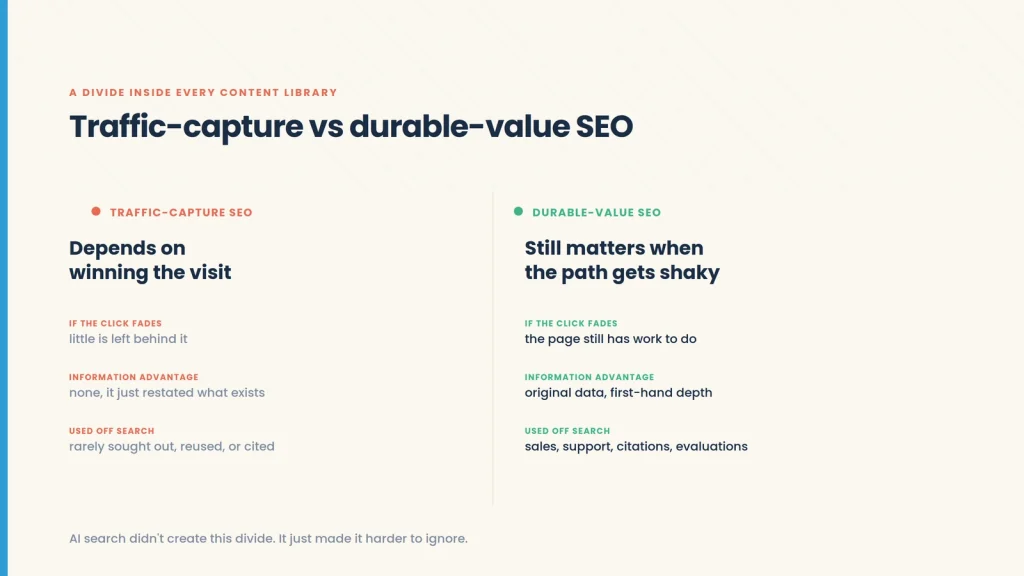
Traffic-capture SEO vs. durable-value SEO
Traffic-capture SEO is work that depends almost entirely on winning the visit. If the page ranked and sessions came in, it had done its job. If the click fades, there’s not much behind it: no unique information, no role in a buying decision, no depth, and no reason for anyone to seek it out, reuse it, or cite it.
Durable-value SEO creates something that still matters when the path to the page gets less reliable. Sales might use it in live conversations. Support might link it in replies. It might get cited in industry coverage or shared during vendor evaluations, because it helps someone understand, compare, or implement something real.
Most programs have both. Traffic used to blur the line, because both kinds showed up as sessions in the same report. AI search didn’t create the divide. It just made it harder to ignore.
The SEO most exposed to AI search was already on shaky ground
The work under the most pressure isn’t informational content as a whole. It’s content whose case was always thinner than the traffic made it look: pages kept because they ranked and widened topical coverage, not because they offered anything unique or useful after the click.
“Informational content is vulnerable” is too blunt to be useful. Some informational pages still earn their place because they teach something hard to find elsewhere or solve a real problem. The exposed ones were often justified by much thinner logic: the keyword existed, the topic seemed close enough, and the traffic made the page feel strategic.
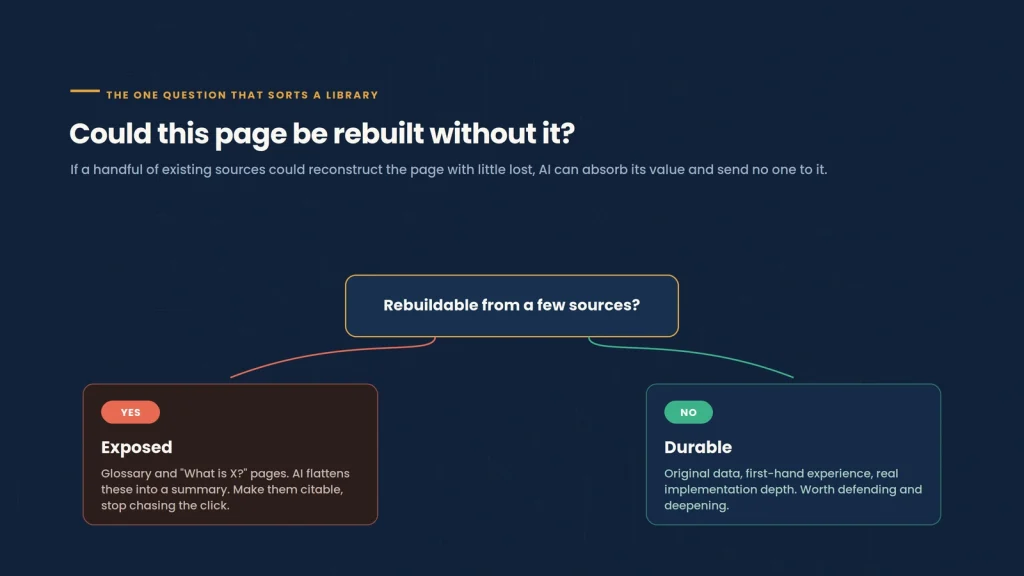
Generic pages are exposed when they’re easy to rebuild
Some informational pages teach something difficult to reconstruct. Others mostly restate what’s already out there. Many content libraries have more of the second kind than teams like to admit.
A generic page can be accurate and well organized and still be vulnerable. If its content can be rebuilt from a handful of existing sources with little lost, an AI answer can soak up most of its value without sending anyone to it. That’s why light glossary pages, “What is X?” explainers, best-practice posts built around a keyword instead of real experience, and thin pages made to fill topical gaps are feeling the pressure. Many of them were built to rank, not to offer anything new.
This isn’t an argument against top-of-funnel content. An introductory page written by someone who has done the work, seen the tradeoffs, and knows where things go wrong is a different asset altogether. The topic isn’t the issue. The question is whether the content could be rebuilt without the page. If the honest answer is yes, AI search can easily flatten it into a summary.
Keyword-adjacent coverage looks different without the traffic argument
Expanding into neighboring topics wasn’t irrational. Ranking across a broad topic area grew the site’s footprint and added traffic, which justified the writing budget. But it carried a quiet assumption: if a page ranked and got visits, that was reason enough to exist.
That assumption looks shakier now. A cluster of adjacent pages can keep pulling in steady sessions without doing much for product evaluation, implementation, or customer understanding. The pages hardest to defend often aren’t the worst performers. They’re the ones where the answer to “what is this for?” still comes back to “it ranks.”
Query fan-out makes narrow keyword targeting a riskier bet
AI retrieval doesn’t stop at the exact words someone typed. It can pull from related angles of the question and build an answer from a wider set of material. Research on AI Overviews suggests the sources cited in AI answers can differ noticeably from the regular search results, including sites that don’t appear on page one at all. Something beyond traditional ranking is shaping what gets picked.
So a page built tightly around one keyword is a narrower bet than it used to be. If its main value is matching a known search phrase, it becomes more exposed once the system looks at the broader question behind it. Pages with real depth hold up better because they’re aligned with the job the searcher is trying to get done, not just the phrase they typed.
Keyword research still matters. It tells you what people ask, the words they use, and where demand is. But AI search retrieves differently from traditional ranking, and matching the visible query is no longer enough on its own when the system is also pulling in related questions, comparisons, and context the searcher never typed.
The audit question
The fastest way to see what your content library is really made of is to ask, page by page: what would this page still be doing if it kept its rankings but lost a big share of its clicks?
A page with a real role usually has an answer. It gets used in onboarding. Sales sends it to prospects. Support links to it because it solves a common question. People share it during evaluations because it contains something specific worth reusing. Its value shows up outside the search results.
A page built mainly to fill a keyword gap usually doesn’t have much of an answer. Once the traffic argument fades, there’s little left to point to.
A few more questions help. Does the page contain something that’s hard to rebuild from a summary? Does it help with evaluation, implementation, or understanding the product in a way that ties back to revenue? Does it earn links because of something specific in it? Or does it overlap so much with nearby pages that the only reason they’re separate is that each once brought in its own traffic?
Those questions sort a content library faster than traffic data, because they get at what traffic used to hide: whether the page has a job worth paying for.
What still compounds in SEO
The pages most likely to hold their value in AI search are the ones that don’t depend entirely on the click. They get there in different ways. Some contain information that’s hard to rebuild from a generic summary. Some help at the moments when people need more than a quick answer, like comparing options, planning a migration, or rolling something out. And some benefit from the fact that the company behind them is already recognized, cited, and discussed across the web.
Distinctive information changes what a page is for
A page gets harder to replace when it contains something the rest of the web can’t easily recreate. Not because it’s polished or long, but because the substance exists there for a reason. Someone ran the test. Someone worked through the migration, or noticed the same failure pattern across several projects and wrote it down. Someone compared the options closely enough to explain where one setup breaks and why another holds up.
That’s the difference between a page that summarizes a topic and a page that becomes a source for it. AI can paraphrase widely available knowledge easily. It has a much harder time replacing original data, hands-on experience, or a decision process someone actually worked through.
A simple test: if this page disappeared, could someone easily rebuild it from five other decent sources? If yes, it’s easy to flatten into a summary. If no, because it has benchmark data, failure patterns, edge cases, migration lessons, or a view shaped by real use, then it’s doing something different. It gives both readers and AI systems a reason to come back to it.
That’s why original research, product benchmarks, implementation notes, workflow breakdowns, and pages by people with first-hand knowledge tend to hold up better than generic explainers. It isn’t that they sound more expert. They contain information that’s harder to swap out.
Evaluation, migration, and implementation pages solve a different problem
Some pages hold up for another reason. They help at the point where someone is trying to make a decision, reduce risk, or get through a piece of work that a general answer can’t carry them through.
That’s why migration guides, alternatives pages, implementation tutorials, setup docs, and comparison content close to pricing can keep their value even as generic informational clicks drop. The searcher is no longer asking “What is this?” They’re asking “Will this fit our setup?”, “What breaks if we switch?”, “How long will this take?”, or “What do I need to know before rolling this out?” A summary can’t fully answer those.
Funnel labels can flatten this. A migration guide isn’t durable just because it sits lower in the funnel. It’s durable because it reduces uncertainty at the moment uncertainty gets expensive. A good alternatives page helps a buyer understand the tradeoffs honestly enough to decide. A strong implementation guide saves someone from making the same mistake twice.
You can usually tell these pages carry weight because they get used outside search. Sales sends the alternatives page because it answers the comparison directly. Onboarding relies on the implementation guide. Support links to the troubleshooting doc because it solves the problem faster than a ticket thread. Once a page is doing that kind of work, it’s outgrown a traffic-only defense.
What the rest of the web already says about you
There’s one more layer, and it sits partly outside your website. AI search doesn’t just read the page. It also seems to weigh what the wider web says about the source, including whether that company already shows up where the topic gets discussed, compared, and cited. Understanding how generative engines select sources, narrowing billions of pages down to a cited few, makes it clear why your presence off-site can matter as much as the page itself.
A page doesn’t enter that process as a blank slate. If the only place a company sounds authoritative is its own website, every page has to build trust from scratch. If the company is already cited in trade coverage, mentioned in implementation write-ups, compared in buyer conversations, discussed in communities, and described by customers in ways that match its own claims, the page starts from a stronger position.
The research points the same way. A study of AI citations across 128 brands found that 85.7% of citations pointed to third-party sites rather than the brands’ own pages. Separate large-scale experiments across multiple verticals found that AI search leans heavily toward earned media over brand-owned content, which is a different mix from Google’s regular results.
That doesn’t mean off-site visibility can rescue weak content. A thin page won’t become valuable because the brand has a few mentions in the right places. But traditional SEO trained teams to treat the page on their own site as the main unit of work, and AI search is less forgiving of that. If your page claims you’re a credible source but the rest of the web doesn’t back it up, the gap is harder to hide.
What to protect
The pages worth protecting are the ones that keep their value when clicks weaken, and for a clear reason. Sometimes that reason is distinctive information: original data, implementation knowledge, or a point of view earned by doing the work. Sometimes it’s decision support: helping someone compare options, plan a migration, or get through setup with fewer mistakes. And sometimes it’s trust: the page is backed by a company that’s already visible and credible where the category gets evaluated.
These are also the pages most worth investing in further. An implementation guide with modest traffic but real depth is often a better long-term asset than a cluster of keyword-adjacent posts whose main contribution is their combined sessions. A comparison page that sales and prospects actually use is usually worth more than several keyword-shaped posts nobody remembers.
So instead of asking which pages still bring in enough visits to defend themselves, ask which ones would still deserve investment if the traffic dropped. The list will usually be shorter, but stronger.
How to re-evaluate an SEO program when ranking isn’t enough
Once rankings stop being enough proof, content reviews have to get stricter about what value looks like. Traffic still matters. It just can’t do all the explaining anymore. Pages need to be judged on what they actually contribute: what they teach that’s hard to find elsewhere, what decision or task they support, whether they’re used beyond search, and whether you’d lose anything real if they disappeared.
Re-score pages by what they contribute
Rankings and traffic still count. If a page brings in qualified visitors who convert, feed the pipeline, or reliably introduce the right buyers to your product, that’s clearly useful. The trouble starts when traffic is the only thing a page can point to.
A better review asks different questions. What does this page do that would still matter if traffic fell? Is it hard to replace, or is it a competent summary of common knowledge? Does it help a buyer compare options, understand tradeoffs, or get through a migration or setup? Do teams like sales, onboarding, support, or product marketing actually rely on it? Does it get cited, linked, or shared because of something specific in it?
A page doesn’t need to be bottom-of-funnel to pass that test. But it does need a clearer job than “it ranks.” If it vanished tomorrow, what would you lose besides visits?
Keep, improve, merge, or stop creating
Judging pages by contribution changes what you do next. The answer usually isn’t “refresh everything.” It’s deciding which pages to keep, improve, or merge, and which kinds you should stop making.
Keep pages that already do something hard to replace. They > contain distinctive information, help with evaluation or setup, > reduce support load, get used in buyer conversations, or earn > citations. Losing one would cost you more than sessions.
Improve pages with a real role but weak execution. A migration > guide might cover the right problem but read like it was written > from the outside, with generic steps and no sense of where teams > actually get stuck. An alternatives page might target the right > comparison but dodge the tradeoffs buyers care about. Don’t cut > these. Add what’s missing: clearer decision criteria, > implementation detail, first-hand lessons, or a more honest take > on where your product fits and where it doesn’t.
Merge pages that only stayed separate because each once brought > in its own traffic. Three overlapping posts can look fine on a > dashboard while splitting attention, adding maintenance work, and > repeating each other. If they don’t have distinct jobs, one > stronger page is usually better.
Stop creating generic informational pages with no unique > information, no role in evaluation or setup, and no reason to > exist once the click weakens. This is the uncomfortable category, > but often the most important one. If your production process keeps > turning these out, the problem isn’t just page quality. Your > content model is still built for traffic rather than lasting > value.
Stop using traffic as the default defense
SEO teams should still track sessions, rankings, click-through rates, and organic contribution. None of that goes away. What changes is how much those numbers are allowed to justify on their own.
A page shouldn’t survive a content review just because it still gets traffic. It should survive because that traffic points to something useful: a page people rely on, one buyers use to compare options, one customers use to get unstuck, one that earns links because it’s worth citing, or one that explains your product better than anything else you have.
That doesn’t require perfect attribution. It does require a higher bar for evidence. If the only defense is “it still gets sessions,” the page is on weak ground. If it’s used in sales conversations, referenced in onboarding, linked by support, or cited in industry coverage, the case is much stronger, even if traffic is modest.
The principle is simple. Applying it consistently is the hard part.
Fewer pages, with a stronger reason to exist
The likely result of this kind of review isn’t a slightly tidier content calendar. It’s a smaller, clearer idea of what your SEO program is for.
In practice, that means fewer pages built around neighboring keywords and more investment in pages that are hard to substitute. It means treating expert input as a requirement when a topic needs real depth, not as polish added after the draft is done. It means merging overlapping pages that never had distinct jobs, and putting more effort into original information, product-specific insight, honest comparison content, and implementation resources people keep coming back to.
It also means taking a wider view of what drives SEO performance, including how AI tools can strengthen SEO programs from the inside rather than just churning out content at scale. Some of the work that makes a page more visible and credible in AI search won’t happen on the page at all. It might come from original research, sharper product positioning, better comparison coverage, credible mentions where your category is discussed, and a clearer presence across the web.
You’ll usually end up with fewer interchangeable pages and more that can stand on what they actually do. That’s a harder standard than “it ranks,” but it lasts longer.
Conclusion
For years, traffic let SEO programs avoid a hard question: what is this page doing besides attracting visits? Rankings and sessions made it easy to keep big libraries alive without being clear about why each page existed or what it did after the visit ended.
AI search doesn’t make that question new. It just makes it harder to dodge. When AI answers can handle more of the easy informational work without a click, the pages that depended most on the visit come under the most pressure. The dividing line is no longer just what ranks or what gets traffic. It’s which pages would still be worth keeping if rankings held but clicks dropped sharply.
That test doesn’t punish informational content. It shows which informational content was doing real work all along. Pages with distinctive information, pages that reduce decision risk, pages that help with implementation, and pages people seek out, cite, or reuse still have a strong claim on your budget. Content built mainly to capture rankings doesn’t. That’s the distinction worth getting honest about now.
If this has you looking at your content library differently, our SEO Audit Services can help you work out which pages to keep, improve, merge, or retire, and where AI search changes your priorities.