
Key Takeaways
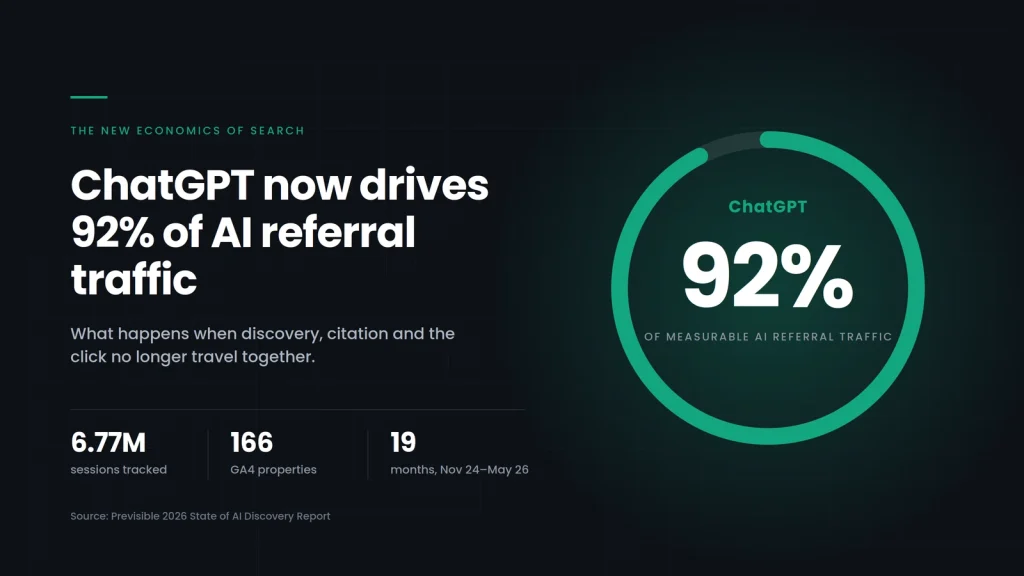
- ChatGPT accounts for over 92% of measurable AI referral traffic, making it the dominant AI traffic source for websites.
- AI's influence extends far beyond referral clicks, shaping brand discovery and purchase decisions that traditional analytics often miss.
- The future of SEO is shifting from optimizing for clicks to optimizing for visibility, citations, and trust in AI-generated answers.
- Businesses should measure AI success using visibility and brand mentions—not just website traffic from AI platforms.
- As AI assistants answer more questions directly, website traffic is no longer the only indicator of digital marketing success.
A new traffic dataset suggests ChatGPT has become the main referral engine in AI search. The larger story is not platform share alone but what happens when discovery, citation, recommendation, and the click no longer travel together.
Search visibility and the referral click used to be one transaction. A page earned a ranking, a user followed the pointer, and a session began. Publishers built revenue models around that sequence. Brands measured demand through it.
Previsible’s 2026 State of AI Discovery Report, covered by Search Engine Land, tracked 6.77 million sessions from standalone LLM tools across 166 GA4 properties between November 2024 and May 2026 and found that ChatGPT accounted for 92% of measurable AI referral traffic in that window.
Previsible analysis of 166 GA4 properties found that ChatGPT accounted for 92% of measurable AI referral traffic between November 2024 and May 2026. That figure is worth examining carefully — not just because it shows which AI platform currently dominates referral volume, but because of what it implies about the transaction itself. AI systems can now surface, summarize, cite, and recommend content without always sending the user to the source. The task is no longer just to count AI referrals. It is to understand which parts of discovery still end in a click, which stop at citation or recommendation, and which show up later under a different source label altogether.
What the 92% figure says about AI referral traffic
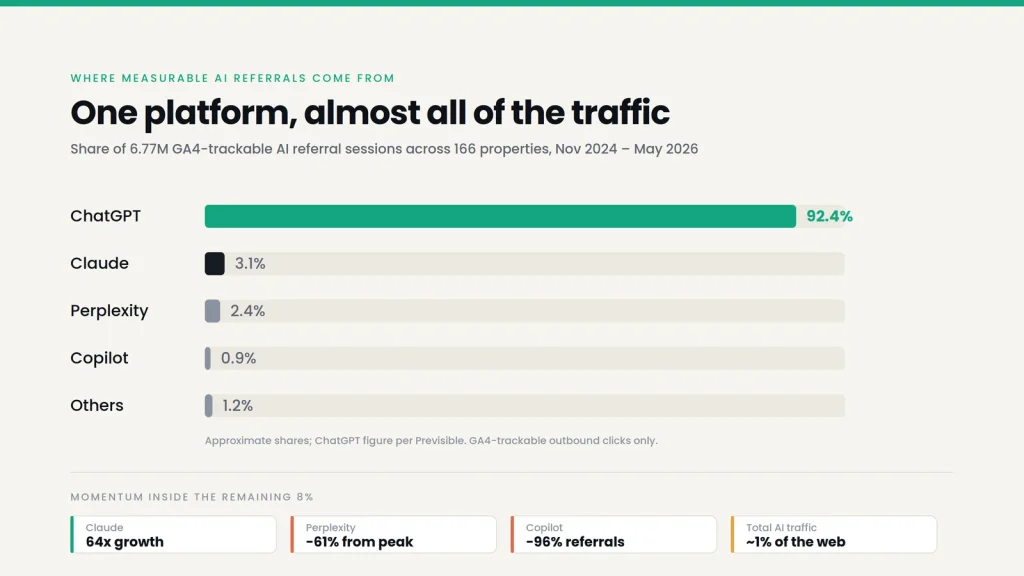
Previsible’s 2026 State of AI Discovery Report tracked 6.77 million sessions from standalone LLM tools across 166 GA4 properties held constant over a 19-month window. ChatGPT accounted for 92.4% of those trackable referral sessions.
Monthly sessions grew roughly tenfold over that period, reaching approximately 644,000 by May 2026. Claude grew 64x and overtook Perplexity by March 2026. Perplexity fell 61% from its peak. Microsoft Copilot lost 96% of its referral volume. These figures reflect GA4-trackable outbound clicks only.
Within measurable AI referral traffic, ChatGPT is not simply ahead — it is operating at a scale that makes the rest of the field secondary for any team trying to understand where AI-referred sessions are currently coming from. A tenfold increase in monthly sessions over eighteen months signals a real referral channel forming, even if its absolute scale remains modest. Conductor data from late 2025 placed total AI referral traffic at around 1% of all web traffic, with ChatGPT accounting for the overwhelming share.
What the 92% figure measures, and what it does not
The 92% figure captures GA4-trackable referral sessions where a user clicked an outbound link from ChatGPT and arrived with the referrer recorded. It does not capture AI-influenced visits arriving later via direct traffic or branded search, Google AI Overviews traffic arriving under Google’s referrer, or the influence AI systems exert through citation and recommendation when no outbound click follows. It is a clean measure of one visible category, not a complete measure of AI-mediated influence.
Referral sessions record visits that arrived with a traceable source — not everything that happened before the click and nothing about influence that stopped short of one. That boundary matters more in AI search because a large share of AI interactions do not end with an outbound visit. A user can ask ChatGPT for product comparisons, receive an answer with cited sources, and leave with enough information to act — without clicking anything. Comscore’s ChatGPT usage research found outbound clicks in only a small minority (5.2%) of conversation sessions. The 92% figure tells teams where trackable AI referral traffic is concentrated. It does not tell them how often AI shaped a visit that later appeared under a different label or not at all.
AI is separating discovery from referral
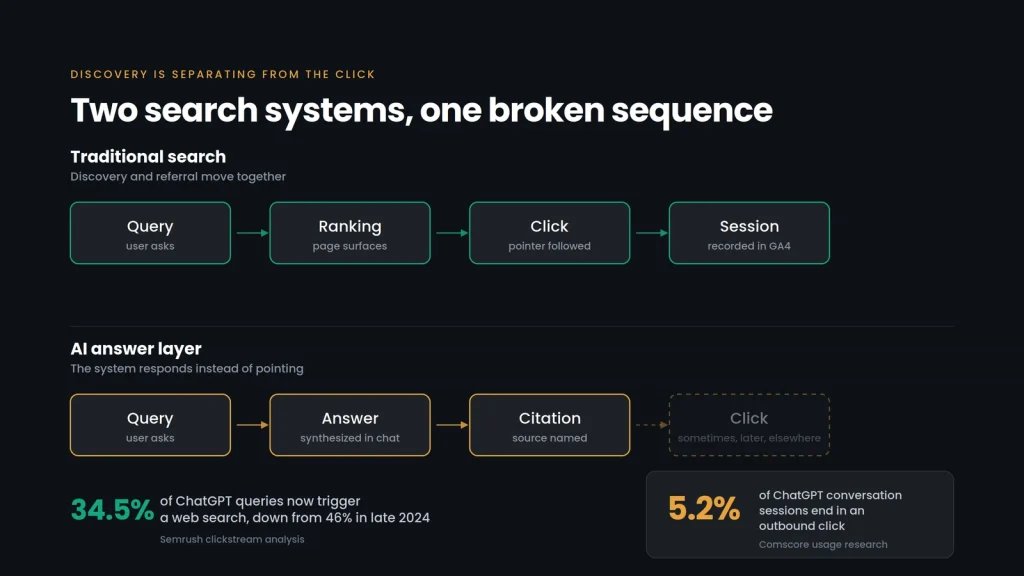
Traditional search tied discovery and referral together. A result surfaced, the user clicked, and a session was logged. AI search systems break that sequence — answering, summarizing, comparing, citing, and recommending without requiring the same outbound click. Discovery and referral now frequently occur through different mechanisms, at different times, measured by different signals or not measured at all.
Traditional search was a directory. It pointed; users followed. A ranking produced clicks, and those clicks were the proof that being found had translated into something measurable.
AI answer systems are not directories. When a user asks ChatGPT about a product category, the system responds rather than points. Sources may be cited, but the user’s question is often resolved inside the conversation. The source has shaped the answer, but the visit that used to follow is no longer guaranteed.
A brand can appear in an AI answer, be compared favorably against competitors, and shape a purchase decision without ever receiving a visit from that interaction. Semrush’s clickstream analysis found that ChatGPT triggered a web search on only 34.5% of queries in its measurement window, down from 46% in late 2024. Being surfaced is no longer a reliable guarantee of being visited — and that is where the 92% figure becomes more than a market-share statistic. It becomes evidence of a search system where the click still matters but no longer captures the whole exchange.
Why that split matters differently to publishers and brands
For publishers, the separation of discovery from referral is primarily a monetization problem: revenue models built on pageviews depend on visits arriving. For brands, the primary risk is attribution failure — not measuring influence that is real — rather than a direct revenue gap from missing visits.
Publishers are contending with a reciprocity problem. Their content is crawled, summarized, and cited by systems that benefit from access to it, while the traffic return that historically made investing in original content viable is declining. AI Overviews, which appeared on roughly 25% of queries at their 2025 peak, consistently reduced organic click-through rates across multiple independent studies — with declines ranging from 15% to over 60% depending on query type. The AI referral traffic that does arrive is not, for most publishers, offsetting those losses.
Brands face a different problem. If a user asks an AI assistant which tools to evaluate or which agency to consider, and a brand appears prominently with a favorable characterization, that moment may carry more commercial weight than a standard search impression — the AI has already done the comparison work. But if the interaction ends without a click, the commercial effect may be real even when the reporting layer never records it.
What “the economics of search” means now
The economics of search, as used here, means the bargain that linked content production to traffic return. Publishers and brands invested in searchable assets because visibility could turn into visits, and visits could turn into revenue, leads, or demand. AI answer systems loosen that bargain by extracting information from pages, recomposing it inside their own interfaces, and satisfying part of the user’s need before any click occurs.
For two decades, that bargain was straightforward enough to build around. A publisher wrote a review or a reported piece. A software company built comparison pages and category content. Google indexed the page, ranked it, and sent users through. Some visits became ad impressions, subscriptions, or pipeline. The system had a clear logic: if search engines kept surfacing the work, the work had a path back to the business.
AI answer layers interrupt that path. They can pull from a buying guide, a help article, or a product page, synthesise the useful parts, and hand the user a resolved answer without returning the same traffic. For publishers, fewer visits mean less ad inventory and a weaker direct relationship with readers. For brands, if AI visibility is influencing evaluation without showing up as a referral session, teams can undercount the value of content that is still shaping demand.
The old bargain has not vanished. Search still sends traffic, AI referrals are growing, and AI-referred visits often arrive later in the decision process and convert at higher rates than cold organic sessions. The change is that visibility, influence, and traffic are no longer tied together as tightly as they once were. Once those pieces move on different timelines, search performance stops being a simple traffic exchange and becomes a question of which forms of value a team can still see and which it cannot.
The crawl-to-referral gap shows why publishers are uneasy
Cloudflare’s mid-2025 analysis found that AI crawlers generate far more page requests than referral clicks. Anthropic’s crawler registered a crawl-to-referral ratio of approximately 70,900:1 in a sample week from June 2025. That ratio had reached approximately 286,930:1 in January 2025 before declining after Anthropic added web search to Claude. Perplexity’s ratio worsened 257% over the same period.
The data puts numbers on a tension publishers have felt without being able to fully demonstrate. The dominant driver is training: Cloudflare estimated that training-related crawl activity accounted for roughly 80% of total AI bot activity by mid-2025 — bots ingesting content to shape future model weights, not to answer current queries. That content informs AI answers without any ongoing referral relationship with the source. Publishers are not simply seeing less traffic. They are seeing their content used through a mechanism that was never part of the original exchange, while AI answer layers simultaneously reduce the click-through rates that traditional search used to deliver.
What kind of AI traffic is this? A better way to read the visits
AI referral traffic is not a single category. A working taxonomy: navigational clicks, where a user sees a brand named in an AI answer and clicks through; research-completion clicks, where the user has already reached a conclusion and visits to confirm or act; citation-following clicks, where a user follows a named source to verify what they read; and exploratory clicks, where AI has introduced a topic and the user is browsing further. These carry different commercial values.
AI-referred visits tend to arrive later in the decision process. Visibility Labs’ analysis of 94 ecommerce stores found that ChatGPT referral traffic converted 31% better than non-branded organic search traffic across 2025, with higher revenue per session despite a lower average order value. Notably, GA4 referral attribution likely undercounts AI’s commercial influence because many users continue their journey through branded search or another route rather than clicking directly from ChatGPT. A citation-following click and a late-stage product visit may arrive under the same source label while representing very different moments — which is why referral volume alone is not enough, and the next question is how to audit AI visibility more broadly.
How to audit AI visibility without treating referrals as the whole story
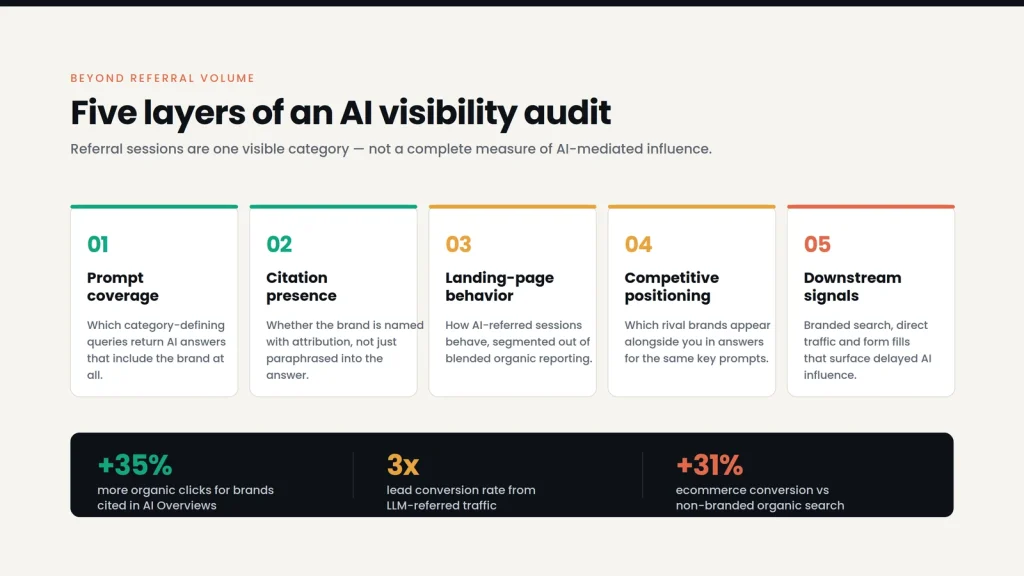
A complete audit examines: prompt coverage — which category-defining queries return AI answers including the brand; citation presence — whether the brand appears with attribution; landing-page behavior of AI-referred sessions relative to other channels; competitive positioning — which brands appear in AI answers for key prompts; and downstream signals — whether AI-influenced users return later via direct traffic or branded search.
Prompt coverage maps whether the brand is present in the conversation before any click decision is made — something referral data cannot show. Citation presence is the next layer: Seer Interactive’s analysis found that brands cited in Google AI Overviews received 35% more organic clicks and 91% more paid clicks than comparable brands appearing without citation. Being named with attribution correlates with downstream traffic in ways that merit separate tracking.
Landing-page analysis should be segmented from blended organic reporting. Downstream signals — branded search trends, direct traffic patterns, form-fill attribution — surface the delayed effect of AI visibility on users who did not click in the moment but returned later. In HubSpot’s internal AEO case study, LLM-referred traffic converted at roughly three times the rate of traditional search traffic for lead generation — a finding that illustrates both the quality of AI-referred visits and the importance of measuring them separately from blended organic.
For teams that want a structured view across all five layers, AI search analytics pulls them into one reporting frame.
The 92% figure is a signal, not a complete measure of search value
The 92% ChatGPT share reflects where AI referral volume is currently concentrated. It does not measure AI-influenced visits arriving through other channels, citation appearances without clicks, or demand generated by AI discovery that converts through non-referral paths. It is a useful leading indicator, not a complete theory of AI search performance.
For search and content teams, the reading is straightforward: if measurable AI referral traffic is showing up in analytics today, ChatGPT is most likely driving it. The number is useful precisely because it is narrow — it shows where the measurable traffic is, not the full effect of AI search on demand. Referral sessions and AI visibility are related but not equivalent, and treating the first as a proxy for the second is where AI search measurement currently goes wrong most often.
Conclusion
The click bargain was clean while it held. Visibility produced traffic, traffic produced measurable outcomes, and search performance could be read from a single set of numbers.
AI search has not replaced the click. It has made the click less complete as a record of what search did. A user can reach a brand through a ChatGPT recommendation, absorb a publisher’s reporting through a cited summary, or arrive at a product page after the comparison work has already happened elsewhere. Some of those journeys end in a measurable visit. Some do not. Some return later under a source label that hides the AI touchpoint entirely.
Search now includes citation without traffic, recommendation without attribution, and discovery that converts later under another name. The work is not to abandon referral data — it is to place it back in context and to build a clearer view of what AI visibility is doing before, around, and beyond the click.
If you want to know where your brand stands across those surfaces before the referral session, not just after it, an AI visibility audit is the right place to start.