
Key Takeaways
- More reviews or testimonials do not always make people trust a brand more.
- People trust honest and detailed feedback more than big numbers or hype.
- Too much social proof can feel fake or pushy to customers.
- Real and relatable customer stories build stronger trust than perfect ratings.
- Good products and clear communication matter more than showing lots of social proof.
When Credible Signals Still Don’t Settle Decisions
On most consultation websites, nothing appears to be missing. Testimonials are in place. Client logos line the page. Numbers and credentials do their quiet work in the background. At a glance, the signals suggest competence. The site looks finished.
And yet, when a decision moment arrives, something hesitates. Visitors scroll a little longer than expected. They reread sections they already understood. The proof is visible, but it doesn’t quite settle the question forming in their mind. The issue isn’t disbelief. It’s the uncertainty that hasn’t fully eased.
This is the contradiction many consultation websites now live with. Social proof for consultation websites is present almost everywhere, and trust is widely discussed as essential. Still, confidence doesn’t always follow. What looks credible on paper can feel incomplete in practice—not because the signals are wrong, but because the moment they’re meant to resolve remains unresolved.
Why Proof Is Now Asked to Do More Than Impress
The issue isn’t that social proof has become less important. If anything, it has become expected. What has changed is what that proof is asked to do. It’s no longer there to impress. It’s there to resolve a very specific moment of doubt—and it only works when it meets that moment precisely.
Credibility, in this context, isn’t built by accumulation. It doesn’t strengthen simply because more testimonials, client reviews, case studies, or expert endorsements are added. It forms when the right trust signal appears at the right time, answering the question a visitor hasn’t fully articulated yet. When proof aligns with uncertainty, confidence follows. When it doesn’t, even strong signals can sit quietly, acknowledged but unconvinced.
How Trust Gets Evaluated When Outcomes Can’t Be Verified
Consultation is evaluated under conditions that are inherently uncertain. Unlike products or tools, the value of consulting services can’t be inspected upfront or easily compared side by side. Outcomes unfold over time, depend on context, and often involve judgment rather than execution alone. As a result, decisions aren’t made by measuring features. They’re made by assessing risk—by asking whether someone else has stood here before and found the ground steady enough to proceed.
That’s where social proof entered the picture. Not as persuasion, but as orientation. When outcomes are hard to verify, people look outward for cues. This tendency has been well established in behavioral research, including the work of Robert Cialdini, who described social proof as the mechanism by which individuals reduce uncertainty by observing others’ choices.
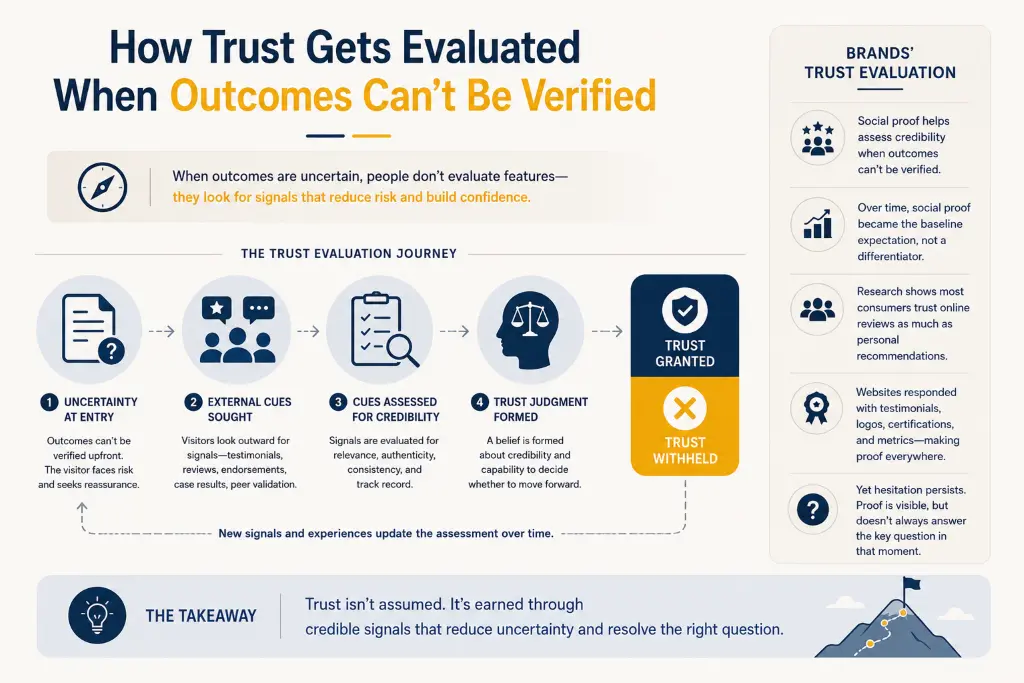
Social proof, in the context of consultation websites, refers to visible signals—such as testimonials, peer validation, and outcomes—that help visitors assess credibility when direct verification isn’t possible.
Over time, what began as reassurance became expectation. Testimonials, reviews, endorsements, and performance metrics moved from being differentiators to being baseline credibility markers on professional services websites.
That expectation is not theoretical. For more than a decade, studies such as the Local Consumer Review Survey by BrightLocal* have consistently shown that a large majority of consumers trust online reviews as much as personal recommendations. While the exact percentage has fluctuated over the years, the structural insight remains: peer validation is now assumed. In response, consultation websites adapted. Testimonials became standard. Client logos grew prominent. Certifications and statistics filled the margins. On the surface, the system looked complete.
And yet, hesitation persisted. Visitors didn’t reject what they saw—but they didn’t always move forward either. The proof was visible, acknowledged, and even understood. What was missing wasn’t belief; it was resolution. The signals didn’t always answer the specific question forming in that moment of evaluation.
Why Familiar Proof Still Leaves Decisions Unresolved
One reason lies in how proof is often collected. Testimonials tend to be gathered for visibility rather than clarity. Short affirmations—“great experience,” “highly recommend”—signal satisfaction but rarely explain impact. Numbers appear without context, detached from the conditions that produced them. A percentage increase without a baseline. A revenue figure without a timeframe. In isolation, none of this is wrong. But when proof doesn’t reflect the problem a visitor is trying to solve, it fails to reduce uncertainty in a meaningful way.
Different forms of social proof also do different work, though they’re frequently treated as interchangeable. A written testimonial communicates affirmation. A video testimonial adds presence, tone, and emotional credibility. A before-and-after metric suggests change over time. An expert endorsement implies external validation beyond the consultant’s own claims. Each addresses a different doubt in the buyer’s decision-making process. When they’re layered without intention, they accumulate. When they’re aligned with the question at hand, they reassure.
Scale complicates this further. Large consumer brands have shown how volume and visibility can reinforce trust when relevance is maintained. Dior, for example, demonstrated this through its influencer-led “67 Shades of Dior*” campaign, which collaborated with dozens of creators to reflect a wide range of identities and audiences. The campaign generated millions of impressions and engagements, and it worked not because of reach alone, but because participation felt representative and contextually aligned.
A similar dynamic played out when Apple leaned heavily on user-generated content to address long-standing perceptions about smartphone camera quality. By showcasing real photos taken by everyday users, Apple didn’t attempt to prove everything at once. It resolved one specific doubt at scale. The result was tens of millions of social mentions and sustained engagement, driven by peers demonstrating outcomes rather than the brand asserting claims.
In many cases, these credibility cues extend beyond the website itself, intersecting with how brands appear across platforms where visibility, repetition, and context are shaped by social media advertising.
When More Proof Starts to Work Against Resolution
For consultation businesses, this distinction matters. What works for global consumer brands doesn’t translate directly to advisory services, where decisions are personal, stakes are higher, and trust is contextual. The more proof is displayed without regard to timing or intent, the more it begins to fade into the background. Pages grow heavier. Signals multiply. Resolution doesn’t.
This creates a quiet paradox. As proof accumulates, decisiveness can diminish. Everything looks credible, yet nothing quite closes the gap. What appears complete still feels unfinished—not because the signals are wrong, but because the moment they’re meant to resolve remains unanswered.
Seen this way, the issue isn’t social proof itself. It’s how that proof is framed, sequenced, and encountered. Credibility doesn’t fail because it’s absent. It falters when it arrives without context, too early, too late, or simply everywhere at once. Understanding that distinction is what allows movement forward without adding more noise.
What Changes When Proof Is Treated as Timed Evidence
Moving forward doesn’t require adding more proof. It requires looking at existing proof through a different lens. Instead of asking whether a site has enough testimonials, logos, or numbers, the more useful question becomes simpler: what question is a visitor trying to answer at this moment, and does anything on the page actually answer it?
That shift alone changes how proof gets used. A client story earns its place when it mirrors the situation a visitor is evaluating. A before-and-after number becomes meaningful when its starting point, timeframe, and constraints are clear enough to be comparable. A short video works when presence and tone matter more than detail. An endorsement helps when a visitor is looking beyond the site for reassurance. In practice, this means proof isn’t chosen for strength in isolation, but for relevance to the doubt it’s meant to resolve.
Placement becomes an act of prioritization. Proof near a service description helps a visitor decide whether you’re capable of the work. Proof near pricing or a contact point helps them decide whether the risk feels justified. When everything appears everywhere, nothing stands out. When signals are positioned where hesitation naturally peaks, they do their work quietly.
One way teams begin applying this is by reviewing pages not for completeness, but for friction. Patterns like hesitation, repeated scrolling, or drop-off often become clearer when viewed through tools that connect behavior with outcomes, such as Google Analytics and conversion analysis.
Where do visitors slow down, scroll back, or pause before leaving? What questions might that behavior reflect? Proof that doesn’t address those questions can often be removed or relocated without loss. Proof that directly answers them usually needs less volume, not more.
The same thinking applies to visibility. Social mentions, user-generated content, and public feedback tend to work best when they resemble the audience being addressed. Instead of asking whether there is enough visibility, a more useful check is whether the examples shown feel recognizable to the visitor making the decision. Specific signals often outperform broad ones, especially in professional services where decisions are rarely impulsive.
Freshness adds another layer of action. Proof that never changes stops signaling activity. Updating a single case example, replacing an outdated testimonial, or removing work that no longer reflects the current focus often does more for credibility than adding something new. This isn’t optimization for its own sake. It’s the maintenance of accuracy.
Measurement helps, but only when it informs judgment rather than drives volume. Behavioral tools can highlight where attention concentrates and where it drops off, but their real value is in prompting better questions: What is this visitor trying to resolve here? And is the proof present, helping, or simply present?
Across all of this, restraint becomes a practice. Not every outcome needs to be public. Not every success needs to be quantified. Proof that’s shared with permission, context, and proportion tends to feel more believable than proof that feels exhaustive.
Ultimately, navigation isn’t about persuading someone to act. It’s about helping them understand the ground they’re standing on. When proof clarifies what has happened before, what is likely now, and what remains uncertain, decisions begin to feel safer. That safety—not pressure—is what allows confidence to form.
When Enough Doubt Quietly Gives Way to Trust
In the end, credibility rarely arrives all at once. It settles gradually, as moments of uncertainty soften rather than disappear. What matters most isn’t how much proof is displayed, but whether the signals encountered feel proportionate, timely, and real enough to stand in for experience that hasn’t happened yet.
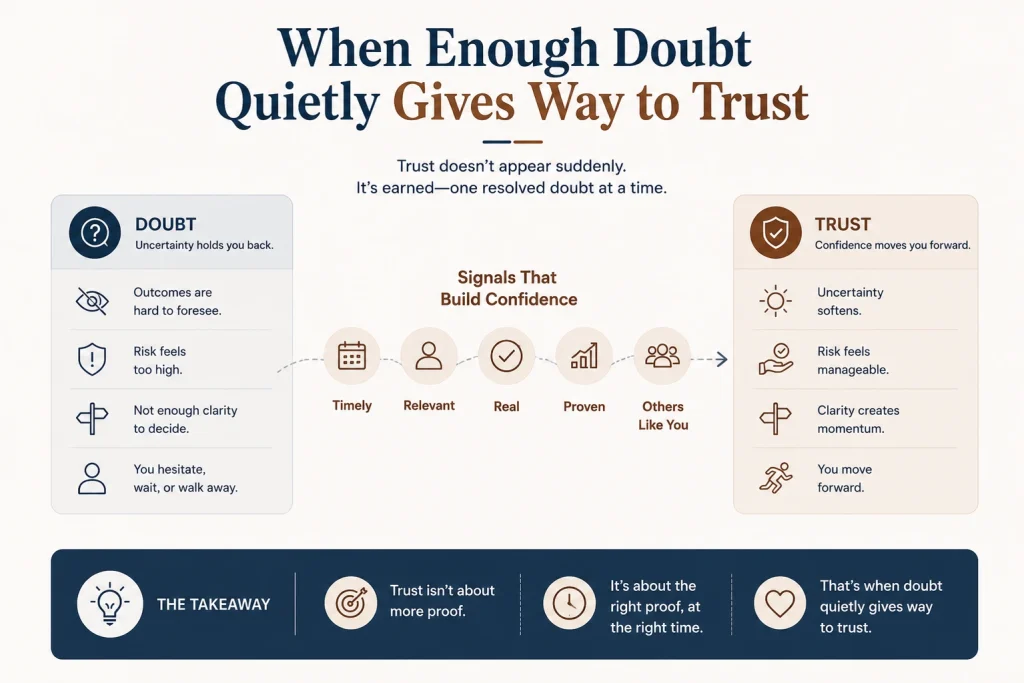
Seen this way, social proof isn’t a performance. It’s a record. A trace of work done, decisions made, and outcomes shaped over time. When that record is allowed to remain specific, current, and incomplete in honest ways, it does more than persuade. It reassures.
And perhaps that’s the quieter truth underneath it all. Trust doesn’t form because every doubt is eliminated. It forms when enough of them are answered for a decision to feel safe to make.
Most consultation websites don’t need more proof—they need clearer moments of resolution.
At Sage Titans, we unpack such patterns through ongoing research, client work, and shared insights.
References: