
Key Takeaways
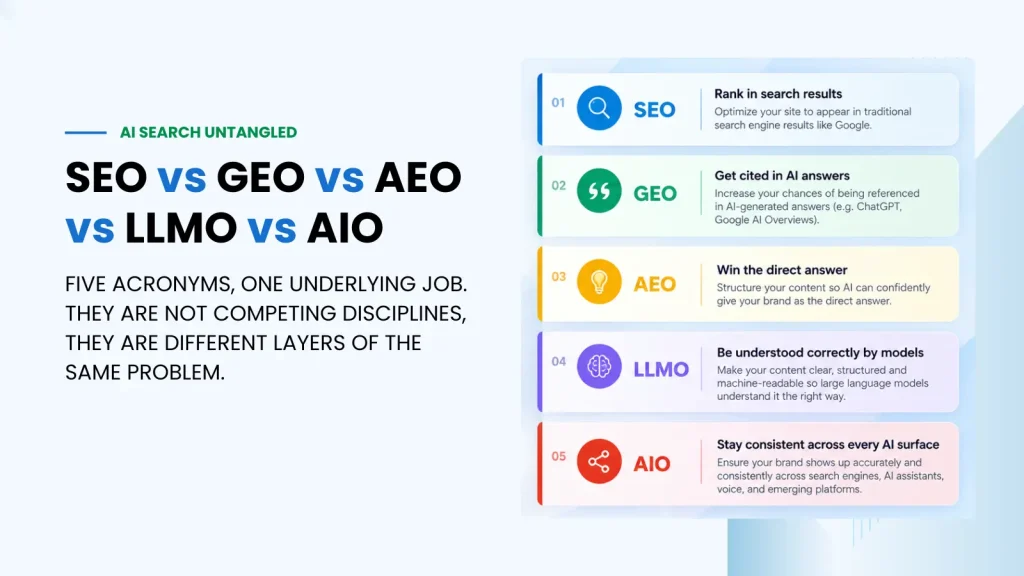
- SEO helps you rank in search engines, while GEO helps your content get cited in AI-generated answers.
- AEO focuses on creating clear, direct answers that search engines and AI systems can easily extract.
- LLMO is about making AI models accurately understand your brand, expertise, and offerings.
- AIO takes a broader view by maintaining consistent brand information across different AI platforms.
- The core recommendation is to build strong SEO fundamentals first, then optimize content and brand information for AI discovery and citation.
TL;DR: SEO gets pages ranked in traditional search. GEO helps content earn citations in AI-generated answers. AEO makes answers easy to extract. LLMO goes beyond individual citations; it’s about helping large language models more accurately understand and represent your brand over time. AIO is the broadest umbrella term: think of it as keeping your brand consistent wherever people interact with AI. These aren’t competing disciplines, they’re different layers of the same problem. That’s the mental model we’ll use throughout this guide.
Until recently, most conversations about search optimization started and ended with SEO. Now there are five terms in circulation, SEO, GEO, AEO, LLMO, and AIO, with GSO trailing behind. The acronyms are multiplying faster than the underlying practices. The key is understanding how GEO differs from SEO (GEO vs. SEO). That comparison reveals what has truly changed between the traditional SEO world and the emerging GEO landscape.
The terminology is still evolving, but the underlying work overlaps far more than the labels suggest. Throughout this guide, we’ll use these terms the way they’re most commonly used across the industry today.
The Side-by-Side Comparison
SEO targets rankings. GEO targets AI citations. AEO targets direct answers. LLMO focuses on how large language models understand and represent your brand. AIO brings all of those efforts together across AI-powered experiences.
| Framework | Primary Goal | Optimizes For | Primary Surfaces | Unit of Visibility | Measurement | Current Role |
| SEO | Rank in search results | Keywords, backlinks, technical health | Google, Bing | Page / URL | Rankings, traffic, clicks | Foundational |
| GEO | Get cited in AI answers | Retrieval-friendly, quotable content | ChatGPT, Perplexity, AI Overviews, Gemini | Passage / entity | Citation share / AI visibility | Fast-growing, increasingly central |
| AEO | Win direct answers | Concise, structured answers | Featured snippets, AI answer experiences, voice assistants | Answer block | Snippet capture rate, answer inclusion rate | Established, folding into GEO |
| LLMO | Be represented accurately by LLMs | Representation signals | LLM-powered platforms | Entity / fact | Brand representation accuracy | Emerging, technical |
| AIO | Keep your brand consistent across every AI touchpoint | Everything above, working together | Search + chat assistants + AI Overviews + enterprise copilots + AI shopping | Brand / topic | Composite AI visibility | Umbrella term |
| GSO | Improve visibility in generative search | Structured, citable content | Generative search interfaces | Passage / source | Citation share | Emerging, often = GEO |
A practical way to remember the differences: SEO asks, “Can people find you in search?” GEO asks, “Will AI use your content in its answers?” AEO asks, “Can search engines and AI easily extract answers from your content?” LLMO asks, “Will large language models accurately understand and represent your brand?” AIO asks, “Are all of these efforts working together?”
How These Frameworks Fit Together
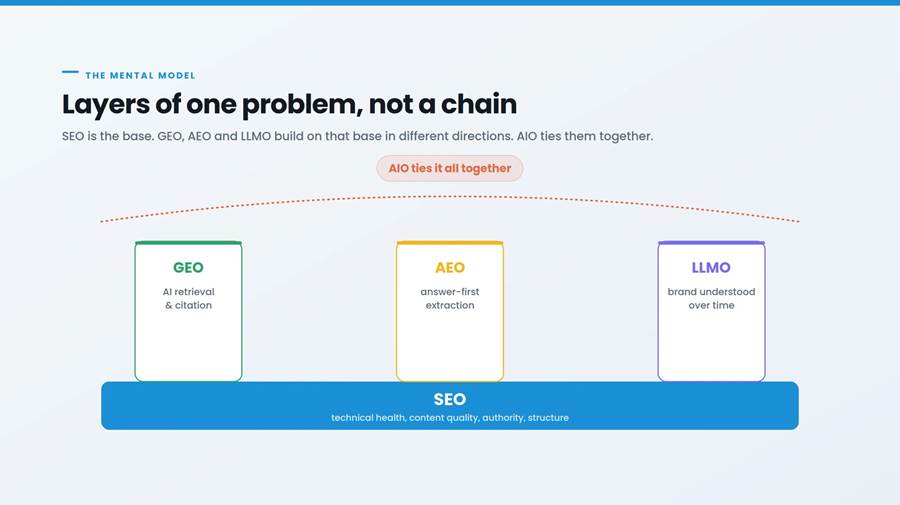
SEO is the base layer: technical health, content quality, site structure, and authority. GEO, AEO, and LLMO each build on that base in a different direction, not on top of each other.
GEO takes that foundation into AI retrieval and citation. AEO takes it into structured, answer-first content that’s easy for search engines and AI to extract. LLMO shifts the focus from individual answers to how large language models understand and represent your brand over time.
Although they emphasize different parts of the same problem, they share the same foundation. AEO existed before GEO did. LLMO emerged later to address a different emphasis, not to replace GEO or AEO. They’re siblings, not a chain.
Which raises the obvious question: if they’re this closely related, why does the industry need five names for them?
Why So Many AI Optimization Acronyms Exist
Each term arrived at a different point in AI search’s short history, solving whatever the most pressing problem was at the time. AEO showed up first, built around featured snippets and voice assistants, years before generative search became part of everyday marketing conversations. GEO followed. A widely cited KDD 2024 research paper helped formalize and popularize the term within the SEO and AI search community. LLMO approaches the same challenge from a more model-centric perspective: not “did this page get cited?” but “does the model consistently understand and represent your brand?” AIO sits above all of it, often the term people reach for when they mean everything at once. GSO is another label you’ll increasingly come across, and it’s often used interchangeably with GEO.
Part of why this happened is that different communities approached the same problem from different directions, SEO practitioners, AI researchers, tool vendors, and agencies, each naming the part they cared about most. A founder googling any of these terms today will land on five articles, each one written by someone convinced their term is the right one.
Practitioners who do this for a living tend to settle on one or two terms and stop worrying about it. The rigor goes into the work. The label is just a label.
Myth vs. Reality
Myth: GEO replaces SEO.
Reality: Good GEO starts with good SEO. A site with no technical foundation and no topical authority doesn’t start getting cited by AI just because someone renamed the effort.
Myth: AEO, LLMO, and AIO each need their own team.
Reality: For most organizations, one content or growth team can usually own all of it. The underlying skills overlap heavily; what changes is the question you’re asking of the same underlying work.
Where They Overlap
Crawlability. Structured data. Topical authority. Clear entities. Trustworthy content.
These help a page rank in traditional search and earn citations in AI-generated answers because both rely on many of the same signals of quality, authority, and clarity.
A well-structured page on “entity SEO,” with clean headings, schema, internal links, and some original research, often performs well in both traditional search and AI-generated answers. Strengthen one of these signals, and you’ll often see the benefits in both places.
Where They Genuinely Diverge
AI systems don’t read a page the way a search engine ranks one. Before generating an answer, most AI search systems pull the most relevant passages first, then build a response from that retrieved material, which means a single well-written paragraph often matters more than the rest of the page in earning a citation, even when the whole document is sitting right there.
Ask ChatGPT “what is entity SEO?” It won’t hand back your 2,000-word article. It’ll hand back the three sentences that answer the question.
Good SEO gets you discovered. Good GEO gets you quoted.
Ranking is about being found. Citation is about being chosen.
Multiple pages can deserve to rank for the same query. Only a handful end up cited for it. A paragraph that depends on the one before it, “as mentioned above,” “this is why,” may rank just fine and still be less likely to get lifted out, because nothing reads it as a standalone unit except a person scrolling through the page.
Retrieval is only half the decision. Being trustworthy enough to be cited alongside competing sources is the other half, and that’s a separate judgment the system makes after it’s already found the passage. Recent studies of Google AI Overviews found a meaningful share of cited pages sitting outside the top 10 organic results for the same query. Some don’t rank in the top 100 at all. One reason is that rankings and citations aren’t decided in exactly the same way.
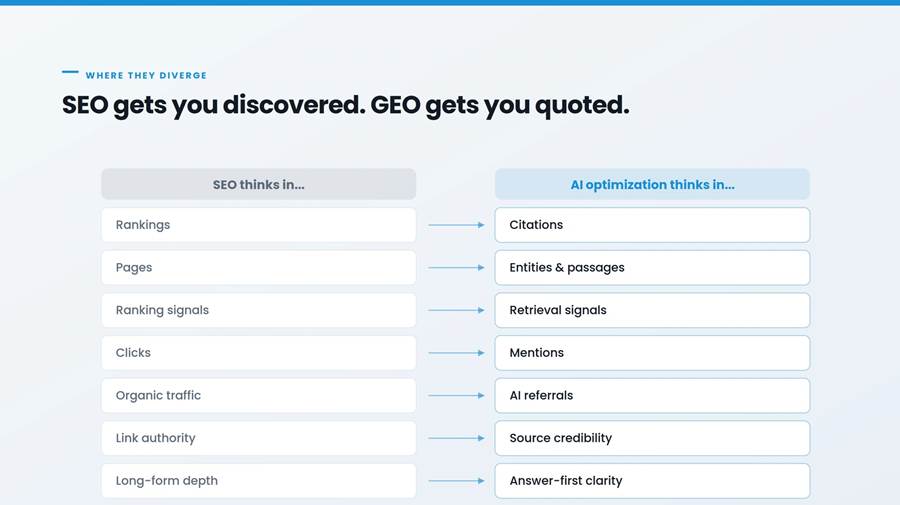
| SEO thinks in… | AI optimization thinks in… |
| Rankings | Citations |
| Pages | Entities and passages |
| Ranking signals | Retrieval signals |
| Clicks | Mentions |
| Organic traffic | AI referrals |
| Link authority | Source credibility |
| Long-form depth | Answer-first clarity |
Like every comparison in this guide, these are differences in emphasis rather than strict boundaries. Modern search engines and AI systems share many of the same signals; the table highlights what each primarily optimizes for, not everything each system considers.
AI visibility is also probabilistic. Run the same prompt twice, and you can get two different citations, different models, different retrieval passes, sometimes nothing more than a different phrasing of the question. Rankings usually change over time. AI citations can change from one prompt to the next.
Beyond the Acronyms
The terms overlap, but each one focuses on a different part of how people discover information through AI. Here’s what each one means, not just what the letters stand for.
SEO, Search Engine Optimization
Earning visibility in traditional rankings. A blog post that lands on page one for “best running shoes” is a clean SEO win, nothing more complicated than that.
GEO, Generative Engine Optimization
A generative engine pulls passages from across the web, evaluates which ones look most relevant and trustworthy, and builds an answer from the strongest supporting sources. That’s the core idea, and it’s why GEO focuses on making individual passages easy to lift out, not simply on where the page ranks. A page can rank fine and still not get cited, simply because its best answer isn’t presented as a standalone passage. This gap shows up most on competitive topics, where dozens of pages are all technically correct and the system has to pick between them somehow.
GEO changes the target. Not “rank the page,” but “make this paragraph easy to retrieve and trust.”
AEO, Answer Engine Optimization
AEO, the oldest term here, is built around featured snippets and voice search. If a system can already retrieve relevant passages from anywhere on a page, why would placement still matter? Because retrieval finds candidates, but answer engines often favor passages that are already self-contained and easy to extract. Lead with the answer, then explain it, that’s most of what AEO is. It matters most for informational queries, where the system is trying to synthesize a direct response, and matters much less when someone’s clearly comparing options or trying to get something done.
There’s also query fan-out: modern AI assistants often split one question into several related sub-questions before answering it. Content that happens to answer the cluster, not just the one keyword someone typed, tends to win more of those sub-questions.
LLMO, Large Language Model Optimization
This is the term people confuse with GEO most often, and it’s solving a different problem. GEO asks whether one piece of content got cited in one answer. LLMO asks something broader and slower: does the model understand this brand correctly at all, across conversations that have nothing to do with each other? You can win a GEO citation today and still have the same model describe your company wrong tomorrow on a completely different prompt.
That understanding is shaped by far more than a company’s own website. It comes from many sources, including documentation, press coverage, public profiles, forum threads, or wherever the model happened to encounter the brand. An analysis of 75,000 brands found branded mentions correlating more strongly with AI Overview visibility than backlinks or Domain Rating did. Correlation, not proof, but it lines up with something that shows up constantly: companies think they have an SEO problem when the real issue is that their own properties describe the product three different ways, and nothing on the open web agrees with any of the three.
AIO, AI Optimization
AIO is the layer that ties the rest of this together. Less a technique, more a discipline of consistency: making sure the brand shows up the same way whether someone’s in ChatGPT, an AI Overview, an enterprise copilot, or an AI shopping assistant. Most companies discover their AIO problem by accident, someone notices the product is described one way on the website, another way in the docs, and a third way in support content. AI systems don’t reconcile that for you. They inherit it and usually amplify whichever version was easiest to find.
An ecommerce brand juggling product feeds, marketplace listings, and a help center has a much bigger surface to keep straight than a SaaS company with one product and one doc site, which is most of why AIO becomes a governance problem at scale rather than a content task.
GSO, Generative Search Optimization
A newer label, mostly interchangeable with GEO, is sometimes used a little more narrowly for generative search interfaces specifically.
None of this replaces SEO. It extends where SEO already works.
A Quick Way to Check Your Own LLMO
You don’t need a tool subscription to start diagnosing how AI sees you. Open an AI assistant and ask it three questions about your own business:
- What does this company do?
- What topics is this brand associated with?
- Who are its competitors?
Vague, outdated, or wrong answers aren’t necessarily a citation problem you fix by publishing another blog post. They’re often a representation problem, the model hasn’t formed a clear, consistent picture of your brand from the information it’s able to draw on.
Running this test doesn’t give you control over what the model says next time. What it does give you is a clearer picture of the gaps, so you can improve the quality, consistency, and authority of the information these systems are likely to draw on.
Is SEO Dead?
No, in fact, SEO matters more than ever. AI Overviews and chat assistants still lean heavily on traditional search infrastructure to find what they cite. Pull back on SEO and the loss isn’t just rankings, it’s the raw material AI systems are pulling from in the first place.
Search and AI discovery aren’t two separate fights anymore. They’re the same fight on different fronts.
How to Split Your Budget
This depends less on the acronym and more on company size, how much content already exists, and how often the industry’s buyers are turning to AI search in the first place.
| Situation | Priority |
| Limited content and low authority | SEO first |
| Building both organic and AI visibility | Balanced investment |
| Large, established content library | Expand AI optimization efforts |
| Strong SEO foundation and growing AI traffic | Increase investment in AI optimization |
A startup with limited resources gets more out of strengthening SEO first, then layering AI optimization in once there’s enough high-quality content for AI systems to retrieve consistently. Chasing GEO before that exists tends to produce very little, no matter how well-written the content is.
A publisher with thousands of evergreen articles is the opposite case. The hard part, building useful, discoverable content, is already done. That makes GEO a natural next investment because there’s already a large body of content AI systems can retrieve, evaluate, and cite. Industry exposure to AI search, content maturity, and existing brand trust all shift more of the investment toward AI optimization once the basics are solid.
FAQ
Should I stop investing in SEO? No, it’s the foundation everything else in this guide builds on.
Is GEO replacing SEO? No. It extends visibility into AI-generated answers; it doesn’t substitute for rankings.
Is AEO still relevant? Yes, especially for snippets, voice search, and informational queries; its answer-first logic carries straight into GEO work.
What’s the difference between GEO and LLMO? GEO is about getting your content cited in AI-generated answers. LLMO is about whether large language models consistently understand and represent your brand across many conversations.
Do I need separate SEO and GEO teams? Usually not. The same team can handle both; the skills overlap too much to split cleanly.
Which strategy should come first? SEO fundamentals, then GEO-specific work like answer-first formatting once that’s solid.
How do I measure AI visibility and GEO ROI? Citation frequency across AI tools; AI-referral traffic where attribution allows; and brand mention accuracy are some of the most useful AI visibility metrics to track, along with some expected volatility from query to query, since none of this is fully deterministic.
Which acronym matters? GEO has the widest adoption right now. The work underneath it matters more than what it’s called.
The Bottom Line
The biggest mistake isn’t picking the wrong acronym. It’s optimizing for only one way people discover information.
The terminology will keep shifting. The underlying job, making it easy for search engines and AI to find, understand, and trust what you’ve made, won’t shift nearly as fast. Not sure how to balance SEO and AI search visibility for your business? Get an SEO + AI visibility gap assessment now.