
Key Takeaways
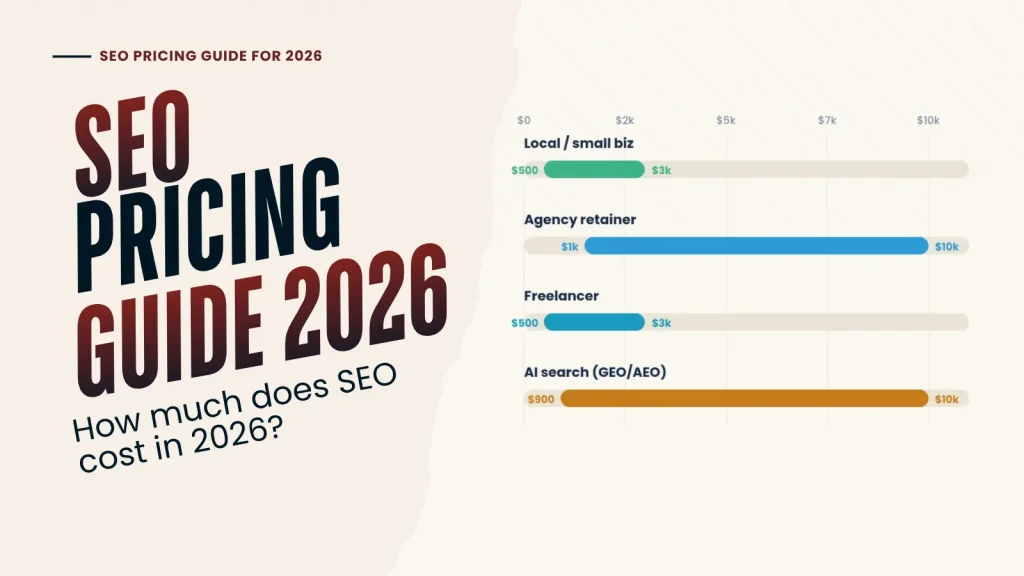
- SEO costs most businesses $500 to $10,000 a month in 2026, with the average agency retainer around $3,200.
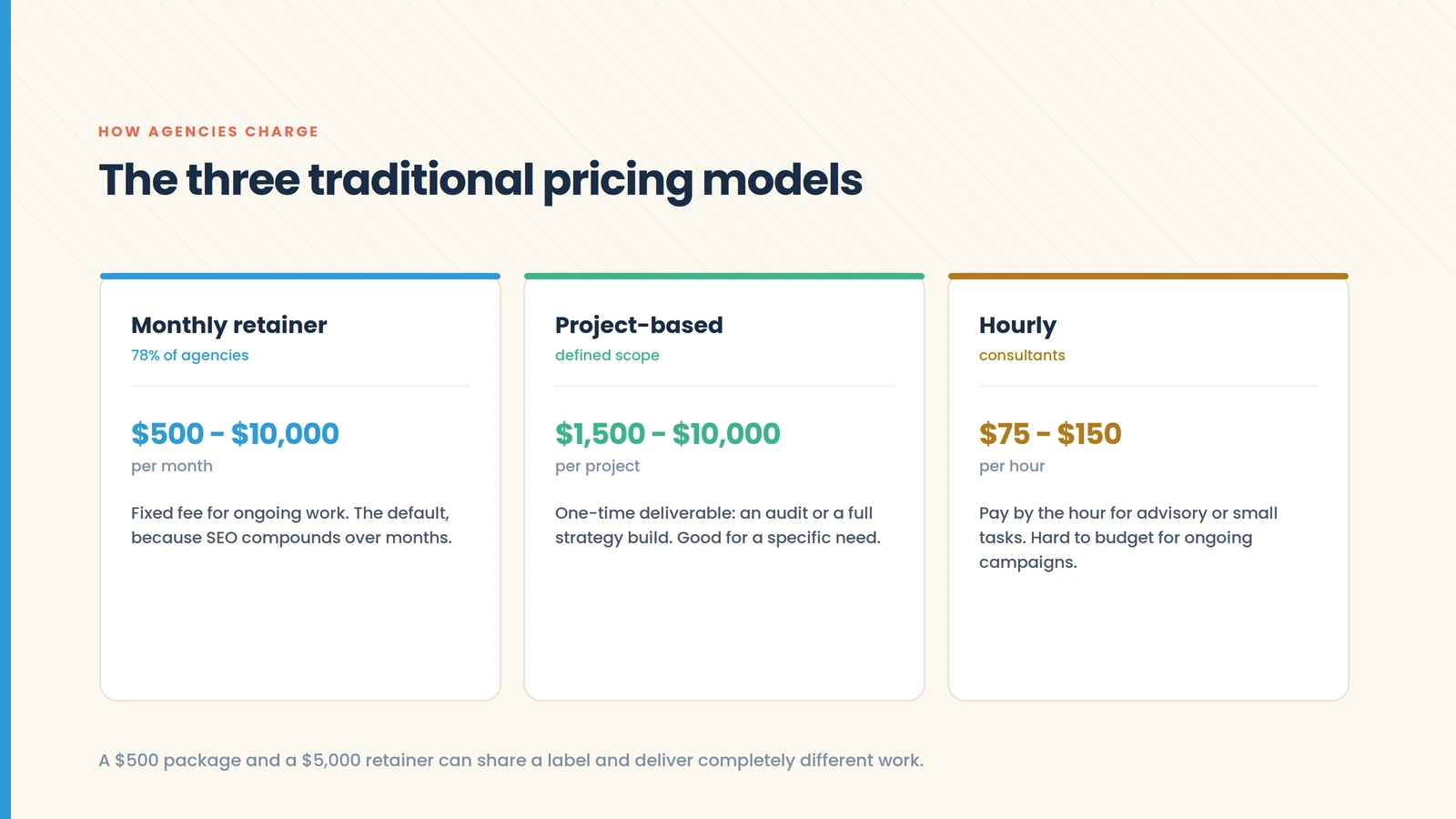
- The three traditional models are monthly retainers ($500–$10k, and the most popular by far), project work ($1,500–$10k), and hourly ($75–$150).
- AI search optimization (GEO/AEO) is the new line item, adding $900+ a month to a retainer or $2,000–$10,000 standalone.
- Price tracks scope, not labels — a $500 package and a $5,000 retainer can share a name and deliver completely different work.
- When comparing quotes in 2026, check whether AI search visibility is included, because a quote that ignores it is pricing for the search of a few years ago.
If you are trying to budget for SEO, the honest answer to “how much does it cost?” is: it depends, but the ranges are knowable. Most businesses pay somewhere between $500 and $10,000 a month, with the average agency retainer sitting around $3,200. What you actually pay comes down to your goals, your market, the scope of work, and one newer factor that didn’t exist a few years ago: whether you also need to be visible in AI search.
This guide breaks down what SEO costs in 2026 across every pricing model, what drives those numbers up or down, and how the rise of AI Overviews and answer engines like ChatGPT is reshaping budgets. The goal is to help you set a realistic budget and recognize a fair quote when you see one.
The Short Answer: What SEO Costs in 2026
Across the major 2026 industry surveys, the numbers converge on a clear picture:
- SEO agency retainer: $1,500 to $10,000 per month, averaging around $3,200
- Local or small-business SEO: $500 to $3,000 per month
- Freelancer or consultant: $500 to $3,000 per month, or $75 to $150 per hour
- Project-based work: $1,500 to $7,500 for an audit, $2,000 to $10,000+ for a full strategy build
- AI search optimization (GEO/AEO): $900+ per month added to a retainer, or $2,000 to $10,000 per month as a standalone service
Those are the headline ranges. The rest of this guide explains what moves you within them, because a $500 package and a $5,000 retainer can carry the same label while delivering completely different work.
Why SEO Matters Enough to Budget For
Before the numbers, the reason the spend is worth it. Most people still start their search for a product or service on Google, and a large share of those searches are for local businesses. Ranking well puts you in front of people who are actively looking for what you offer, which is why organic traffic tends to convert better than most paid channels.
SEO is also cost-effective over time. There are upfront costs, but once a page ranks, the traffic it brings in is essentially ongoing at no additional cost per visit, which is where the strong long-term return comes from. It also builds credibility: appearing prominently in search, and now in AI answers, signals authority in a way advertising cannot buy outright.
What Determines Your SEO Cost
Five factors move your price within the ranges above.
Business goals and competition
The more competitive your market and the more ambitious your goals, the more the work costs. Ranking for high-value, competitive keywords takes more content, more links, and more time than ranking in a narrow local niche. Aligning the SEO strategy to a real business objective, whether that’s traffic, leads, or sales, is what keeps the spend efficient rather than open-ended.
Scope of services
SEO is a bundle of activities, and the more of them you need, the higher the cost. A typical scope includes keyword research, on-page optimization, content creation, link building, and technical SEO. In 2026, a modern scope increasingly adds AI search optimization to that list. A narrow engagement focused on one or two of these costs far less than a comprehensive program covering all of them.
Size of your website
A five-page local service site and a 5,000-page ecommerce store are not the same job. Larger sites need more keyword research, more pages optimized, more technical work, and more ongoing maintenance, all of which raises the cost. Site complexity, like faceted navigation or duplicate product descriptions, pushes it higher still.
Local vs. national SEO
Local SEO, optimizing for a specific geographic area, is generally cheaper because the competition and scope are narrower. It centers on your Google Business Profile, local listings, and location-specific keywords. National or international campaigns compete on a far larger stage and require more extensive work, so they cost more.
Whether you need AI search visibility
This is the factor that didn’t exist in older pricing guides, and it is now one of the biggest drivers of cost. More on this below.
The Three Traditional SEO Pricing Models
Monthly retainers
The most common model by far, used by roughly 78% of agencies, because SEO is ongoing work rather than a one-time fix. You pay a fixed monthly fee for a defined scope of services.
For small businesses and local work, retainers typically run $500 to $3,000 per month. For growing and mid-size businesses, the common band is $1,500 to $5,000 per month, which is where most legitimate agency work sits. Larger and more competitive programs run $5,000 to $10,000 or more. The average agency retainer across 2026 surveys lands around $3,200 per month.
What you get scales with the fee. A budget package might cover basic on-page tweaks and a monthly report. A mid-tier retainer covers technical SEO, content, link building, strategy, and increasingly AI search optimization. The label “SEO retainer” tells you almost nothing on its own; the scope is what matters.
Project-based pricing
For one-time work with a defined deliverable, agencies offer fixed-project pricing. A technical website audit typically runs $1,500 to $7,500 depending on site size. A comprehensive strategy build, including competitor analysis, keyword research, and content planning, runs $2,000 to $10,000 or more. Project pricing suits businesses that want a specific piece of work done rather than an ongoing relationship, though retainer clients tend to see better compounding results over time.
Hourly rates
Consultants and freelancers often bill hourly, typically $75 to $150 per hour, though rates range from $20 at the low end to $200+ for specialists. Hourly works for small, well-defined tasks or advisory work. It’s harder to budget against for ongoing campaigns, which is why most sustained SEO moves to a retainer.
The New Layer: What AI Search Optimization Costs
This is the biggest change to SEO pricing since these guides were first written, and skipping it is the most common way a 2026 budget goes wrong.
Search no longer ends at ten blue links. Google now places an AI Overview above the results, and a growing share of people ask ChatGPT, Perplexity, or Gemini directly instead of searching at all. Being visible in those AI answers requires work that traditional SEO doesn’t fully cover, and that work has its own price.
Two terms describe it. AEO (Answer Engine Optimization) is about structuring content so it can be extracted as a direct answer. GEO (Generative Engine Optimization) is about earning citations inside AI-generated answers. In practice they overlap heavily and are often sold together.
Here’s what the 2026 market charges:
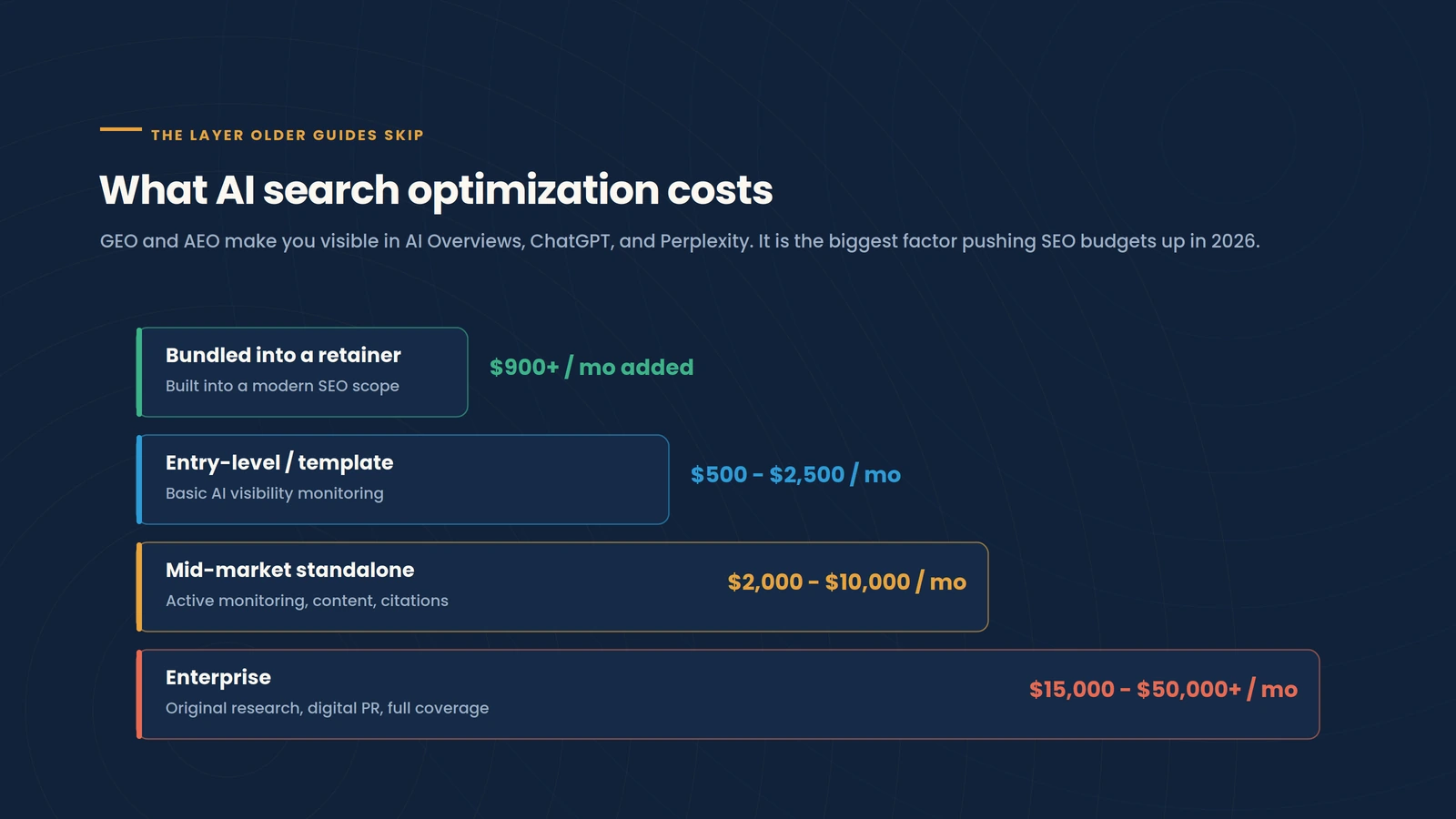
- Bundled into a traditional SEO retainer: AI search optimization commonly adds $900 or more per month to an existing retainer. Many modern agencies now build it into the base scope rather than pricing it separately.
- Entry-level or template-based: $500 to $2,500 per month for basic AI visibility monitoring and foundational work.
- Mid-market standalone retainer: $2,000 to $10,000 per month for active monitoring, content optimization, entity work, and citation building across ChatGPT, Gemini, Perplexity, and Google AI Overviews.
- Enterprise: $15,000 to $50,000+ per month for original research, full content production, digital PR for citations, and cross-platform coverage.
One telling data point: among agencies that raised their prices recently, roughly 37% cited GEO and AEO as the main reason. AI search optimization is the single biggest factor pushing SEO budgets up in 2026.
The practical takeaway: when you compare SEO quotes now, check whether AI search visibility is included, priced separately, or not addressed at all. A quote that ignores it is quoting for the search experience of a few years ago. The good news is that the same foundational work, strong technical health, authoritative content, and consistent information, helps you in both traditional search and AI answers, so a well-built program serves both at once.
What a “Reasonable” Price Looks Like
A fair price is one where the scope matches the fee and the fee matches your goals. As rough guidance:
- A local business with modest goals can expect to pay $500 to $2,000 per month and get meaningful results.
- A growing business in a competitive market should budget $2,000 to $5,000 per month for a program that includes content, links, technical work, and AI search optimization.
- A business with national ambitions or a large site should expect $5,000 to $10,000+ per month.
Be skeptical of anything far below these ranges. SEO at $100 a month is almost always automated output with little real strategy, and it rarely moves the needle. The cheapest option usually costs more in wasted time than it saves in fees.
Why the Monthly Retainer Is the Most Popular Model
Retainers dominate because SEO rewards consistency. Rankings and AI citations build over months of sustained work, not a single push. A retainer gives you:
- Ongoing execution, so the work continues as search engines and AI systems change
- A dedicated team that knows your site and market over time
- Compounding results, since content and authority built this month keep paying off next year
- Adaptability, so strategy can shift as algorithms, AI Overviews, and competitors move
Retainer clients also tend to stay engaged far longer than project clients, which tracks with how SEO value actually accumulates.
What a Monthly Retainer Usually Includes
A solid 2026 retainer typically covers:
- Keyword and search-intent research
- On-page optimization
- Content creation and optimization
- Link building and digital PR
- Technical SEO
- AI search optimization (GEO/AEO)
- Monitoring, reporting, and strategy
If a retainer leaves out AI search work entirely, that’s worth questioning in 2026.
How to Choose the Right SEO Company
Price is one input, not the whole decision. When comparing providers:
- Ask what’s actually included, especially whether AI search optimization is in scope.
- Look for a clear method, not guarantees. Anyone promising a #1 ranking or instant AI citations is overselling.
- Check real results, case studies, and references, not just a client logo wall.
- Understand the reporting, so you know what you’ll see each month and how success is measured.
- Favor transparency on pricing. A credible provider explains what drives the cost and sets realistic timelines.
What If Your Budget Is Tight?
Limited budgets can still make progress. Prioritize the highest-leverage work first: fix technical issues, optimize your most important existing pages, and claim and complete your Google Business Profile and key named profiles. Focus on a narrow set of achievable keywords rather than trying to compete everywhere at once. You can expand scope as results, and budget, grow. Starting small and consistent beats an ambitious program you can’t sustain.
Should You Increase SEO Spend Over Time?
Often, yes, if it’s working. SEO compounds: as you build authority and content, each additional investment tends to produce more than the last, up to a point. A sensible approach is to start at a level you can sustain, measure the return, and increase the budget as the results justify it, rather than committing to a large spend before you’ve seen the program perform.
What’s the ROI of SEO?
SEO is one of the higher-return marketing channels when done well, because the traffic is intent-driven and the cost per visit falls over time as rankings hold. Unlike paid ads, which stop the moment you stop paying, organic rankings and AI citations keep working. The return isn’t instant, results typically build over months, but the compounding nature means a well-run program often outperforms paid channels on long-term return. Measuring it means tracking not just traffic but leads, conversions, and revenue influenced, including the branded searches and direct visits that AI visibility increasingly drives.
The Bottom Line
SEO in 2026 costs most businesses between $500 and $10,000 per month, with the average agency retainer around $3,200. What you pay depends on your goals, your market, your site, and whether you need AI search visibility, which is now one of the biggest factors in the price. The single most important thing when comparing quotes is to look past the label and check the scope, especially whether the work covers both traditional search and AI answers, because that’s where discovery actually happens now.
If you want a realistic estimate for your specific situation, a professional SEO services provider can asses and map what you need, what it should cost, and where AI search changes the priorities.