
Key Takeaways
- Excellent Ad Strength measures creative potential, not conversions, so it can look great while results stay flat.
- Google can only test real variety when your headlines give distinct buying reasons, not the same idea reworded.
- More clicks isn't progress: if conversions stay flat, you're paying for broader, lower-intent attention.
- Constantly rewriting assets before they gather enough data destroys the signal you need to learn anything.
- Ads decay as the market shifts around them, so refresh messaging against current competitors, not just account data.
There is a frustration that Google Ads managers encounter often enough to recognize on sight: an RSA showing Excellent Ad Strength, a healthy click-through rate, and conversion numbers that do not move. The ad appears healthy by several platform metrics. The account looks well-managed. The business outcome says otherwise.
Responsive Search Ads are not a broken format. Across conversion-focused accounts, what goes wrong is fairly consistent: the metrics Google makes most visible get optimized, while the inputs that drive commercial results get less attention. Google’s automation works with the assets it receives. When those assets are shaped around platform recommendations rather than clear customer value, the system may have less persuasive material to combine than the asset count suggests.
This article works through the recurring patterns behind RSA underperformance and offers a clearer path toward ads that serve business outcomes, not just account dashboards.
Why Responsive Search Ads Underperform More Often Than They Should
Google’s matching system assembles combinations from the headlines and descriptions an advertiser provides. Diversity in message is not the same as diversity in wording, and the platform cannot make that distinction on the advertiser’s behalf.
Ad Strength scores, asset ratings, and recommendation prompts are useful feedback tools, but they measure creative potential. They do not measure whether that potential is producing business results. Attention flowing toward the most visible metrics rather than the most meaningful ones is where underperformance often begins.
Four patterns appear repeatedly in RSAs that are not delivering:
- Weak message diversity, where headlines vary in wording but repeat the same underlying idea
- Misreading optimization signals as performance indicators
- Frequent asset changes that reduce the time available to evaluate combinations before further edits are made
- Creative that has grown less distinctive as competitors adopt similar messaging and customer expectations shift
Each has a distinct cause and a distinct fix.
Your Ad Strength Is Excellent, But Results Aren’t
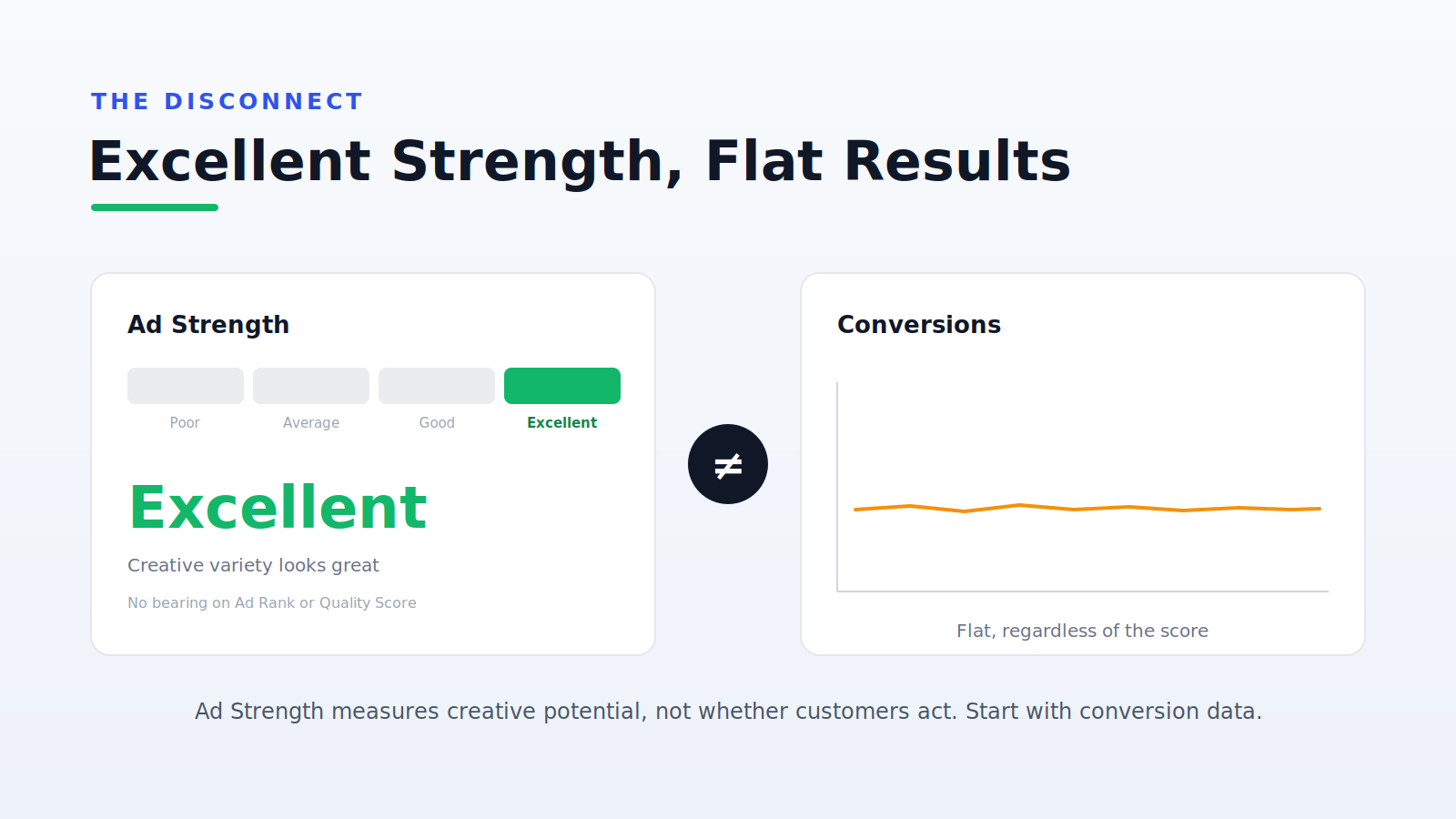
An excellent Ad Strength score often reassures advertisers that the creative is in good shape. That reassurance is worth questioning. The score evaluates the ad’s creative potential, not whether those combinations are persuading customers to act. According to Google, Ad Strength measures asset quality and diversity and has no bearing on auction eligibility, Ad Rank, or Quality Score.
Ad Strength is highly visible, updates dynamically, and responds quickly to creative changes. Conversion data takes longer to accumulate and requires more volume before it can be read with confidence. The metric that responds fastest is also the one least connected to commercial outcomes, which is why assets get rewritten to move a score while conversion data goes unexamined.
Start with conversion data. Conversions, cost per acquisition, return on ad spend, and lead quality tell you whether the ad is working commercially. The actual performance data comes first. Ad Strength gets consulted after as a check on creative variety rather than a measure of campaign health. That sequence changes what gets optimized and why.
If Ad Strength is not the issue, the next question is whether Google is actually being given meaningful creative choices to work with.
Why Google Often Shows the Same Headlines
The advertisers who get the most from RSAs do not think in terms of headlines. They think in terms of distinct buying reasons. Google’s system can generate useful variation only when the underlying messages are genuinely different from one another. Rotating three headlines that all say “affordable” in different words gives the system three versions of one argument, not three arguments.
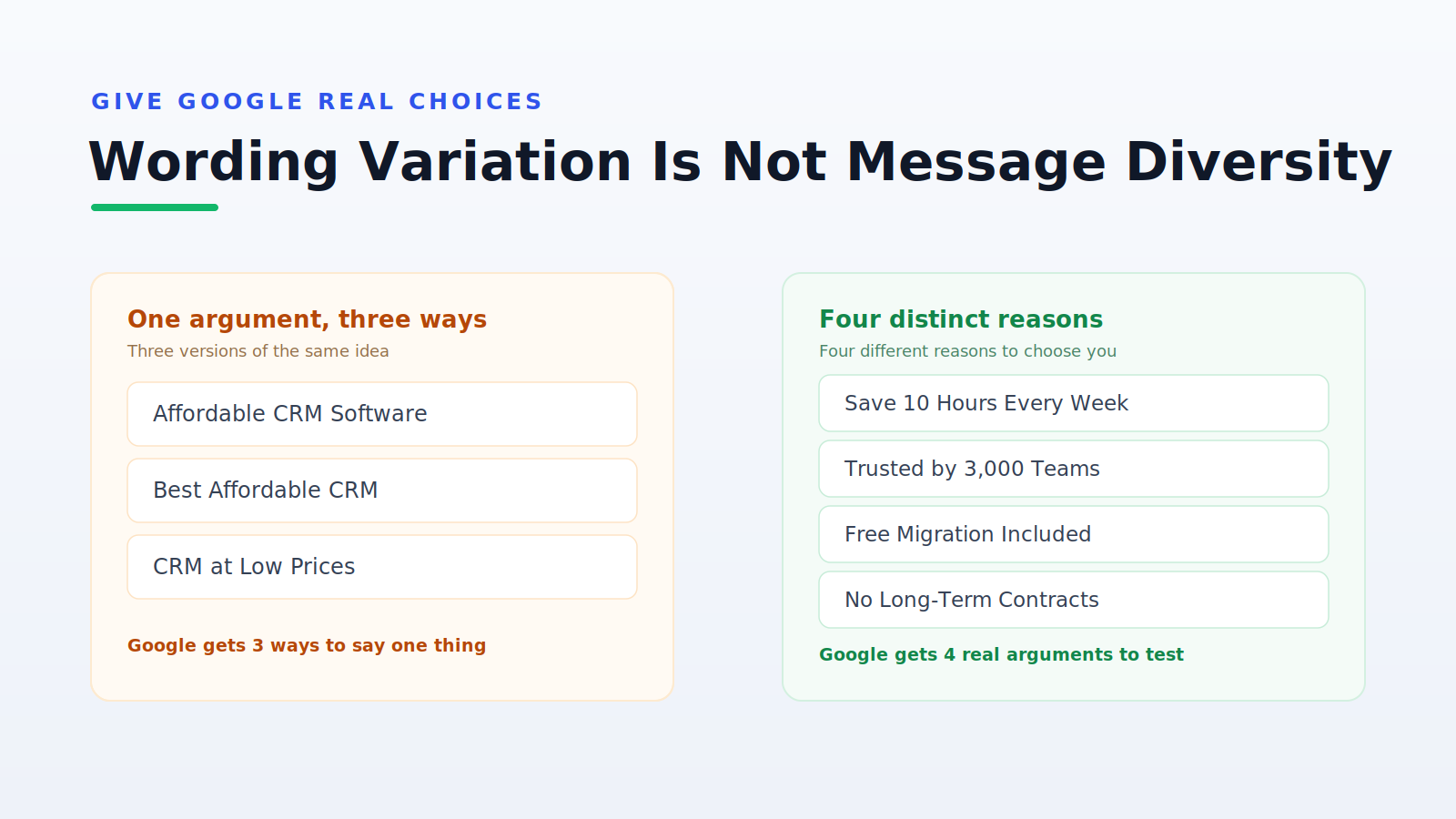
Consider the difference. These three are wording variation without message diversity, three ways to say one thing:
- Affordable CRM Software
- Best Affordable CRM
- CRM at Low Prices
These four are genuine message diversity, four distinct reasons a customer might choose the product:
- Save 10 Hours Every Week
- Trusted by 3,000 Teams
- Free Migration Included
- No Long-Term Contracts
The first set gives Google three ways to say the same thing. The second gives Google four distinct reasons a customer might choose this product. When an RSA keeps showing the same combinations, the more productive place to look is not the account settings but whether the headlines are actually saying different things. Across industries, that distinction tends to determine how much useful work Google’s matching can do.
Even with strong message variety inside an RSA, the ad can still underperform if those messages are pulling in the wrong audience.
You’re Getting More Clicks, But Not More Customers
A stronger CTR does not automatically mean progress. If conversion efficiency falls at the same time, the campaign may simply be paying for more attention rather than better customers.
When a CTR increase runs alongside flat conversions, the ad has likely started reaching a broader audience, some of whom had lower purchase intent from the beginning. A broad benefit in the headline draws a broad audience. Click volume rises, conversion rate falls, and total conversions stay roughly flat or soften. The additional traffic is real. The additional revenue is not.
Tighter offers, more specific language, and clearer qualifications in the headlines often reduce lower-intent clicks while improving the ratio that converts. The goal of Google Ads management at this level is not to win more auctions. It is to win the right ones. An ad that qualifies its audience through specificity does more commercial work than one that attracts attention through breadth.
You’re Constantly Tweaking Assets Without Learning Anything
It is surprisingly common to rewrite an RSA after one disappointing week, only to find that several other changes happened during the same period. At that point, it is difficult to know which adjustment actually mattered, and the next round of changes starts from the same uncertain footing.
Changing assets before enough data has accumulated fragments performance across multiple versions. An asset combination needs sufficient impression volume before its results reflect anything more than normal variation. Changing a headline after a few hundred impressions is a different decision from changing one that has shown a consistent pattern across a much larger sample. The difference is not caution. It is whether the data is saying something or whether the account is just noisy.
As Google notes, Ad Strength recalculates as assets, keywords, and account context shift. Treating every recalculation as a prompt to act makes it harder to identify what is genuinely driving performance. This is one of the dynamics behind Google Ads performance plateaus. Consistent review intervals, with changes tied to identified patterns rather than recent fluctuations, tend to produce more legible results over time.
Your Responsive Search Ads Haven’t Evolved With Your Market
The previous section is about variety within an RSA. This one is about whether those messages are still distinctive in the market they are running in. Both matter, but they require different kinds of attention.
An RSA that performed well a year or more ago was built for a different competitive environment. What felt specific at launch can become harder to distinguish from category noise as competitors adopt similar language and customer expectations adjust. The ad has not changed. The context around it has.
This is easy to miss because the shift happens outside the account. When headlines have not changed, there is no obvious account-level event to investigate. Performance may erode gradually. The ad may continue generating clicks, but a smaller share may come from people with genuine purchase intent.
Refreshing RSA creatives does not mean rebuilding campaigns. It means paying closer attention to what the market is currently saying: what competitors now emphasize, what objections surface in customer conversations, and what the category has started to take for granted. Paid search work tends to focus on account data, which makes it easy to miss those shifts entirely. Treating observation as a deliberate part of creative review produces better inputs than waiting for performance to deteriorate before revisiting messaging.
A 5-Minute RSA Audit Before You Publish or Optimize
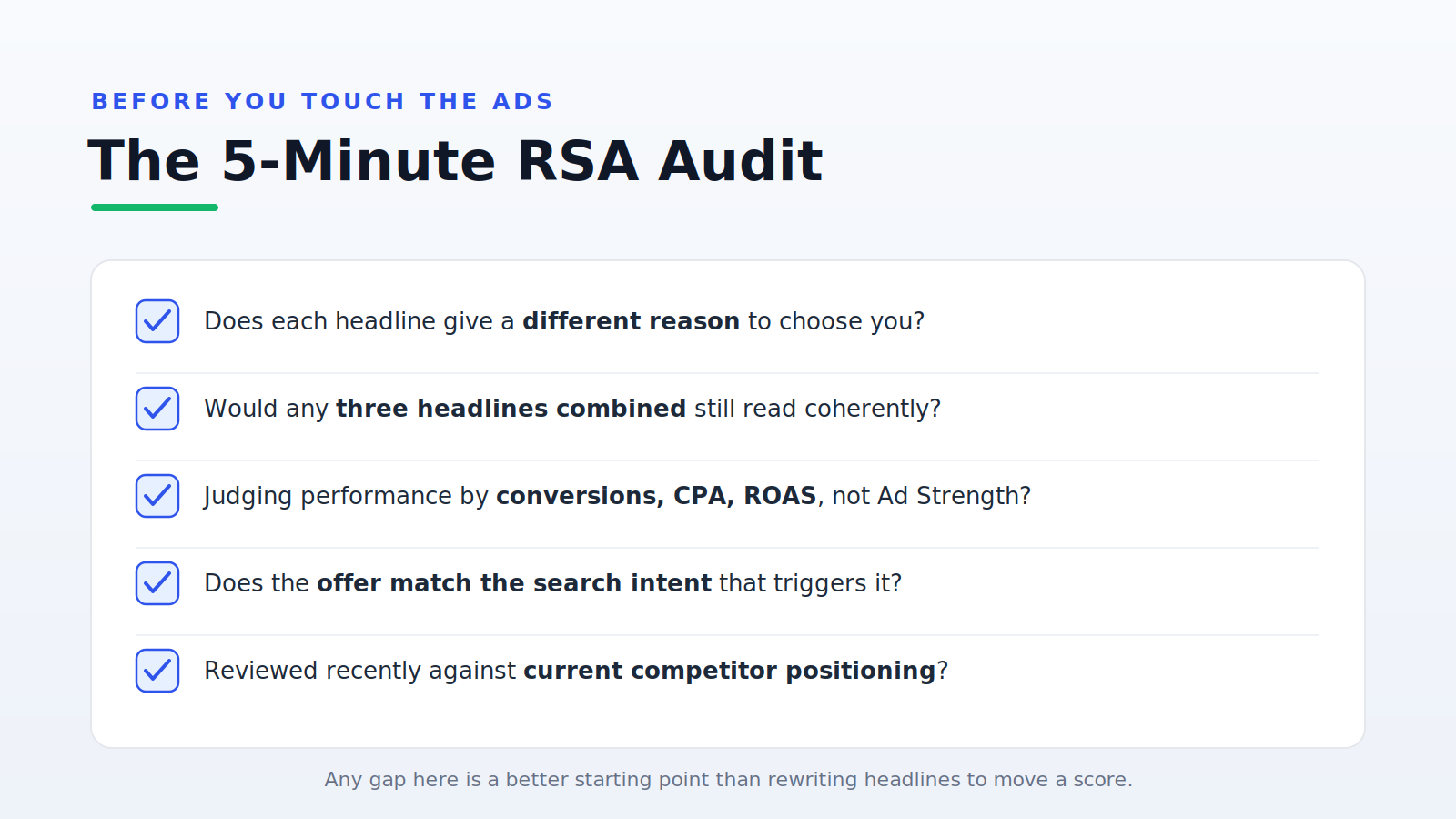
Run through these before making any change to an underperforming RSA:
- Does each headline communicate a different reason to choose this product or service?
- Would a random combination of three headlines still form a coherent, credible message?
- Are you evaluating performance using conversions, CPA, or ROAS rather than Ad Strength alone?
- Does the offer in the ad match the intent of the search terms triggering it?
- Has the core messaging been reviewed recently against current competitor positioning?
If any of these surfaces a gap, addressing it is a more productive starting point than rewriting headlines to improve an asset rating.
Conclusion
Google’s automation is capable, but it works with the inputs it receives. The accounts that see consistent RSA performance tend to treat the ad as a commercial argument, not a platform compliance exercise. That means building assets around distinct buying reasons, evaluating success through business metrics rather than creative scores, and revisiting messaging as the market around it changes.
Before making the next change to an underperforming RSA, run it through the checklist above. The issue often lies in the strategic inputs, such as messaging quality or asset relevance, rather than in the ad format itself.
If you would rather have someone audit your RSAs against these patterns before making further changes, our Google Ads management service is a good place to start.