
Most guides to Instagram advertising are quietly out of date. They walk you through an interface that no longer exists, list campaign objectives Meta retired years ago, and quote click costs from before the iOS privacy changes reshaped the whole system. If you set up a campaign by following one of them, you would spend the first ten minutes looking for options that are not there anymore.
So this is not another click-here-then-here walkthrough. It is a current picture of how Instagram advertising actually works in 2026: what Meta changed, which of the six campaign objectives to pick, what ads really cost now, and the budget mistakes we see waste money most often. The mechanics of the buttons shift constantly. What is worth understanding is the logic underneath them, because that is what still holds when the interface moves again.
Instagram is worth the effort: it now has around 2.4 billion monthly users, and in the US alone roughly half the population is active on it, skewing heavily toward the 18 to 34 audience most brands want to reach. The platform is bigger than ever. What has changed is how you buy attention on it.
What Actually Changed Since the Old Playbook
Four shifts matter more than any button-level detail, and they are why older tutorials mislead.
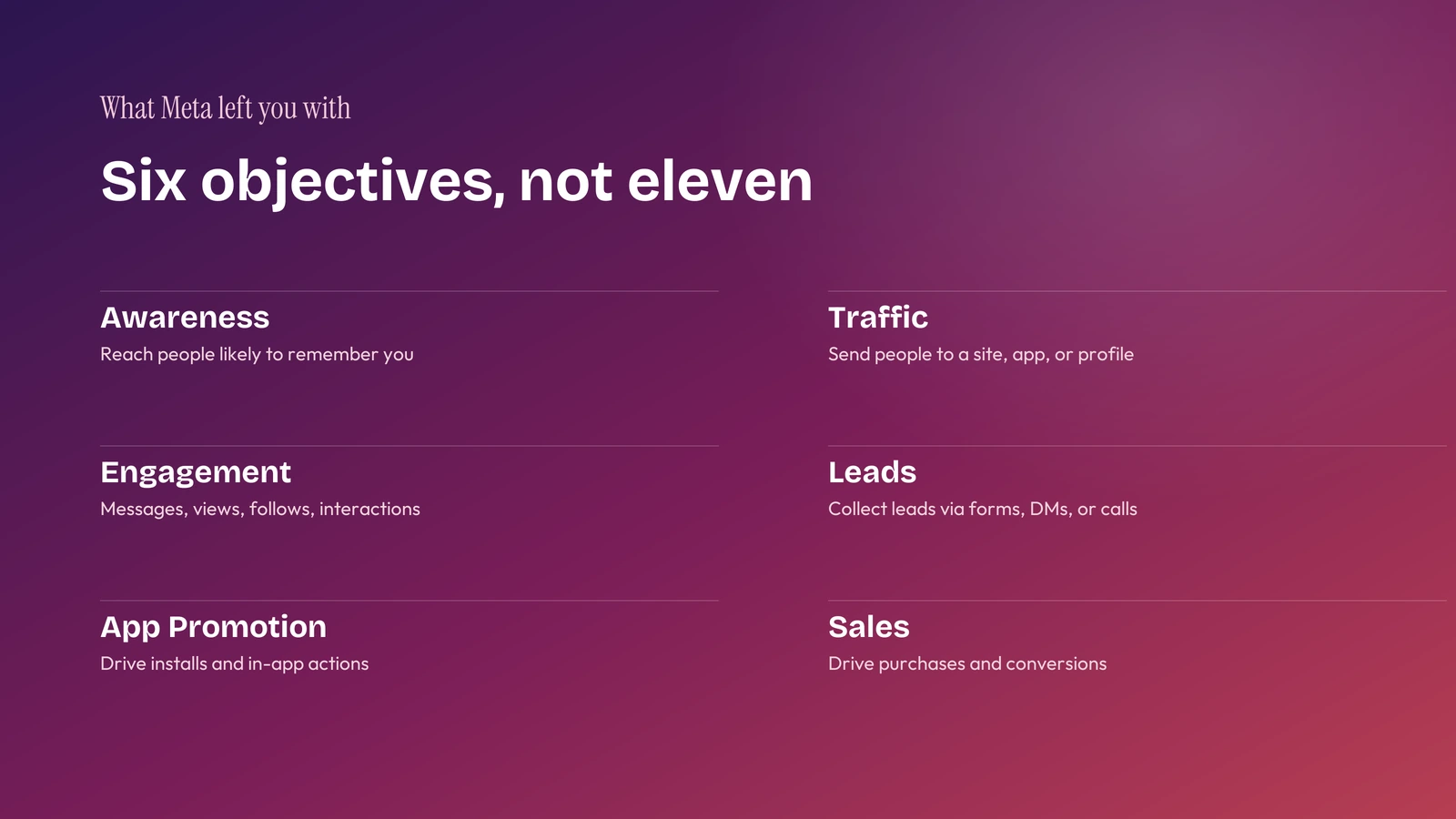
Meta replaced 11 objectives with 6. The old campaign setup asked you to choose among Brand Awareness, Reach, Traffic, Engagement, App Installs, Video Views, Lead Generation, Conversions and more. That system, and every guide built around it, is gone. Meta now uses ODAX (Outcome-Driven Ad Experiences), which collapses everything into six outcome-based goals. If a guide still lists “Brand Awareness” and “Reach” as separate objectives, it predates this change.
AI now runs more of the campaign than you do. Advantage+ is Meta’s suite of AI-driven tools, and in 2026 it does much of the heavy lifting that advertisers used to do by hand: finding the audience, placing the ads, and optimizing delivery. Detailed manual targeting still exists, but the system increasingly rewards giving the AI room rather than over-constraining it. This is the single biggest practical shift, and it inverts a lot of old advice.
Privacy changes made precise targeting less reliable. After Apple’s iOS tracking changes, the granular interest-and-behavior targeting that older guides lean on lost much of its precision. Broad targeting plus strong creative now often outperforms narrow targeting plus weak creative, which is close to the opposite of the 2022 approach.
Reels became the center of gravity. Short vertical video is now where much of Instagram’s attention and ad inventory sits. A 2022 guide treats Reels as an afterthought. In 2026, if your creative is not built vertical-first, you are competing poorly for the placements that matter most.
The Six Campaign Objectives, and Which to Pick
Everything in a Meta campaign still starts with the objective, because it tells the AI what to optimize for. Here are the current six and when each fits.
- Awareness: show your ad to the most people likely to remember it. Use it for top-of-funnel brand building, not for direct response.
- Traffic: send people to a destination, a website, app, or profile. Use it when the click itself is the goal, though not when you can measure a real conversion instead.
- Engagement: drive messages, video views, post interactions, or follows. Use it to build an active audience or warm people up.
- Leads: collect leads through instant forms, messages, or calls. Use it for service businesses and anyone whose sale happens off-platform.
- App Promotion: drive installs and in-app actions. Only relevant if you have an app.
- Sales: drive purchases and conversions, on-site or in-catalog. Use it for ecommerce and any campaign where revenue is the point.
The common mistake is choosing Traffic or Engagement because the numbers look good and cheap, when the business actually needs Sales or Leads. Cheap clicks and easy engagement are the most flattering metrics on the platform and the least connected to revenue. Pick the objective that matches the business outcome, not the one that will make the dashboard look busy.
Setting Up: The Short Version
The setup flow is simpler than most guides make it sound, and it has not fundamentally changed even as the screens have.
You need an Instagram professional account (switch from a personal one in your profile settings) connected to a Meta Business Suite account. Ads run through Meta Ads Manager, not a separate Instagram tool, because Instagram and Facebook share one ad system. Inside Ads Manager you build a campaign in three layers: the campaign (where you pick the objective), the ad set (where you set audience, placements, and budget), and the ad itself (the creative). That three-layer structure is the one durable thing to understand; the exact menu labels will keep moving.
One setup choice still trips people up: placements. By default Meta will run your ads across both Facebook and Instagram. If you specifically want Instagram, you can select it, but in 2026 the stronger default is usually to let Advantage+ placements run everywhere and judge by results, rather than restricting inventory out of habit. Narrowing placements by hand often raises your cost per result rather than lowering it.
Audience Targeting in 2026
This is where the old playbook goes most wrong. It describes layering detailed demographics, interests, and behaviors to build a tight audience. That approach has lost much of its edge.
With Advantage+ audience, you now give Meta a suggestion of who to target and let the system expand beyond it when it finds people likely to convert. The location, age, and language controls still matter, and custom audiences (your own customer lists and site visitors) and lookalike audiences built from them are still genuinely valuable, because they start from real data you own. But stacking narrow interests on top of all that increasingly works against you, by starving the AI of the room it needs to find buyers.
The practical rule we follow in 2026: start broader than feels comfortable, anchor with a custom or lookalike audience where you have the data, and let strong creative do the targeting work that interest-stacking used to do. The creative is now the targeting.
The Ad Formats That Matter
Instagram supports several formats, but they are not equally important anymore.
Reels are the priority. Full-screen vertical video (9:16) is where attention and inventory concentrate. If you make one format well, make this one.
Stories remain strong for full-screen, time-limited promotion, also vertical.
Feed ads (single image, video, or carousel) still work, especially carousels for showing multiple products or telling a short sequence.
Collection and Shop formats support ecommerce, turning an ad into a tappable storefront.
The format question in 2026 is less “which one is allowed” and more “is this built vertical-first.” A horizontal video repurposed into a vertical placement reads as an afterthought, and it performs like one.
What Instagram Ads Actually Cost in 2026
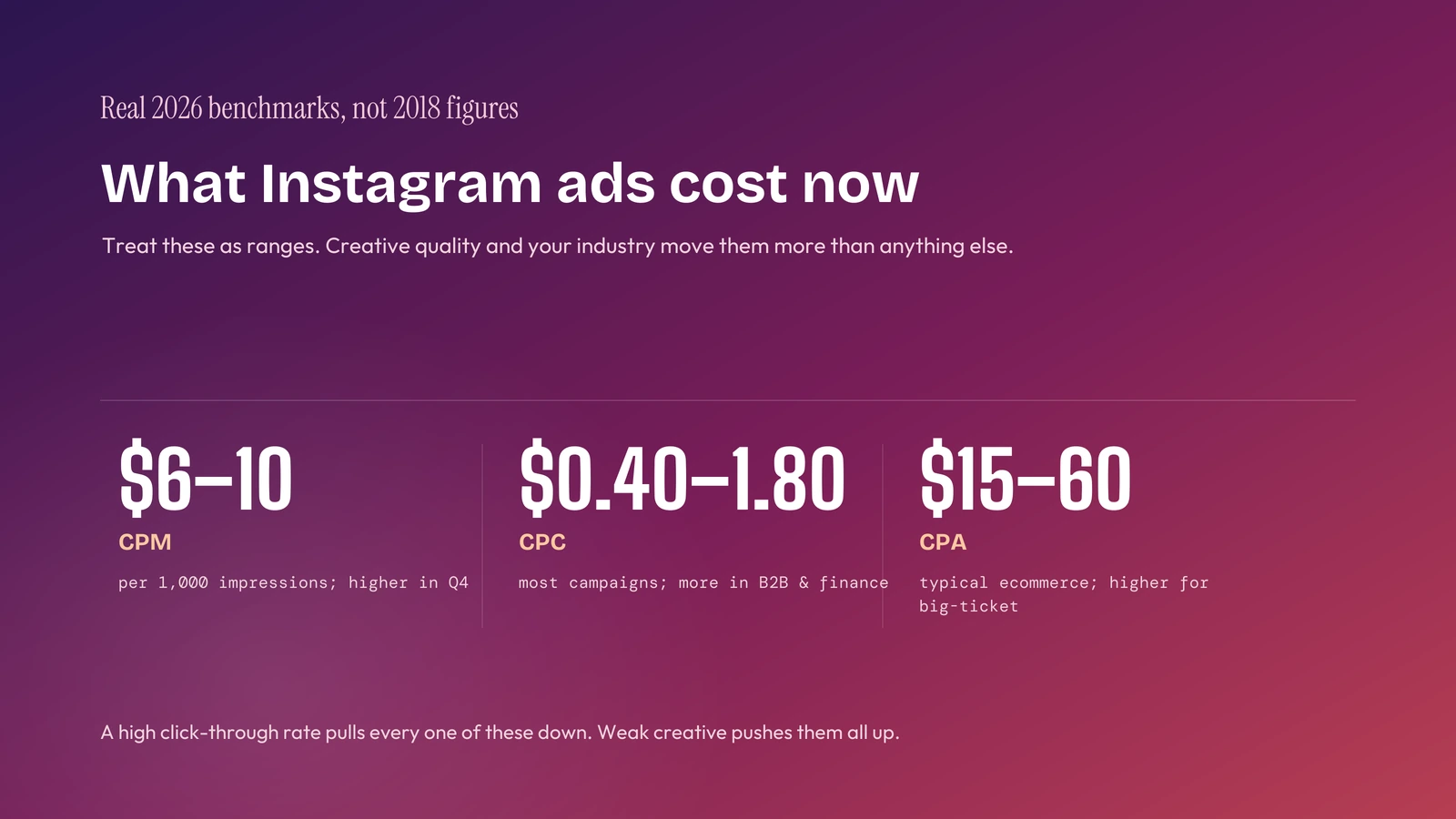
Cost depends on your objective, audience, competition, industry, and season, so treat these as ranges, not promises. But the real 2026 benchmarks look nothing like the sub-dollar figures older guides quote.
- CPM (cost per 1,000 impressions): roughly $6 to $10 on average, higher in competitive verticals like beauty and finance, and 40 to 80% higher in Q4 when everyone is bidding for holiday attention.
- CPC (cost per click): roughly $0.40 to $1.80 for most campaigns, rising well above that in high-value industries like B2B, finance, and legal.
- CPA (cost per acquisition): commonly $15 to $60 for ecommerce, and much higher for considered or high-ticket purchases.
Two things move these numbers more than anything else. Creative quality is the big lever: a high click-through rate pulls your costs down across the board, because Meta rewards ads people actually engage with. And competition in your specific industry sets the floor. A legal or finance advertiser will never pay apparel prices, no matter how good the campaign.
If you are starting out, a budget of around $20 to $30 a day is enough to gather real signal without burning money while you learn. Watch the results for a week or two before scaling, and increase spend only once a campaign is actually producing the outcome you set, not just cheap clicks.
The Budget Mistakes That Waste the Most Money
This is where experience matters more than the interface, and where most self-run campaigns leak money. The patterns we see most often:
Optimizing for the wrong objective. Choosing Traffic or Engagement because it is cheap, when the business needs Sales or Leads. The campaign looks like it is working while producing nothing that matters.
Over-narrowing the audience. Stacking interests and behaviors until the AI has no room to find buyers. In 2026, this usually raises cost per result rather than improving quality.
Scaling too fast off a good week. A strong result at one budget level does not guarantee the next dollar performs the same way. When you double the budget, you are often buying into different, less efficient inventory. Scale in steps and watch whether the economics hold, rather than assuming they will.
Judging the campaign by platform metrics alone. A low cost per click means little if those clicks never convert. The numbers inside Ads Manager describe behavior at the ad; the business result happens after the click, on your landing page and in your follow-up. If the campaign metrics look great but revenue is flat, the problem is usually not the ad.
Letting the creative go stale. The same ad shown too long to the same audience fatigues, and your costs quietly climb. Refreshing creative regularly is one of the most reliable ways to keep costs down.
When to Run It Yourself, and When to Get Help
Plenty of businesses can run effective Instagram ads in-house, especially with a clear objective, honest measurement, and someone willing to watch the results and adjust. The barrier to starting has never been lower.
The cases that benefit from expert help are the ones where getting it wrong is expensive: a meaningful monthly budget, a competitive or high-cost industry, a complex funnel where the sale happens well after the click, or a history of spend that produced activity without results. Those are the situations where the difference between a campaign that looks busy and one that actually grows the business is worth paying for.
If your Instagram ads are spending without clearly producing, or you want a campaign built around real business outcomes rather than platform-level vanity metrics, our social media advertising team can audit what you are running or build it properly from the start.