
Key Takeaways
- Managing your name in 2026 means both Google and AI, since AI Overviews and chat assistants now answer questions about you above or instead of the ten blue links.
- Removal takes content down at the source and needs policy, law, or publisher cooperation; suppression just outranks it with stronger positive content, and most situations need both.
- Google's free Results about you tool now removes search results exposing your phone, email, address, and government ID numbers, but it hides them from Search, not from the web.
- Outranking a negative result no longer solves it, because AI keeps reading live sources even after they fall in rankings, so you have to address the source itself.
- The tactics that still work, genuine removal, real authority, and consistent facts across your profiles, are the same ones that make AI describe you accurately.
Your name is searched more often than you think, by employers before an interview, clients before a contract, dates before a first meeting, and investors before a deal. For most people, the first page of Google, and now the AI summary that sits above it, is their reputation. When something unfair, outdated, or damaging shows up there, the instinct is to get it gone as fast as possible.
The reality is more involved than a single delete button, and in 2026 it has changed in one important way: it is no longer only about Google’s ten blue links. AI Overviews and chat assistants like ChatGPT, Gemini, and Perplexity now answer questions about you by drawing from sources across the web, which means a negative result can shape what AI says about you even when it is buried on page two. Removing what you can and controlling what remains now spans both traditional search and AI search.
This guide explains what can realistically be removed, what can only be suppressed, how AI search has changed the rules, and the order to work in.
Removal vs. Suppression: Two Different Jobs
Two tactics get used interchangeably, and conflating them leads to wasted time and money.
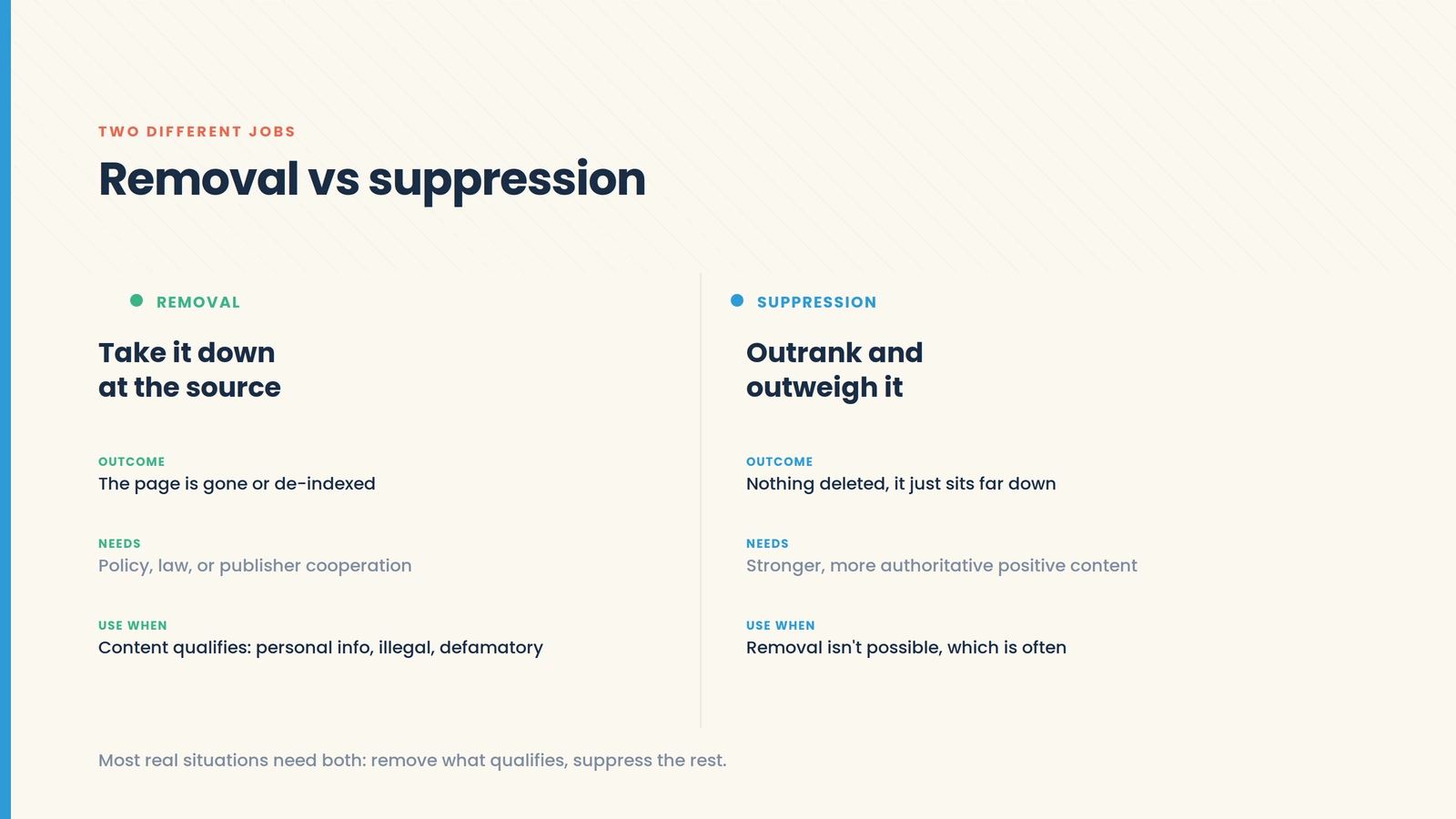
Removal means getting the content taken down at its source, or de-indexed from search. When it works, the page is gone or no longer appears in results. Removal is the stronger outcome, but it depends on the content qualifying under a platform’s policy, the law, or the cooperation of whoever published it. You cannot remove something just because it is unflattering.
Suppression means pushing negative results down by building stronger, more authoritative positive content that outranks them. Nothing is deleted. The negative content still exists; it just sits far enough down that fewer people see it. Suppression is what you use when removal isn’t possible, which is often.
Most real situations need both: remove what qualifies, suppress the rest.
What You Can Actually Get Removed From Google
Google will remove certain categories of content from search results, and in 2026 the tools for doing this are far better than they were a few years ago.
Personal and sensitive information
Google’s free Results about you tool, now used by more than 10 million people, lets you monitor for and request removal of search results that expose your personal information. As of its February 2026 update, that includes your phone number, email, home address, and now government-issued ID numbers like a passport, driver’s license, or Social Security number. You add the details you want watched, Google scans for them and notifies you when they appear, and you can request removal directly from the dashboard. You can find it at goo.gle/resultsaboutyou or through the Google app.
Google also removes, through its policies and request forms, content such as financial account numbers, login credentials, confidential medical records, and non-consensual explicit images. The explicit-image removal process was also simplified in 2026: you can now start a request from the three-dot menu on a Google Images result, submit several images at once, and track every request in one place.
One important limit: removing something from Google Search does not remove it from the web. The page still exists; it just no longer surfaces in Google for those queries. For full removal you still have to go to the source.
Content that breaks a platform’s rules
Most platforms, from review sites to social networks to forums, have policies against harassment, impersonation, doxxing, and certain kinds of false or abusive content. If a post genuinely violates those rules, reporting it through the platform’s own process is often the fastest route. The key is matching the content to a specific policy it breaks, rather than simply arguing that it is unfair.
Content that is illegal or defamatory
Where content is defamatory, violates a court order, or breaks the law, a formal legal request to the host, or a court order, can compel removal. This route is slower and usually needs legal help, but it carries weight that a polite request does not, especially when backed by documentation.
What Google will not remove
Google generally will not remove content simply because it is negative, embarrassing, or old, as long as it is lawful and publicly available. Honest reviews, legitimate news coverage, and public records usually stay. This is the point where suppression, not removal, becomes the realistic goal.
How AI Search Changed the Rules in 2026
This is the part that did not exist when most reputation advice was written, and it is the single biggest shift.
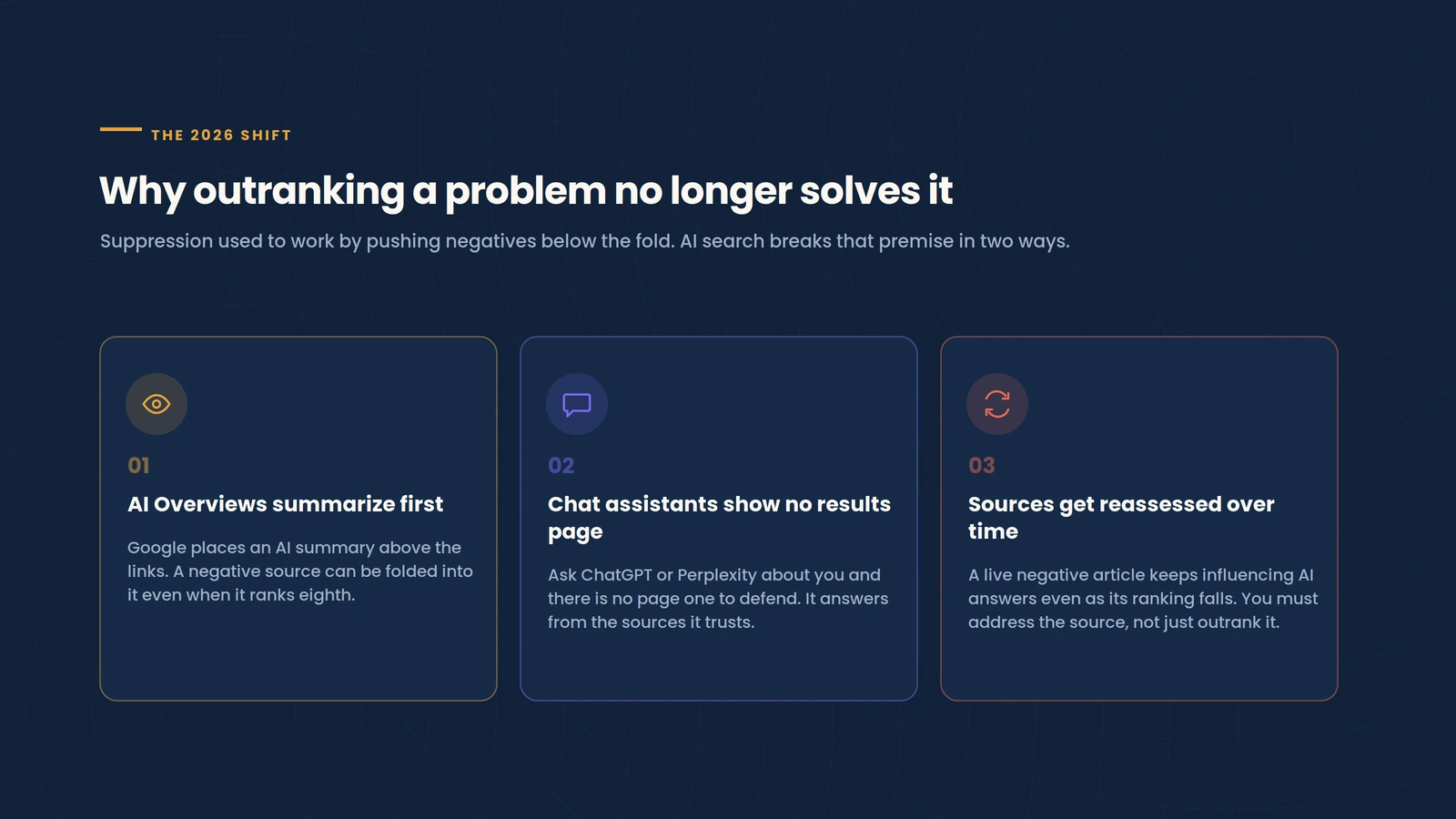
Traditional suppression worked on a simple premise: push the negative result far enough down page one, or onto page two, and most people never see it, because most people never scroll. AI search breaks that premise in two ways.
AI Overviews summarize before anyone scrolls. Google now places an AI-generated summary above the regular results, assembled from multiple sources. If a negative article is authoritative enough, the AI can fold it into that summary even when it is not the top-ranked link. Pushing it to position eight does not help if the AI still reads it and repeats it.
Chat assistants don’t show a results page at all. When someone asks ChatGPT, Gemini, or Perplexity about you, there is no page one to defend. The assistant draws on sources it considers trustworthy and produces a single answer. If the sources it relies on skew negative, the answer skews negative, and traditional ranking position is almost irrelevant.
The practical consequence: in AI search, you cannot suppress a problem purely by outranking it. AI systems periodically reassess the sources they draw from, so a negative article that stays live and authoritative keeps influencing AI answers even as its search ranking falls. That makes addressing the source itself, through removal where possible or by building stronger, more authoritative positive sources, far more important than it used to be. It also makes a new failure mode possible: an AI summary that is simply wrong about you, stitched together from bad or outdated data. Correcting that means fixing the underlying sources the model is reading, not filing a takedown.
This is why modern reputation work has to cover both surfaces at once. The same authoritative, well-structured, consistent content that helps you in Google is what AI engines prefer to cite, so the two goals reinforce each other when the work is done well.
How to Suppress Negative Results That Can’t Be Removed
When content can’t be removed, the goal is to make stronger positive content rank above it, and to make that content the kind AI engines trust and cite. The principle is the same across both: be the most authoritative, consistent, well-structured source about yourself.
Own your named properties
Secure and fully build out the profiles that rank for your name: a personal website, LinkedIn, and the major social and professional platforms relevant to you. These rank well for name searches and give you controlled real estate on page one. Keep them complete, current, and consistent with each other, because inconsistency across your own profiles is one of the most common reasons AI describes a person wrongly.
Publish genuinely useful content under your name
Create content that is worth finding: articles, interviews, talks, case studies, or expertise you can legitimately claim. This is where the old playbook of paying to place thin, self-written “news” articles has stopped working. Google’s quality systems and AI engines both reward demonstrated experience and authority, and penalize low-quality placement. Publish things that are actually true and actually useful, and they do double duty, ranking in Google and earning citations in AI answers.
Earn authoritative third-party coverage
AI systems weight independent, third-party sources more heavily than content on your own website. Legitimate press coverage, interviews, mentions on respected industry sites, and genuine reviews on structured platforms all shape how both Google and AI characterize you. This is the single highest-leverage suppression activity in the AI era, because it addresses the sources the models actually read.
Keep profiles and facts consistent
An AI assistant builds its picture of you from many places at once. If your bio says one thing on LinkedIn, another on your website, and a third in an old interview, you give the model room to get you wrong. Consistent names, titles, descriptions, and facts across every property reduce that risk and strengthen the overall signal.
Be patient and keep going
Suppression is gradual. Rankings shift over weeks and months, and AI systems re-evaluate sources on their own schedule. New content can also appear later, so monitoring is part of the job, not a one-time fix.
A Realistic Order of Operations
Working in the right sequence saves effort and money.
- Audit both surfaces. Search your name in Google and note everything on the first two pages. Then ask ChatGPT, Perplexity, and Google’s AI about yourself and note what they say and which sources they seem to draw on. The AI audit is the step most people skip, and it is now essential.
- Remove what qualifies. Use Google’s Results about you tool for personal information, platform reports for policy violations, and legal routes for defamation or illegal content. Start here, because removal is the strongest outcome.
- Address live negative sources. For anything that can’t be removed but keeps influencing AI answers, decide whether the source can be corrected, resolved, or outweighed, rather than assuming a lower ranking solves it.
- Build and strengthen positive content. Own your named properties, publish genuinely useful content, and earn third-party coverage, so stronger sources outrank and outweigh the negatives in both Google and AI.
- Keep facts consistent and monitor. Align your profiles, then keep watching both search and AI results, because reputation work is ongoing.
Common Mistakes to Avoid
Paying to publish fake “news” about yourself. The old tactic of paying small fees to place third-person articles that read like news is both dated and risky. Modern quality systems penalize it, and it does nothing for AI citation, which rewards genuine authority.
Treating suppression as a one-time project. Rankings move and new content appears. Without monitoring, old problems resurface.
Ignoring AI search entirely. Defending page one while an AI Overview repeats a negative story above it, or while ChatGPT describes you from bad sources, means solving half the problem.
Engaging publicly with the negative content. Arguing in review replies or comment threads often amplifies the very content you want buried, and gives AI systems more negative material to read.
Expecting instant results. Removal requests take time to process, and suppression compounds slowly. Overnight-fix promises are a warning sign.
When to Get Professional Help
Some situations are manageable on your own: a single exposed phone number, one review that violates a platform’s policy, a thin search presence that a few strong profiles can improve.
Others call for professional support: multiple negative results across different sites, content that keeps reappearing, defamation that may need legal action, AI answers that repeat damaging or false information, or a reputation problem significant enough that getting it wrong is costly. These cases benefit from people who do this daily and understand both traditional search and AI search.
Be cautious of any service that guarantees instant removal or promises to erase something from AI entirely. Neither is possible, and the promise itself is a sign to look elsewhere. A credible provider explains its method, sets realistic expectations, and works across both Google and AI.
The Bottom Line
Managing what people find when they search your name is no longer a matter of winning ten blue links. It is a matter of removing what genuinely qualifies, strengthening the authoritative sources that describe you, and keeping those sources consistent enough that both Google and AI represent you accurately. The tactics that still work, real removal, genuine authority, and consistency, are the same ones that make you look good to an AI engine. The ones that have stopped working, thin placement and ranking tricks, were never built for the search experience people actually use now.
If negative or inaccurate results are shaping how people and AI see you, a professional reputation assessment can map what is removable, what needs suppression, and where AI search is changing the priorities.